


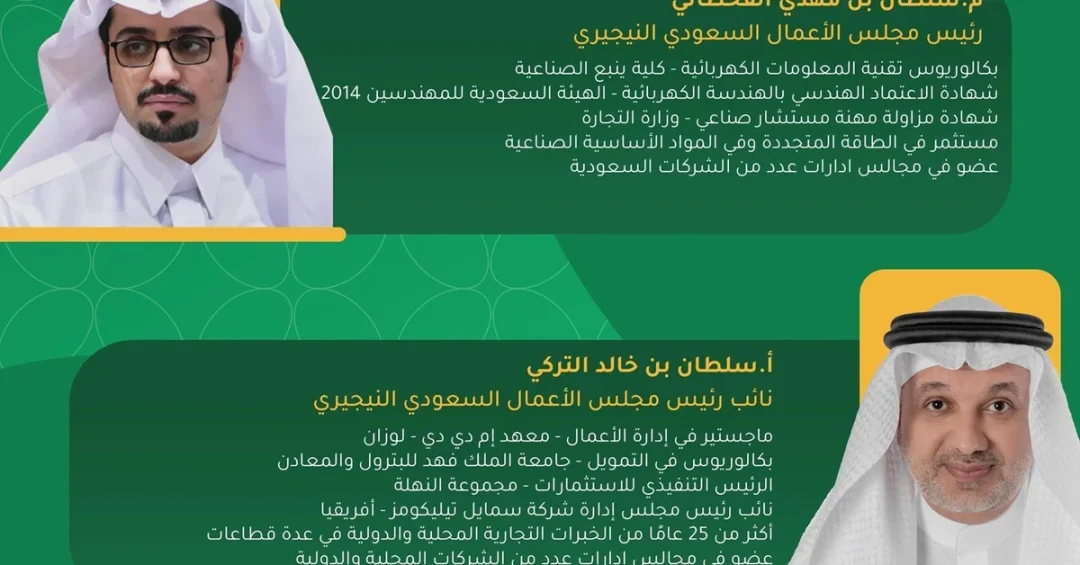
The Federation of Saudi Chambers has announced the final formation of the Saudi-Nigerian Business Council, appointing Sultan bin Mahdi Al-Qahtani as Chairman, alongside Sultan bin Khalid Al-Turki and Nasser bin Abdulaziz Al-Sudais as Vice Presidents. The announcement, made during the Council’s founding session for the 1445–1449 term, marks a significant step in strengthening economic ties between the Kingdom of Saudi Arabia and Nigeria, Africa’s largest economy.
Context and Background
The establishment of the Saudi-Nigerian Business Council comes as part of Saudi Arabia’s broader strategy to deepen economic engagement with African nations, aligned with the goals of Saudi Vision 2030. Nigeria, with a GDP of approximately $477 billion in 2022, represents one of the continent’s most promising markets. The Council aims to facilitate investment opportunities and expand trade, building on existing diplomatic and economic relations between the two countries.
Key Details
In his remarks, Chairman Sultan Al-Qahtani highlighted that bilateral trade between Saudi Arabia and Nigeria currently stands at less than 1.5 billion riyals, underscoring the vast potential for growth. He emphasized the need to raise awareness of opportunities in both markets, particularly in sectors such as services, tourism, transportation, logistics, finance, technology, education, health, industry, and mining. The Council’s formation is expected to catalyze joint ventures and investment flows, leveraging Nigeria’s dynamic economy and Saudi Arabia’s strategic position as a global investment hub.
Implications and Impact
The creation of the Saudi-Nigerian Business Council is poised to enhance economic diplomacy and people-to-people ties. It provides a structured platform for Saudi and Nigerian businesses to explore partnerships, share market intelligence, and navigate regulatory environments. For Saudi Arabia, this aligns with its efforts to diversify its economy beyond oil and to position itself as a bridge between Africa, Asia, and Europe. For Nigeria, it opens doors to Saudi investment in critical sectors, supporting infrastructure development and job creation.
Vision 2030 Alignment
This initiative directly supports Saudi Vision 2030, which seeks to expand non-oil exports, attract foreign investment, and strengthen international partnerships. By fostering closer ties with Nigeria, the Kingdom reinforces its role as a global economic player and a catalyst for sustainable development in Africa. The Council’s work will contribute to the exchange of expertise, technology transfer, and the realization of mutual prosperity, embodying the forward-looking vision of Saudi leadership.
20 Questions
Q1. What is the Saudi-Nigerian Business Council?
A1. The Saudi-Nigerian Business Council is a bilateral body established by the Federation of Saudi Chambers to promote trade and investment between Saudi Arabia and Nigeria. It was formed during its founding session for the 1445–1449 term.
Q2. Who has been appointed as Chairman of the Council?
A2. Sultan bin Mahdi Al-Qahtani has been appointed as Chairman of the Saudi-Nigerian Business Council. He will lead the Council’s efforts to strengthen economic ties and identify new opportunities.
Q3. Who are the Vice Presidents of the Council?
A3. Sultan bin Khalid Al-Turki and Nasser bin Abdulaziz Al-Sudais have been appointed as Vice Presidents. They will support the Chairman in achieving the Council’s objectives.
Q4. When was the Council’s formation announced?
A4. The formation was announced on July 11, 2024, in Riyadh, as reported by the Saudi Press Agency. The founding session covered the 1445–1449 term.
Q5. What is Nigeria’s GDP as mentioned in the announcement?
A5. Nigeria’s GDP was approximately $477 billion in 2022, making it one of Africa’s largest economies. This highlights the significant potential for trade and investment.
Q6. What is the current trade volume between Saudi Arabia and Nigeria?
A6. The trade volume between the two countries does not exceed 1.5 billion riyals, according to Chairman Al-Qahtani. This indicates ample room for growth.
Q7. Which sectors are highlighted as promising for investment?
A7. Promising sectors include services, tourism, transportation, logistics, finance, technology, education, health, industry, and mining. These areas offer diverse opportunities for Saudi and Nigerian businesses.
Q8. How does the Council align with Saudi Vision 2030?
A8. The Council supports Vision 2030 by aiming to expand non-oil trade, attract investment, and strengthen international partnerships. It reflects the Kingdom’s drive to diversify its economy.
Q9. What role does the Federation of Saudi Chambers play?
A9. The Federation of Saudi Chambers represents the private sector and facilitates business development. It established the Council to enhance economic cooperation with Nigeria.
Q10. Why is Nigeria important to Saudi Arabia’s economic strategy?
A10. Nigeria is Africa’s largest economy and a gateway to the African market. Strengthening ties with Nigeria helps Saudi Arabia access new markets and investment opportunities.
Q11. What are the objectives of the Saudi-Nigerian Business Council?
A11. The Council aims to increase trade, facilitate investment, and promote collaboration in key sectors. It also seeks to raise awareness of business opportunities in both countries.
Q12. How will the Council operate?
A12. The Council will serve as a platform for dialogue between Saudi and Nigerian businesses. It will organize events, share market insights, and advocate for favorable business environments.
Q13. What benefits can Nigerian businesses expect?
A13. Nigerian businesses can gain access to Saudi markets, investment capital, and expertise. They can also partner with Saudi firms in sectors like technology, health, and mining.
Q14. What benefits can Saudi businesses expect?
A14. Saudi businesses can explore Nigeria’s large consumer market and invest in sectors such as services, tourism, and industry. They can also leverage Nigeria’s strategic location in Africa.
Q15. How does this Council fit into Saudi Arabia’s Africa strategy?
A15. It is part of Saudi Arabia’s broader efforts to deepen economic ties with African nations. The Kingdom seeks to be a key investor and partner in Africa’s growth.
Q16. Were there any previous trade agreements between the two countries?
A16. While specific agreements were not detailed, the Council builds on existing diplomatic and economic relations. It aims to elevate trade and investment to new levels.
Q17. What is the expected impact on job creation?
A17. Increased trade and investment are expected to create jobs in both countries. Sectors like industry, technology, and services are likely to benefit from new ventures.
Q18. How can companies engage with the Council?
A18. Companies can contact the Federation of Saudi Chambers or the Council’s leadership. They can participate in events, seek partnerships, and utilize the Council’s networks.
Q19. What are the next steps after the formation?
A19. The Council will develop an action plan, organize business forums, and facilitate trade missions. It will also work to remove barriers and promote mutual understanding.
Q20. How does this Council reflect Saudi Arabia’s global role?
A20. It showcases Saudi Arabia’s commitment to international cooperation and economic diplomacy. The Kingdom is positioning itself as a connector between continents and a driver of global prosperity.
Reader Feedback
We value your thoughts. Please share your feedback on this article.
Your feedback helps us improve our coverage.