


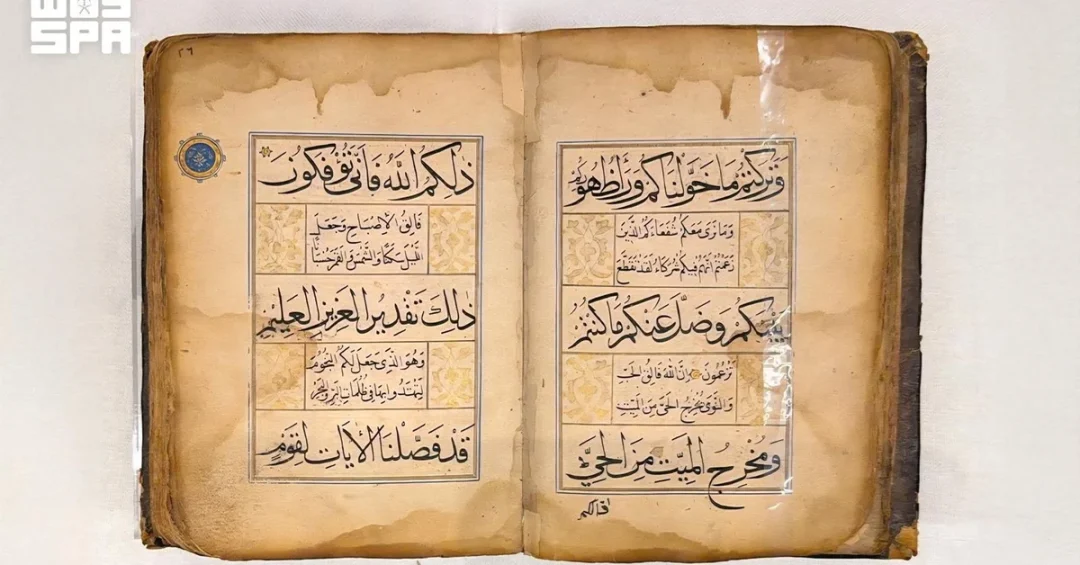
A rare Quran manuscript dating to the twelfth century of the Hijri calendar — approximately the eighteenth century CE — is now on display at the Holy Quran Museum in the Hira Cultural District of Makkah, offering visitors a window into the golden age of Islamic calligraphy and illumination. The manuscript, preserved at the King Abdulaziz Public Library and exhibited at the Holy Quran Museum, was announced via the Saudi Press Agency (SPA) as one of the museum’s most significant treasures, showcasing the meticulous craftsmanship that Muslim scribes and illuminators devoted to transcribing the sacred text.
Context and Background
The Holy Quran Museum, located in the Hira Cultural District — a landmark cultural destination developed as part of the Kingdom’s broader tourism and heritage strategy — is dedicated to documenting the history of Quranic manuscripts, the evolution of Arabic calligraphy, and the ornamental traditions that accompanied the production of Quran copies across different historical eras. The King Abdulaziz Public Library in Riyadh, one of the Kingdom’s foremost archival and cultural institutions, holds the manuscript in its collection and has lent it to the museum for public exhibition.
According to information released through official Saudi channels, the manuscript reflects the high degree of care Muslims have historically devoted to the calligraphy and ornamentation of the Quran, as well as the aesthetic refinement achieved by Islamic decorative arts during that period. Such manuscripts are considered valuable documents of cultural heritage, illustrating both religious devotion and artistic excellence.
Key Details
The manuscript is distinguished by its black-ink script, which combines several Islamic calligraphic schools — notably Thuluth, Rayhani, and Naskh. This deliberate blending demonstrates the scribe’s deep mastery of these scripts and the ability to harness their distinct features to transcribe Quranic verses with precision and elegance.
The text was reproduced with rigorous accuracy in vocalization and diacritical marks, underscoring the meticulous attention given to the notation and writing of Quranic manuscripts. The beginning of the manuscript is adorned with botanical motifs and decorations, adding to its artistic value and illustrating a hallmark of Quranic illumination art over the centuries.
Golden circular separators punctuate the verses, serving both to distinguish them and to enhance the page’s ornamental beauty. The pages thus combine structural function with decorative elegance — a characteristic style of many historical manuscripts whose scribes and illuminators paid particular attention to the harmony of page elements. The details reveal the evolution of Quranic calligraphy, where Arabic script, vocalization marks, botanical motifs, and gold-leaf illumination unite, reflecting the Quran’s eminent status among Muslims and their enduring commitment to perfecting its calligraphy and producing manuscripts of the highest care and mastery.
Implications and Impact
The exhibition of this manuscript at the Holy Quran Museum constitutes a cultural window that allows visitors to discover a facet of Quranic manuscript history, the Arabic calligraphy schools employed, and the ornamentation and illumination techniques that accompanied the production of Quran copies across historical epochs. For international audiences, the display offers a tangible connection to the Islamic world’s intellectual and artistic heritage, positioning Makkah not only as a spiritual center but also as a custodian of cultural treasures.
The Hira Cultural District, where the museum is located, is part of Saudi Arabia’s broader efforts to enrich the pilgrimage and visitor experience, providing educational and cultural dimensions to the millions who travel to the Kingdom annually. By showcasing such manuscripts, the Kingdom reinforces its role as a guardian of Islamic history and a promoter of cultural dialogue.
Vision 2030 Alignment
The display of the twelfth-century Hijri Quran manuscript at the Holy Quran Museum aligns closely with Saudi Vision 2030, which seeks to diversify the economy, promote cultural tourism, and preserve the Kingdom’s rich Islamic heritage. Under the leadership of the Custodian of the Two Holy Mosques, King Salman bin Abdulaziz Al Saud, and Crown Prince Mohammed bin Salman, Saudi Arabia has invested significantly in cultural infrastructure — including museums, heritage sites, and religious tourism — to share its history with the world while creating new opportunities for visitors and researchers.
The Holy Quran Museum, together with the Hira Cultural District, embodies this vision by offering a world-class destination that celebrates the art of Quranic calligraphy and illumination, ensuring that future generations and international guests can appreciate the timeless beauty of the sacred text and the devotion of those who transcribed it. As the Kingdom continues to open its cultural doors, such exhibitions stand as a testament to Saudi Arabia’s commitment to preserving Islamic heritage and fostering global understanding.
20 Questions
Q1. What is the estimated age of the Quran manuscript displayed at the Holy Quran Museum?
A1. The manuscript is estimated to date back to the twelfth century of the Hijri calendar, which corresponds approximately to the eighteenth century CE. It reflects the artistic and calligraphic traditions of that era.
Q2. Where is the Holy Quran Museum located?
A2. The museum is situated in the Hira Cultural District in Makkah, Saudi Arabia. It is dedicated to showcasing the history and artistry of Quranic manuscripts and Islamic calligraphy.
Q3. Which institution preserves the manuscript?
A3. The manuscript is preserved at the King Abdulaziz Public Library. It is currently exhibited at the Holy Quran Museum through a loan arrangement for public viewing.
Q4. What calligraphic styles are combined in the manuscript?
A4. The manuscript combines three major Islamic calligraphic styles: Thuluth, Rayhani, and Naskh. This blending demonstrates the scribe’s exceptional skill and versatility in Arabic calligraphy.
Q5. What color ink was used for the main text?
A5. The main text of the manuscript was written in black ink. This traditional choice enhances readability and contrasts with the gold illumination and decorative elements.
Q6. How does the manuscript reflect the care given to Quranic transcription?
A6. The manuscript shows rigorous precision in vocalization and diacritical marks. This indicates the meticulous attention paid to accurately preserving the Quranic text and its recitation rules.
Q7. What decorative elements are found at the beginning of the manuscript?
A7. The beginning features botanical motifs and decorations. These ornamental elements add artistic value and exemplify the tradition of Quranic illumination.
Q8. What purpose do the golden circular separators serve?
A8. The golden circular separators distinguish between verses. They also enhance the page’s ornamental beauty, combining functionality with aesthetic appeal in a characteristic style of historical manuscripts.
Q9. What does the manuscript reveal about Islamic art?
A9. It reveals the harmony between Arabic script, vocalization marks, botanical motifs, and gold-leaf illumination. These elements reflect the high status of the Quran and the artistic dedication of Muslim scribes.
Q10. Why is the exhibition of this manuscript significant for visitors?
A10. It provides a cultural window into Quranic manuscript history, showcasing calligraphy schools and illumination techniques. Visitors can appreciate the evolution of Islamic art across centuries.
Q11. How does the manuscript relate to Saudi Vision 2030?
A11. It supports Vision 2030 by promoting cultural tourism and preserving Islamic heritage. The exhibition enriches the visitor experience and highlights Saudi Arabia’s role as a cultural guardian.
Q12. What is the Hira Cultural District?
A12. The Hira Cultural District is a cultural destination in Makkah that includes museums and heritage sites. It aims to enhance the pilgrimage experience and educate visitors about Islamic history.
Q13. Who announced the display of the manuscript?
A13. The display was announced via the Saudi Press Agency (SPA). This official channel ensures accurate and authoritative information dissemination to the public.
Q14. What makes this manuscript artistically valuable?
A14. Its artistic value stems from the blend of calligraphic styles, precise vocalization, botanical motifs, and gold illumination. These elements demonstrate the pinnacle of Quranic decorative arts.
Q15. How does the manuscript reflect the devotion of Muslims?
A15. It reflects the constant care Muslims have shown through the ages to perfect Quranic calligraphy. The meticulous details illustrate their commitment to honoring the sacred text.
Q16. What can researchers learn from this manuscript?
A16. Researchers can study the evolution of Arabic calligraphy, illumination techniques, and manuscript production. It offers insights into historical artistic practices and cultural exchanges.
Q17. Is the manuscript accessible to the public?
A17. Yes, it is exhibited at the Holy Quran Museum. Visitors can view it as part of the museum’s collection, which is open to the public in Makkah’s Hira Cultural District.
Q18. What role does the King Abdulaziz Public Library play?
A18. The library preserves and manages the manuscript as part of its collection. It collaborates with cultural institutions to display such treasures for public education and enjoyment.
Q19. How does the museum contribute to cultural tourism in Saudi Arabia?
A19. The museum attracts visitors interested in Islamic art and history. It adds an educational and cultural dimension to the pilgrimage journey, supporting the Kingdom’s tourism goals.
Q20. What message does the exhibition convey about Saudi Arabia?
A20. It conveys Saudi Arabia’s dedication to preserving Islamic heritage and sharing it with the world. The exhibition reflects the Kingdom’s role as a custodian of cultural and religious history.
Reader Feedback
We value your thoughts. Please share your feedback on this article.
Your feedback helps us improve our coverage.