


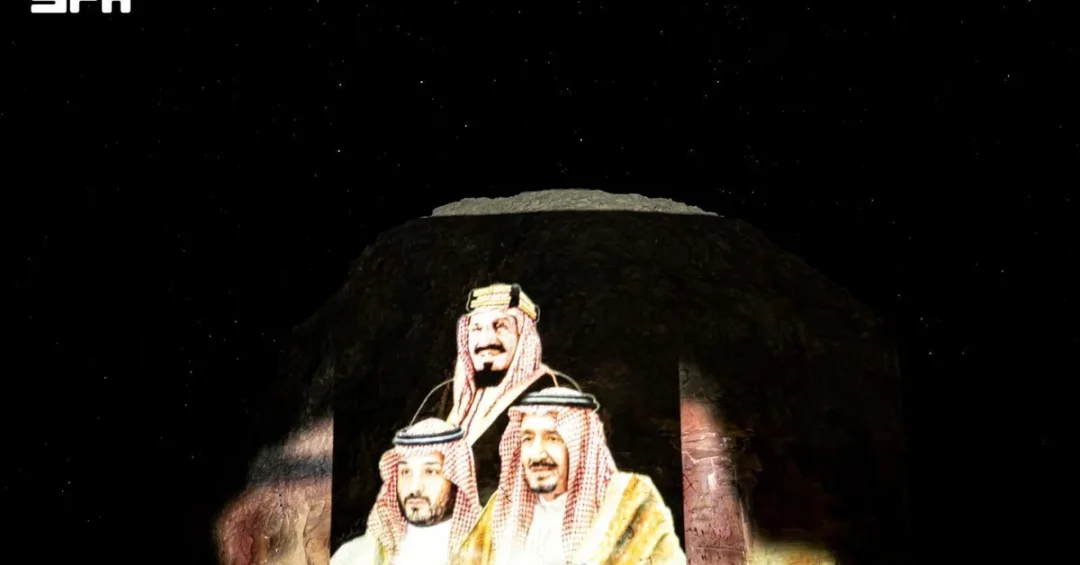
Hasat Al-Hanzaliyah, the iconic rock formation in Saudi Arabia’s Northern Borders Region, was illuminated with spectacular projections featuring the Saudi National Day logo and images of the Kingdom’s leadership, transforming the desert landmark into a glowing national tableau. The display, reported by the Saudi Press Agency (SPA), lit up the rocky facade of the formation on September 21, 2026, combining the raw beauty of the natural landscape with cutting-edge lighting technology to celebrate the Kingdom’s rich heritage and unity.
The illumination of Hasat Al-Hanzaliyah, locally known as “Umm Hasah” rock, marks a creative and patriotic tribute to Saudi National Day, an occasion that commemorates the unification of the Kingdom under the late King Abdulaziz Al Saud. The event not only highlights the region’s unique geological wonders but also underscores the Kingdom’s commitment to honoring its cultural and natural heritage while embracing modernity. As the desert night sky was pierced by the vibrant glow of the projections, the scene resonated with pride and belonging, reflecting the deep connection between the Saudi people and their land.
Context and Background: A Landmark Steeped in History
Hasat Al-Hanzaliyah is one of the most prominent rock formations in the Northern Borders Region, standing approximately six to seven meters high at kilometer 55 on the Arar-Al-Jouf Road, on the western side of Wadi Arar. Shaped over millennia by weathering and erosion of its sedimentary layers, the formation has become a natural landmark that tells the story of the region’s geological past. Its distinctive silhouette against the desert horizon has long served as a point of reference for travelers and locals alike, earning it the affectionate moniker “Umm Hasah.”
The decision to illuminate this natural wonder for National Day reflects a broader strategy by Saudi authorities to integrate cultural and natural heritage into national celebrations. By projecting the Saudi National Day logo and images of the leadership onto the rock’s surface, the event transformed a geological curiosity into a canvas for national pride. This approach not only enhances the visual appeal of the landmark but also reinforces the connection between the Kingdom’s natural environment and its modern identity.
The Northern Borders Region, where Hasat Al-Hanzaliyah is located, is an area rich in history and natural beauty. It borders Jordan and Iraq and has been a crossroads for trade and cultural exchange for centuries. In recent years, the region has received increased attention as part of Saudi Arabia’s efforts to promote domestic tourism and highlight lesser-known attractions. The illumination of Hasat Al-Hanzaliyah is a testament to these efforts, showcasing how even remote desert landmarks can become focal points for national celebration and cultural expression.
Key Details: A Spectacle of Light and National Pride
The illumination event, which took place on September 21, 2026, featured state-of-the-art projection technology that cast vivid images onto the rock’s rugged surface. The Saudi National Day logo, along with portraits of the Saudi leadership, adorned the formation, creating a striking contrast between the ancient stone and the modern light display. The projections were carefully designed to respect the rock’s natural contours, enhancing rather than obscuring its unique shape. According to SPA, the display combined the beauty of the natural formation with modern lighting technology, resulting in a visual scene that evoked pride in the national occasion.
The choice of Hasat Al-Hanzaliyah as a site for such a display is significant. It highlights the Kingdom’s commitment to leveraging its natural assets for cultural and patriotic events, while also drawing attention to the Northern Borders Region as a destination for tourism and exploration. The event was likely coordinated by local authorities and possibly the Ministry of Culture or the Saudi Tourism Authority, though specific organizers were not named in the SPA report. The illumination serves as a reminder of the Kingdom’s diverse landscapes and the importance of preserving them for future generations.
The timing of the event, coinciding with National Day, adds another layer of meaning. National Day in Saudi Arabia is celebrated on September 23 each year, marking the renaming of the Kingdom of Hejaz and Nejd to the Kingdom of Saudi Arabia in 1932. The illumination on September 21 served as a prelude to the main celebrations, setting the tone for a nationwide commemoration of unity and progress. Such events are part of a broader calendar of cultural and national activities that showcase the Kingdom’s achievements and aspirations.
International and Regional Impact: Showcasing Saudi Heritage to the World
The illumination of Hasat Al-Hanzaliyah is not just a local celebration; it also carries implications for Saudi Arabia’s international image. As the Kingdom continues to open up to the world through initiatives like Vision 2030, events that highlight its natural and cultural heritage play a crucial role in attracting international tourists and fostering cultural exchange. The striking images of the illuminated rock formation, shared via official Saudi news channels, are likely to capture the imagination of global audiences, presenting Saudi Arabia as a country that honors its past while embracing the future.
Regionally, the event underscores the Northern Borders Region’s potential as a tourist destination. By transforming a remote landmark into a site of national significance, Saudi authorities are signaling that development and cultural promotion are not limited to major cities like Riyadh, Jeddah, or NEOM. This decentralization of cultural activities aligns with Vision 2030’s goal of diversifying the economy and creating opportunities across all regions of the Kingdom. It also strengthens the sense of national unity by bringing attention to areas that may have been overlooked in the past.
Furthermore, the use of modern lighting technology in a desert setting demonstrates Saudi Arabia’s capacity to blend tradition with innovation. This fusion is a recurring theme in the Kingdom’s development narrative, from smart cities to sustainable tourism projects. The illumination of Hasat Al-Hanzaliyah thus serves as a small but potent symbol of Saudi Arabia’s broader ambitions to be a leader in both preserving heritage and adopting advanced technologies.
Economic and Strategic Significance: Boosting Tourism and Local Engagement
While the illumination event itself is primarily cultural, it has economic and strategic undertones. The Northern Borders Region, with its unique geological formations and historical sites, has the potential to attract domestic and international tourists. Events like this can stimulate local economies by increasing visitor numbers, encouraging investment in hospitality and infrastructure, and creating jobs. The Saudi Tourism Authority has been actively promoting domestic tourism, and highlighting landmarks like Hasat Al-Hanzaliyah contributes to these efforts.
Strategically, the event reinforces the Kingdom’s commitment to its Vision 2030 goals, particularly those related to quality of life and cultural enrichment. By celebrating National Day in such a visually impactful way, Saudi Arabia demonstrates its ability to mobilize resources and creativity to honor its heritage. This not only boosts national pride but also enhances the Kingdom’s soft power, presenting it as a forward-looking nation that values its roots. The illumination also serves as a reminder of the importance of preserving natural landmarks, which are part of the Kingdom’s identity and appeal.
The use of projections rather than physical alterations to the rock also reflects an environmentally conscious approach. By utilizing light rather than permanent installations, the event minimized its ecological footprint, aligning with global trends in sustainable event management. This consideration for the environment is consistent with Saudi Arabia’s broader sustainability goals, including the Saudi Green Initiative and the Middle East Green Initiative, which aim to combat climate change and protect natural habitats.
Vision 2030 Alignment: A Beacon of Progress and Heritage
The illumination of Hasat Al-Hanzaliyah for Saudi National Day is a vivid example of how Vision 2030 is being woven into the fabric of national life. Vision 2030, launched by Crown Prince Mohammed bin Salman in 2016, seeks to diversify the economy, promote social and cultural development, and enhance the Kingdom’s global standing. Cultural events that celebrate national identity while showcasing modernity are integral to this vision, as they foster a sense of pride and belonging among citizens and residents.
Moreover, the event highlights the role of the Northern Borders Region in the Kingdom’s broader development strategy. By drawing attention to this area, the illumination supports the vision’s goal of balanced regional development, ensuring that all parts of Saudi Arabia benefit from economic and cultural growth. It also aligns with the vision’s emphasis on tourism as a key sector, inviting visitors to explore the Kingdom’s natural wonders and rich history.
As Saudi Arabia continues its journey toward a prosperous and diversified future, initiatives like the illumination of Hasat Al-Hanzaliyah serve as reminders of the nation’s enduring spirit and its ability to innovate while honoring its past. The glowing rock formation, adorned with symbols of national unity, stands as a beacon of progress, illuminating the path toward a bright future for all Saudis.
20 Questions
Q1. What is Hasat Al-Hanzaliyah?
A1. Hasat Al-Hanzaliyah, also known as “Umm Hasah” rock, is a prominent natural rock formation in Saudi Arabia’s Northern Borders Region, located at kilometer 55 on the Arar-Al-Jouf Road.
Q2. Where is Hasat Al-Hanzaliyah located?
A2. It is situated on the western side of Wadi Arar in the Northern Borders Region, approximately 55 kilometers along the Arar-Al-Jouf Road.
Q3. What was the purpose of illuminating Hasat Al-Hanzaliyah?
A3. The illumination was part of Saudi National Day celebrations, using projections of the national logo and leadership images to express pride and patriotism.
Q4. When did the illumination take place?
A4. The event took place on September 21, 2026, as reported by the Saudi Press Agency, ahead of National Day on September 23.
Q5. How tall is Hasat Al-Hanzaliyah?
A5. The formation stands approximately six to seven meters high, shaped over time by weathering and erosion of its sedimentary layers.
Q6. What technology was used for the illumination?
A6. Modern projection technology was used to cast images onto the rock’s surface, combining natural beauty with advanced lighting techniques.
Q7. Who reported on the illumination event?
A7. The Saudi Press Agency (SPA) reported on the event, highlighting its significance as a national celebration.
Q8. What does the name “Umm Hasah” mean?
A8. “Umm Hasah” is a local nickname for Hasat Al-Hanzaliyah, reflecting its familiarity among residents of the Northern Borders Region.
Q9. Why is Hasat Al-Hanzaliyah considered a landmark?
A9. Its distinctive shape, resulting from natural erosion, and its visibility along a major road make it a recognizable and cherished natural landmark in the region.
Q10. How does the illumination reflect Saudi Vision 2030?
A10. It showcases cultural heritage and modern innovation, aligning with Vision 2030’s goals of promoting tourism, national pride, and regional development.
Q11. What other National Day celebrations occur in Saudi Arabia?
A11. Nationwide festivities include fireworks, cultural performances, and official events, all commemorating the unification of the Kingdom in 1932.
Q12. Is the Northern Borders Region a popular tourist destination?
A12. It is increasingly being promoted for its natural and historical attractions, though it remains less visited than major cities like Riyadh and Jeddah.
Q13. How does the event impact the local community?
A13. It fosters pride and could boost local tourism, encouraging economic activity and highlighting the region’s potential as a cultural destination.
Q14. What is the geological significance of Hasat Al-Hanzaliyah?
A14. The rock’s formation through erosion of sedimentary layers offers insight into the geological history of the region and its natural processes.
Q15. Are there similar illuminated landmarks in Saudi Arabia?
A15. Yes, various heritage sites and natural formations are occasionally illuminated for special occasions, though each event is unique.
Q16. How does the illumination respect the environment?
A16. By using light projections instead of physical modifications, the event minimizes environmental impact, preserving the rock’s natural state.
Q17. What message does the illumination convey to the world?
A17. It conveys Saudi Arabia’s pride in its heritage, its embrace of technology, and its commitment to celebrating national unity on a global stage.
Q18. Who oversees cultural events like this in Saudi Arabia?
A18. Various government entities, including the Ministry of Culture and the Saudi Tourism Authority, often coordinate such events, though specific organizers were not named in the SPA report.
Q19. How can visitors reach Hasat Al-Hanzaliyah?
A19. It is accessible via the Arar-Al-Jouf Road, with the site located at kilometer 55 on the western side of Wadi Arar.
Q20. What does the future hold for Hasat Al-Hanzaliyah?
A20. As Saudi Arabia continues to develop its tourism sector, the landmark may see increased visitation and further recognition as a symbol of national pride and natural heritage.
Reader Feedback
We value your thoughts. Please share your feedback on this article.
Your feedback helps us improve our coverage.
Related articles
 Historic Emirate Palace in Najran: Witness to Saudi Founding
 Jazan Region Adorned in Green for Saudi National Day
 King Fahd Complex hosts Custodian of the Two Holy Mosques Program guests
 Al-Baha Craft Forum hosts 68 calligraphers
 Al-Atawilah Heritage Festival showcases traditional crafts
 International Falcon Breeders Auction attracts diverse weekend visitors