


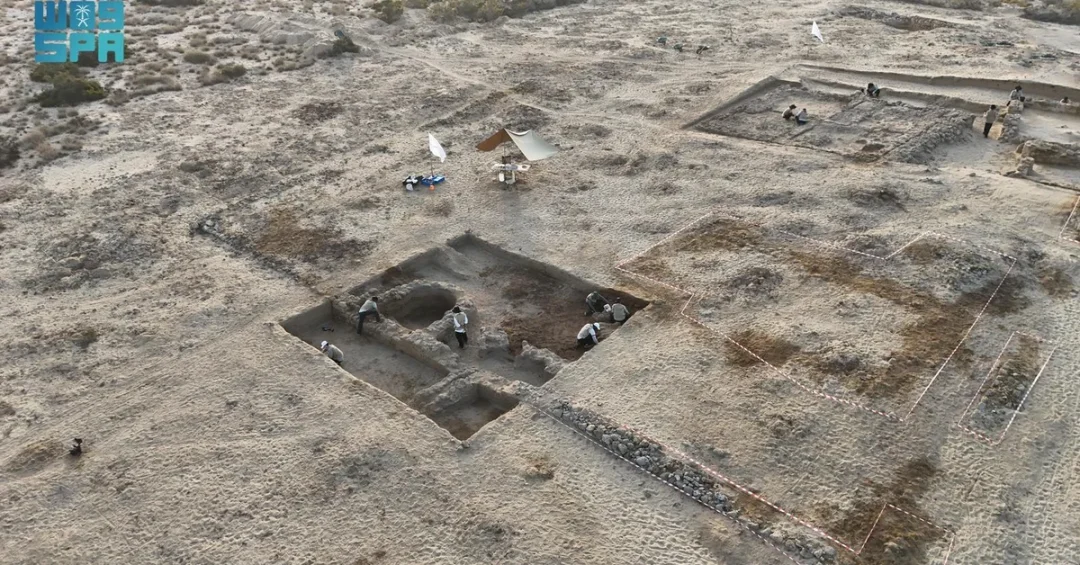
The Heritage Commission has completed the third season of archaeological survey and excavation at the AlSirrain site in Al-Lith Governorate, Makkah Region, conducted in collaboration with the National Cultural Heritage Administration of the People’s Republic of China, according to an official announcement released through the Saudi Press Agency. The season’s work, carried out under an agreement signed between the two parties to strengthen cooperation and the exchange of expertise in archaeological excavation, forms part of the Saudi-Chinese Cultural Year 2025 and underscores the Kingdom’s expanding role in global heritage research and cultural diplomacy.
The announcement follows months of fieldwork at one of the largest archaeological sites along the Red Sea coast, a location that once served as a key station on the Maritime Silk Road. The project reflects a shared commitment by Saudi Arabia and China to advancing scientific and historical research, preserving heritage, and documenting the human legacy that has connected the peoples of the East across centuries. For international observers, the results offer a rare window into the economic and urban life of a Red Sea port that flourished between the early Islamic centuries and the medieval era, while demonstrating how the Kingdom is pairing its Vision 2030 modernization agenda with a rigorous program of cultural preservation and international partnership.
Context and Background
Why does a remote archaeological site on the Red Sea coast matter to anyone beyond the world of specialists? The answer lies in the story AlSirrain tells about trade, faith, and the movement of peoples across the ancient world. Located in Al-Lith Governorate, southwest of Makkah, the site sits on a stretch of coastline that served for centuries as a maritime gateway linking the Arabian Peninsula with East Africa, the Indian subcontinent, and the ports of southern China. The Heritage Commission’s work there is part of a broader national effort to survey, document, and protect archaeological sites across the Kingdom in line with the mandate of the Ministry of Culture.
The current excavation season was conducted under a formal agreement between the Heritage Commission and the National Cultural Heritage Administration of the People’s Republic of China, a partnership that places Saudi Arabia at the center of a growing network of international archaeological collaboration. The agreement provides for joint fieldwork, the exchange of technical expertise, and the training of Saudi specialists alongside Chinese counterparts. It also situates the project within the Saudi-Chinese Cultural Year 2025, a bilateral initiative designed to deepen cultural and civilizational exchange between two nations whose histories have been intertwined since the days of the Silk Road caravans and the monsoon-driven sailing routes of the Indian Ocean.
AlSirrain’s importance has been recognized for years as one of the most significant archaeological sites on the Red Sea littoral. Previous seasons established that the settlement included a substantial residential area, a defensive wall, and a port whose activity peaked in the later Islamic centuries. The third season was designed to build on that foundation, expanding the excavation area and refining the chronological picture of the site through careful study of its architecture and material culture. The results, released through official Saudi channels, confirm that AlSirrain was not merely a waypoint but a thriving urban center integrated into long-distance trade networks that connected the Arabian interior to the wider Indian Ocean world.
Key Details of the Third Season
What did the excavators actually find, and what does it tell us about daily life in a medieval Red Sea port? According to the Heritage Commission’s release, the third season produced a wide range of archaeological finds differing in material and function. These included ceramic and stone vessels, decorative tools, and a gold dinar dating back to the mid-second Hijri century, a coin that provides a precise chronological anchor for the site’s occupation and confirms its integration into the monetary economy of the early Islamic world. The discovery of a collection of Chinese ceramics is particularly significant, offering tangible physical evidence of the maritime trade that linked AlSirrain to ports thousands of miles to the east.
The excavations also uncovered gravestones featuring both raised and sunken decorative patterns, a finding that sheds light on funerary practices and artistic traditions at the site. Alongside these portable objects, the archaeological survey documented a significant number of architectural phenomena, including foundational elements of walls and additional gravestones. The team identified large sections of the city wall, as well as several towers and gates positioned along its length, indicating a settlement with organized defenses and a degree of urban planning that scholars had previously only inferred from historical texts. The study of the residential area, construction patterns, and the functions of individual building components is intended to yield a broader understanding of social and historical life at the site.
The project’s research objectives extend beyond cataloging objects. Investigators are analyzing urban planning and the relationship between AlSirrain and other urban centers of the region, seeking to reconstruct how the port functioned within wider economic and political networks. According to the commission’s release, the site’s port was part of a city that saw sustained economic activity until the end of the third Hijri century, then emerged as a commercial port in the early fourth Hijri century before reaching its peak prosperity in the fifth and sixth Hijri centuries. This long arc of occupation, spanning several centuries of Islamic history, makes AlSirrain an unusually rich case study for understanding the rhythms of Red Sea trade.
International and Regional Impact
What does a joint Saudi-Chinese excavation tell us about the wider direction of cultural diplomacy in the region? The partnership between the Heritage Commission and the National Cultural Heritage Administration of China is one of a growing number of international collaborations through which Saudi Arabia is opening its archaeological record to global scholarship. By working alongside Chinese specialists, Saudi researchers gain access to comparative expertise in ceramics analysis, conservation science, and the archaeology of maritime trade, while Chinese scholars gain firsthand knowledge of a site that documents the western terminus of routes their own ports once served. The arrangement reflects a model of cooperation based on shared scientific goals rather than one-directional assistance.
Regionally, the discoveries reinforce the historical narrative of the Red Sea as a connective corridor rather than a barrier. The presence of Chinese ceramics and a gold dinar at AlSirrain illustrates how goods, people, and ideas moved across the Indian Ocean long before the modern era of container shipping and global supply chains. For Saudi Arabia, this history supports a contemporary foreign policy narrative that emphasizes the Kingdom’s position as a bridge between continents, a theme that resonates with its expanding diplomatic and economic engagement across Asia. The Saudi-Chinese Cultural Year 2025 provides a framework for presenting these findings to international audiences through exhibitions, publications, and scholarly exchange.
Economic and Strategic Significance
How does archaeological research connect to the Kingdom’s broader economic and strategic priorities? Heritage preservation is increasingly recognized in Saudi Arabia as an economic asset as well as a cultural one. Sites such as AlSirrain contribute to the development of cultural tourism, a sector targeted for growth under Vision 2030 as part of efforts to diversify revenue sources beyond hydrocarbons. The documentation of Al-Lith Governorate’s archaeological wealth adds a new dimension to the Red Sea coast’s tourism offering, complementing the luxury resort developments and heritage destinations being created elsewhere in the Kingdom. International visitors with an interest in history and archaeology represent a high-value segment of the global travel market, and Saudi Arabia is positioning itself to compete for that segment.
Strategically, the collaboration with China aligns with the Kingdom’s emphasis on deepening ties with major Asian economies. Cultural and scientific agreements often pave the way for broader cooperation, building trust and mutual understanding that support commercial and diplomatic relationships. The excavation project also contributes to the training of Saudi archaeologists and conservation specialists, building domestic capacity that will be needed to manage the Kingdom’s extensive archaeological heritage in the decades ahead. The Heritage Commission’s efforts to document and protect sites across the country form part of a national infrastructure for heritage management that supports both scholarly research and public engagement.
Vision 2030 Alignment
How does a third season of excavation at a Red Sea port site fit into the grand ambitions of Vision 2030? The answer lies in the vision’s recognition that culture and heritage are not obstacles to modernization but essential components of national identity and economic diversification. The Heritage Commission’s work at AlSirrain advances several objectives simultaneously: it preserves and documents the Kingdom’s cultural legacy, it strengthens international partnerships, it builds scientific capacity, and it creates content and destinations that can attract global visitors. The project’s findings will feed into museum collections, academic publications, and public programming, enriching the cultural landscape that Vision 2030 seeks to expand.
Looking ahead, the completion of the third season opens the way for further analysis and publication of results, as well as planning for future fieldwork. The discoveries at AlSirrain, from the gold dinar to the Chinese ceramics and the city wall with its towers and gates, add concrete detail to the story of Saudi Arabia’s place in world history. As the Kingdom continues to invest in archaeology, heritage tourism, and international cultural cooperation, sites like AlSirrain will serve as evidence that the Red Sea coast was never a periphery but a crossroads. The Heritage Commission’s partnership with China, conducted under the banner of the Saudi-Chinese Cultural Year 2025, demonstrates how the past can be a foundation for the future, supporting the Kingdom’s emergence as a global center for heritage research and cultural exchange.
20 Questions
Q1. What did the Heritage Commission announce regarding the AlSirrain site?
A1. The Heritage Commission announced the completion of the third season of archaeological survey and excavation at the AlSirrain site in Al-Lith Governorate, Makkah Region, conducted in collaboration with the National Cultural Heritage Administration of the People’s Republic of China.
Q2. Where is the AlSirrain site located?
A2. The AlSirrain site is located in Al-Lith Governorate, within the Makkah Region of Saudi Arabia, on the Red Sea coast. It is considered one of the largest archaeological sites along that coastline to this day.
Q3. Which international partner collaborated on the excavation?
A3. The project was carried out in collaboration with the National Cultural Heritage Administration of the People’s Republic of China, under an agreement signed between the two parties to enhance cooperation and exchange expertise in archaeological excavation.
Q4. What is the Saudi-Chinese Cultural Year 2025?
A4. The Saudi-Chinese Cultural Year 2025 is a bilateral initiative that includes numerous joint cultural projects aimed at strengthening cultural and civilizational exchange between Saudi Arabia and China, highlighting historical ties connected through the Silk Road.
Q5. What were the main objectives of the third excavation season?
A5. The season aimed to provide broader insights into the site within its historical and archaeological context by studying the residential area, construction patterns, urban planning, the functions of its components, and its relations with other urban centers.
Q6. What architectural features were discovered during the survey?
A6. The archaeological survey revealed foundational elements of walls and gravestones, as well as large sections of the city wall, several towers, and gates along its length, reflecting organized defenses and urban planning at the site.
Q7. What kinds of artifacts were found at AlSirrain?
A7. Finds included ceramic and stone vessels, decorative tools, a gold dinar dating to the mid-second Hijri century, a collection of Chinese ceramics, and gravestones featuring both raised and sunken decorative patterns.
Q8. Why is the gold dinar significant?
A8. The gold dinar dating back to the mid-second Hijri century provides a precise chronological anchor for the site’s occupation and confirms AlSirrain’s integration into the monetary economy of the early Islamic world.
Q9. What does the presence of Chinese ceramics indicate?
A9. The Chinese ceramics offer tangible physical evidence of the maritime trade that linked AlSirrain to ports thousands of miles to the east, confirming the site’s role as a station on the Maritime Silk Road.
Q10. What do the gravestones with decorative patterns reveal?
A10. The gravestones featuring raised and sunken decorative patterns shed light on funerary practices and artistic traditions at the site, contributing to understanding of its cultural and social life.
Q11. When did the port of AlSirrain reach its peak prosperity?
A11. According to the Heritage Commission, the port reached its peak prosperity in the fifth and sixth Hijri centuries, after emerging as a commercial port in the early fourth Hijri century.
Q12. How long did economic activity continue at the site?
A12. The city saw economic activity until the end of the third Hijri century, then emerged as a commercial port in the early fourth Hijri century and flourished through the fifth and sixth Hijri centuries.
Q13. What is the historical significance of the Maritime Silk Road for AlSirrain?
A13. The Maritime Silk Road connected AlSirrain to long-distance trade networks across the Indian Ocean. Its port was a key station, linking the Arabian Peninsula with East Africa, the Indian subcontinent, and southern China.
Q14. How does this project reflect Saudi-Chinese cooperation?
A14. The project reflects shared commitment to advancing scientific and historical research, preserving heritage, and documenting the human legacy that unites the peoples of the East, as part of the Saudi-Chinese Cultural Year 2025.
Q15. What did the Heritage Commission say about its efforts?
A15. The commission stated that the project reaffirms its efforts in preserving heritage through archaeological and research projects across the Kingdom and enhancing global cooperation, according to the official release.
Q16. What is the role of the Ministry of Culture in this project?
A16. The Heritage Commission operates under the Ministry of Culture, which oversees national efforts to survey, document, and protect archaeological sites across the Kingdom in line with Saudi Arabia’s cultural preservation mandate.
Q17. How does the excavation support Vision 2030?
A17. The excavation supports Vision 2030 by preserving cultural heritage, strengthening international partnerships, building scientific capacity, and contributing to cultural tourism development, all of which support economic diversification and national identity.
Q18. What happens next after the third season?
A18. The completion of the third season opens the way for further analysis and publication of results, as well as planning for future fieldwork, according to the project’s research framework.
Q19. Why is AlSirrain important for understanding Red Sea history?
A19. AlSirrain is one of the largest archaeological sites on the Red Sea coast and documents centuries of trade, urban life, and cultural exchange, making it a rich case study for understanding the region’s historical role as a crossroads.
Q20. How does this project enhance Saudi Arabia’s global cultural role?
A20. By partnering with China and producing significant archaeological findings, the project demonstrates Saudi Arabia’s emergence as a global center for heritage research and cultural exchange, reinforcing its position as a bridge between continents.
Reader Feedback
We value your thoughts. Please share your feedback on this article.
Your feedback helps us improve our coverage.
Related articles
 Birth of a Place’ Installation Art Highlights Diriyah Heritage
 Ramadan Games Bridge Generations in Madinah
 KACCC Hosts Global Youth Gathering on Fasting Traditions
 Manga Productions Partners with Sela to Bring Japanese Brands to Riyadh Season
 Istituto Marangoni, Fashion Commission Partner on Fashion Education in Saudi Arabia
 Al-Hawza Mosque Restoration Boosts Aseer Heritage