


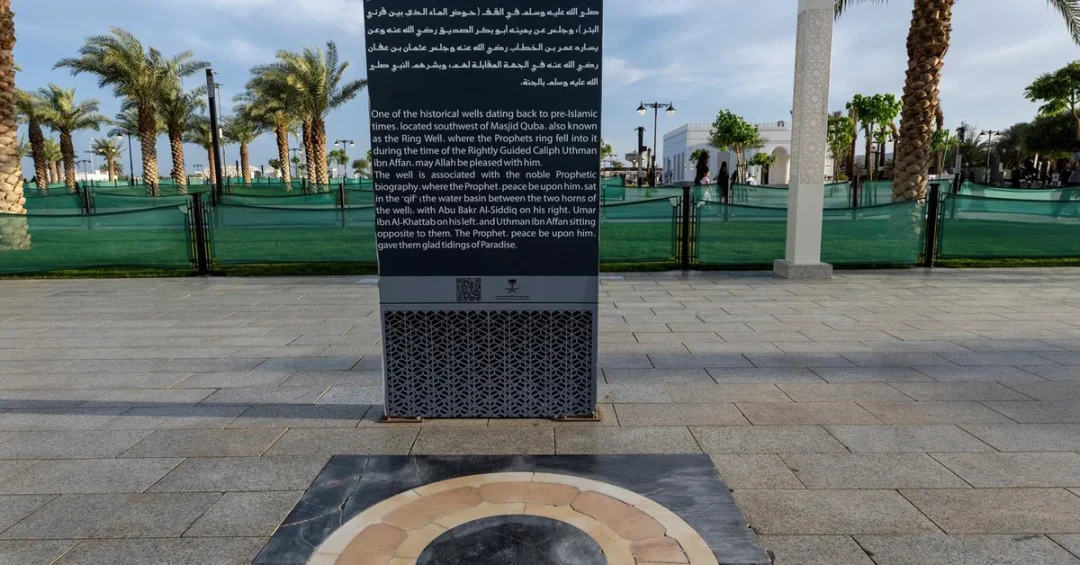
Madinah’s historic Arees Well, also known as the Well of the Ring, holds a revered place in Islamic history as the site where the Prophet Muhammad’s (PBUH) seal ring was lost during the era of Caliph Uthman ibn Affan. According to authenticated narrations in Sahih Al-Bukhari, this location in Quba witnessed significant events involving the Prophet and the first three caliphs, making it an important heritage site for pilgrims visiting Madinah.
Context and Background
The Arees Well gained prominence due to its association with Prophet Muhammad (PBUH), who frequently visited the site during his time in Madinah. Historical records indicate that the Prophet sat by this well and gave glad tidings of Paradise to Caliphs Abu Bakr, Umar, and Uthman, marking it as a spiritually significant location.
Key Details
The Prophet’s silver seal ring, inscribed with “Muhammad, the Messenger of Allah,” was used to authenticate official correspondence. After the Prophet’s passing, the ring was inherited by successive caliphs until it was accidentally dropped into the well by Caliph Uthman around 30 AH (650 CE). Despite extensive search efforts over several days, the ring was never recovered, adding to the well’s historical significance.
Implications and Impact
The Well of the Ring remains an important site for Islamic heritage and tourism in Madinah. Its preservation reflects Saudi Arabia’s commitment to safeguarding historical landmarks connected to the Prophet’s life. The site attracts scholars and pilgrims seeking to connect with early Islamic history, contributing to cultural tourism under Vision 2030.
Vision 2030 Alignment
The preservation and promotion of historical sites like the Well of the Ring demonstrate Saudi Arabia’s dedication to protecting Islamic heritage while developing religious tourism. This aligns with Vision 2030’s goals of diversifying the economy and sharing Saudi Arabia’s rich cultural legacy with the world, reinforcing the Kingdom’s position as the cradle of Islamic civilization.
20 Questions
Q1. What is the alternate name for Arees Well?
A1. The Arees Well is also known as the Well of the Ring (Bi’r al-Khatam) due to its association with the loss of Prophet Muhammad’s seal ring.
Q2. Where is the Well of the Ring located?
A2. The well is situated in Quba, a historic district on the outskirts of Madinah in western Saudi Arabia.
Q3. Why is the well significant in Islamic history?
A3. It’s significant as Prophet Muhammad (PBUH) visited it frequently and gave glad tidings to the first three caliphs there, and where his seal ring was lost.
Q4. What was inscribed on the Prophet’s ring?
A4. The silver ring bore the inscription “Muhammad, the Messenger of Allah” in Arabic.
Q5. How did the Prophet use his seal ring?
A5. The ring was used to seal official letters and documents as a mark of authentication during the Prophet’s time.
Q6. Who inherited the ring after the Prophet’s passing?
A6. The ring passed successively to Caliphs Abu Bakr, Umar, and finally Uthman ibn Affan.
Q7. How was the ring lost?
A7. Caliph Uthman accidentally dropped the ring into the well around 30 AH (650 CE) while drawing water.
Q8. Were efforts made to recover the ring?
A8. Yes, extensive search attempts were made over several days, but the ring was never retrieved from the well.
Q9. Is the well mentioned in authentic hadith collections?
A9. Yes, the well is mentioned in Sahih Al-Bukhari, one of the most authentic collections of Prophet Muhammad’s sayings and actions.
Q10. What spiritual event occurred at this well?
A10. The Prophet gave glad tidings of Paradise to the first three caliphs while sitting by this well.
Q11. Can visitors see the well today?
A11. Yes, the well is preserved as a historical site and can be visited by pilgrims in Madinah.
Q12. How does Saudi Arabia preserve such historical sites?
A12. Through careful maintenance, documentation, and integration into religious tourism programs under government supervision.
Q13. What does the well’s preservation signify?
A13. It reflects Saudi Arabia’s commitment to protecting Islamic heritage and maintaining connection to the Prophet’s legacy.
Q14. How does this site benefit pilgrims?
A14. It allows pilgrims to connect with important locations from Islamic history during their visit to Madinah.
Q15. Is the well part of official pilgrimage routes?
A15. While not part of Hajj rituals, it’s included in many ziyarat (visitation) programs for pilgrims in Madinah.
Q16. What architectural features surround the well?
A16. The site has been developed with appropriate signage and facilities while maintaining its historical character.
Q17. How old is the well’s history?
A17. The well’s significant history dates back over 1,400 years to the early Islamic period in Madinah.
Q18. Does the well still contain water?
A18. Historical accounts don’t specify, but the well is maintained as a dry heritage site today.
Q19. What lessons does the ring’s loss teach?
A19. It serves as a historical reminder of the transition from prophetic to caliphal leadership in early Islam.
Q20. How does this site align with Vision 2030?
A20. Its preservation supports Vision 2030’s cultural heritage and tourism goals, sharing Saudi Arabia’s Islamic history with the world.
Reader Feedback
We value your thoughts. Please share your feedback on this article.
Your feedback helps us improve our coverage.