


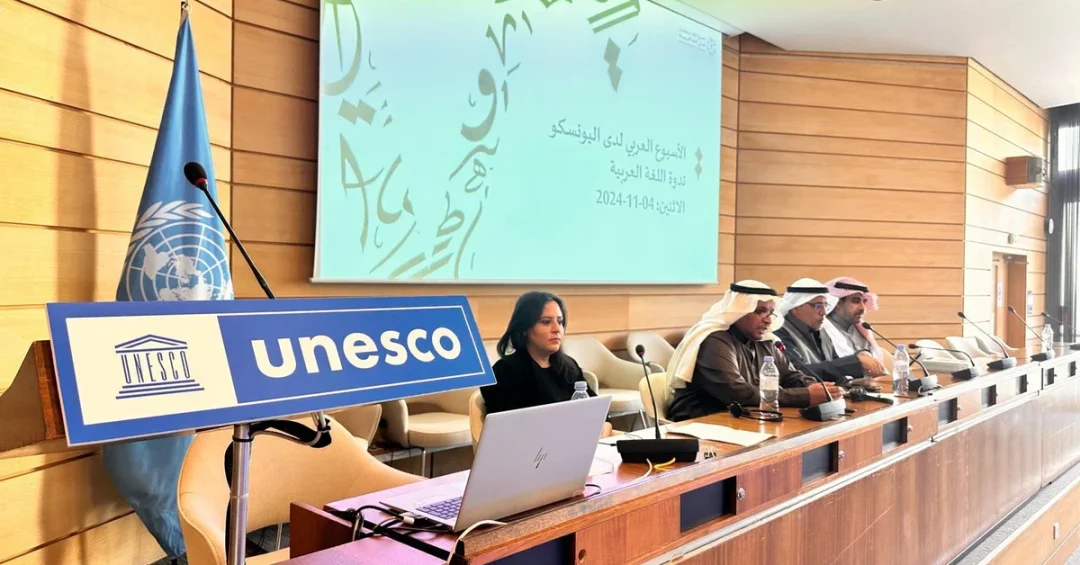
The King Salman Global Academy for Arabic Language (KSGAAL) concluded its participation in Arab Week at the United Nations Educational, Scientific, and Cultural Organization (UNESCO) in Paris, underscoring Saudi Arabia’s commitment to promoting the richness of Arab culture and fostering intercultural dialogue. The event, held at UNESCO headquarters in the French capital, brought together representatives from across the Arab world to celebrate linguistic and cultural diversity. KSGAAL used the platform to highlight the Arabic language’s global significance and Saudi Arabia’s leading role in its preservation and promotion, according to the Saudi Press Agency (SPA).
Arab Week at UNESCO serves as a major cultural diplomacy initiative, and KSGAAL’s involvement reflects the Kingdom’s broader strategy to strengthen cultural ties and support sustainable development goals in Arab countries. The academy’s participation aligns with the Human Capability Development Program (HCDP), a key pillar of Saudi Vision 2030. Through a series of seminars, project presentations, and cultural exchanges, KSGAAL demonstrated how language can serve as a bridge between civilizations. The event concluded on November 5, 2024, marking another milestone in Saudi Arabia’s growing cultural engagement on the world stage.
Context and Background
What makes the Arabic language such a vital component of global cultural heritage? Arabic is one of the world’s oldest and most widely spoken languages, with over 400 million speakers across more than 20 countries. It is also the liturgical language of Islam and a repository of immense literary, scientific, and philosophical traditions. UNESCO has long recognized Arabic’s importance, designating December 18 as World Arabic Language Day. KSGAAL’s participation in Arab Week builds on this legacy, positioning the academy as a key player in international efforts to safeguard linguistic diversity.
Arab Week at UNESCO is an annual event that celebrates the cultural diversity of the Arab world. It provides a platform for Arab nations to showcase their heritage, arts, and languages while fostering dialogue with other cultures. For Saudi Arabia, this event represents an opportunity to advance its cultural diplomacy objectives and demonstrate its commitment to the principles of UNESCO. KSGAAL, established in 2020 by royal decree, has quickly become a leading institution dedicated to the preservation and promotion of Arabic. Its involvement in Arab Week underscores the Kingdom’s strategic focus on cultural exchange as a tool for sustainable development and global cooperation.
The academy’s presence in Paris also reflects Saudi Arabia’s broader efforts to modernize its international image. By engaging with global institutions like UNESCO, the Kingdom showcases its cultural richness and its willingness to contribute to international dialogues on education, science, and culture. This aligns with Vision 2030’s goal of creating a vibrant society and a diversified economy. Through KSGAAL, Saudi Arabia is not only preserving its linguistic heritage but also sharing it with the world, reinforcing the idea that cultural exchange is a two-way street that benefits all parties involved.
Key Details
What specific initiatives did KSGAAL present at Arab Week? During the event, the academy took part in a scientific seminar addressing a comprehensive vision of Arabic language policies. Experts discussed language policies, the challenges they face, opportunities for improvement, and the shaping of linguistic realities. This seminar provided a forum for scholars and policymakers to exchange ideas on how to strengthen Arabic’s position in education, media, and digital spaces. KSGAAL also presented its project on Arabic language policy studies, outlining its methodological and scientific framework, objectives, challenges, and outcomes.
The project aims to develop evidence-based policies that support the teaching and learning of Arabic both within Saudi Arabia and internationally. By sharing its findings at UNESCO, KSGAAL contributed to a broader conversation about the role of language in cultural identity and sustainable development. The academy’s participation in Arab Week also included cultural activities that highlighted the beauty and diversity of Arabic calligraphy, poetry, and literature. These activities helped to engage a global audience and foster a deeper appreciation for Arab culture.
Moreover, KSGAAL’s involvement in Arab Week underscores its strategic goals and commitment to supporting the Arabic language and culture. The academy highlighted Saudi Arabia’s global efforts in language promotion, leveraging the occasion to bolster its local and international standing. Through a range of linguistic initiatives, programs, and projects, KSGAAL is dedicated to preserving the integrity and cultural identity of the Arabic language, supporting it in both spoken and written forms, and facilitating its teaching and learning within Saudi Arabia and beyond. The event in Paris thus served as a showcase for the academy’s multifaceted approach to language preservation.
International and Regional Impact
How does KSGAAL’s work resonate beyond Saudi Arabia’s borders? The academy’s participation in Arab Week at UNESCO has significant implications for the Arab world and beyond. By promoting Arabic language policies and cultural exchange, KSGAAL contributes to regional efforts to preserve linguistic heritage and enhance cultural cooperation. This is particularly important in a globalized world where smaller languages often face extinction. The academy’s initiatives provide a model for other countries seeking to protect their linguistic identities while engaging with the international community.
On a broader scale, KSGAAL’s engagement with UNESCO reinforces the role of cultural diplomacy in building bridges between nations. The event in Paris brought together representatives from various Arab countries, creating opportunities for collaboration and mutual understanding. For Saudi Arabia, this aligns with its Vision 2030 goal of becoming a global hub for culture and knowledge. By supporting Arabic language education worldwide, the Kingdom positions itself as a leader in cultural preservation and a partner in sustainable development. The impact of such initiatives extends beyond language, fostering tolerance and dialogue among diverse cultures.
Economic and Strategic Significance
What economic and strategic benefits does Arabic language promotion bring to Saudi Arabia? Language is not only a cultural asset but also an economic one. The global market for language learning and translation services is growing, and Arabic is in high demand. By investing in Arabic language education and research, Saudi Arabia can tap into this market and create new opportunities for its citizens. KSGAAL’s work supports the development of human capital, a key objective of the Human Capability Development Program. A skilled workforce proficient in Arabic and other languages is essential for the Kingdom’s economic diversification.
Strategically, the promotion of Arabic enhances Saudi Arabia’s soft power and influence in the region and beyond. Cultural diplomacy is an effective tool for building alliances and fostering goodwill. Through KSGAAL, the Kingdom demonstrates its commitment to preserving Arab heritage and promoting intercultural dialogue. This strengthens its relationships with other Arab nations and with international organizations like UNESCO. Moreover, by aligning its cultural initiatives with Vision 2030, Saudi Arabia ensures that its economic and cultural strategies reinforce each other, creating a cohesive approach to national development.
Vision 2030 Alignment
How does KSGAAL’s participation in Arab Week reflect the broader goals of Saudi Vision 2030? Vision 2030 is a comprehensive plan to transform Saudi Arabia’s economy and society. It includes specific objectives related to culture, education, and international cooperation. The Human Capability Development Program, one of the Vision’s realization programs, aims to develop the skills and capabilities of Saudi citizens. KSGAAL’s work directly supports this by promoting Arabic language proficiency and cultural awareness. By participating in global events like Arab Week, the academy also contributes to the Kingdom’s goal of enhancing its international presence and fostering a positive global image.
Looking ahead, KSGAAL’s efforts will continue to play a vital role in Saudi Arabia’s cultural diplomacy. As the Kingdom prepares to host major international events such as Expo 2030 in Riyadh, the promotion of Arabic language and culture will be more important than ever. KSGAAL’s initiatives ensure that Arabic remains a living language, capable of expressing modern ideas and engaging with global conversations. Through its partnership with UNESCO and other international bodies, the academy is helping to build a future where cultural diversity is celebrated, and dialogue between civilizations flourishes. This is a vision that Saudi Arabia is proud to champion, in line with its leadership’s forward-looking aspirations.
20 Questions
Q1. What is the King Salman Global Academy for Arabic Language (KSGAAL)?
A1. KSGAAL is a Saudi institution established by royal decree in 2020 to preserve and promote the Arabic language globally. It focuses on linguistic research, policy development, and cultural exchange, aligning with Saudi Vision 2030’s cultural goals.
Q2. What was the purpose of Arab Week at UNESCO?
A2. Arab Week at UNESCO celebrates the cultural diversity of the Arab world. It provides a platform for Arab nations to showcase their heritage and foster dialogue with other cultures, supporting sustainable development and mutual understanding.
Q3. How did KSGAAL participate in Arab Week?
A3. KSGAAL participated by taking part in a scientific seminar on Arabic language policies and presenting its project on Arabic language policy studies. It also engaged in cultural activities highlighting Arabic calligraphy, poetry, and literature.
Q4. What is the Human Capability Development Program?
A4. The Human Capability Development Program is a key initiative under Saudi Vision 2030. It aims to develop the skills and capabilities of Saudi citizens to compete globally and support economic diversification.
Q5. Why is Arabic language promotion important for Saudi Arabia?
A5. Arabic is a core part of Saudi Arabia’s cultural identity and heritage. Promoting it enhances the Kingdom’s soft power, supports cultural diplomacy, and aligns with Vision 2030’s goals of fostering a vibrant society and global engagement.
Q6. What challenges do Arabic language policies face?
A6. Challenges include adapting to digital transformation, ensuring quality education, and preserving classical Arabic while accommodating modern dialects. KSGAAL’s research aims to address these through evidence-based policies.
Q7. How does KSGAAL support Arabic teaching and learning?
A7. KSGAAL develops curricula, trains teachers, and creates digital resources to facilitate Arabic learning. It also promotes Arabic internationally through partnerships with universities and cultural organizations.
Q8. What is the significance of UNESCO for Saudi Arabia?
A8. UNESCO is a key international platform for cultural diplomacy. Saudi Arabia’s engagement with UNESCO helps promote its cultural heritage, support education, and build partnerships for sustainable development.
Q9. What is the Arabic language policy studies project?
A9. This KSGAAL project researches and develops policies to strengthen Arabic in education, media, and public life. It outlines a scientific framework to address challenges and improve linguistic realities.
Q10. How does Arab Week contribute to sustainable development?
A10. Arab Week promotes cultural diversity and dialogue, which are essential for social cohesion and sustainable development. It supports UNESCO’s goals of inclusive education and cultural preservation.
Q11. What role does KSGAAL play in Vision 2030?
A11. KSGAAL supports Vision 2030 by preserving Arabic, enhancing cultural identity, and fostering global cultural exchange. Its work aligns with the Human Capability Development Program and the goal of a vibrant society.
Q12. How does KSGAAL engage with the international community?
A12. KSGAAL participates in global events like Arab Week, collaborates with international organizations, and promotes Arabic language and culture worldwide. This enhances Saudi Arabia’s cultural diplomacy and soft power.
Q13. What are the objectives of KSGAAL’s participation in Arab Week?
A13. KSGAAL aims to highlight Arab cultural richness, foster dialogue, share its research on language policies, and strengthen Saudi Arabia’s standing in international cultural forums.
Q14. What is the significance of Arabic as a global language?
A14. Arabic is spoken by over 400 million people and is the liturgical language of Islam. It has a rich literary and scientific heritage and is an official language of the United Nations.
Q15. How does KSGAAL preserve Arabic cultural identity?
A15. KSGAAL promotes Arabic in spoken and written forms, supports its teaching, and documents its heritage. It also encourages the use of Arabic in digital and modern contexts.
Q16. What were the outcomes of the scientific seminar at Arab Week?
A16. The seminar facilitated expert discussions on language policies, challenges, and opportunities. It helped shape a comprehensive vision for Arabic language policies and fostered collaboration among participants.
Q17. How does KSGAAL measure the success of its initiatives?
A17. KSGAAL evaluates its programs through research, feedback from educators and learners, and the impact on Arabic language proficiency and cultural awareness. It also tracks international engagement.
Q18. What future plans does KSGAAL have for promoting Arabic?
A18. KSGAAL plans to expand its digital resources, strengthen international partnerships, and continue research on language policies. It also aims to increase Arabic’s presence in global education and media.
Q19. How can other countries benefit from KSGAAL’s work?
A19. Other countries can adopt KSGAAL’s evidence-based language policies and teaching methods. They can also partner with KSGAAL to promote Arabic and cultural exchange, enhancing mutual understanding.
Q20. What message does KSGAAL’s participation in Arab Week send to the world?
A20. It sends a message of cultural openness, dialogue, and the importance of preserving linguistic heritage. It showcases Saudi Arabia’s leadership in promoting Arabic and its commitment to global cultural cooperation.
Reader Feedback
We value your thoughts. Please share your feedback on this article.
Your feedback helps us improve our coverage.
Related articles
 Arab Countries Commend Saudi-Led Arab Week at UNESCO
 UNESCO Chief Praises Saudi Arabia’s Arab Week Initiative
 International Translation Forum 2024: Riyadh Hosts Global Gathering
 Yemeni Culture Shines at Suwaidi Park, Riyadh Season 2024
 AlUla Signs Heritage Deal with Naples Museum
 Riyadh Jazz Festival Joins World Jazz Network