


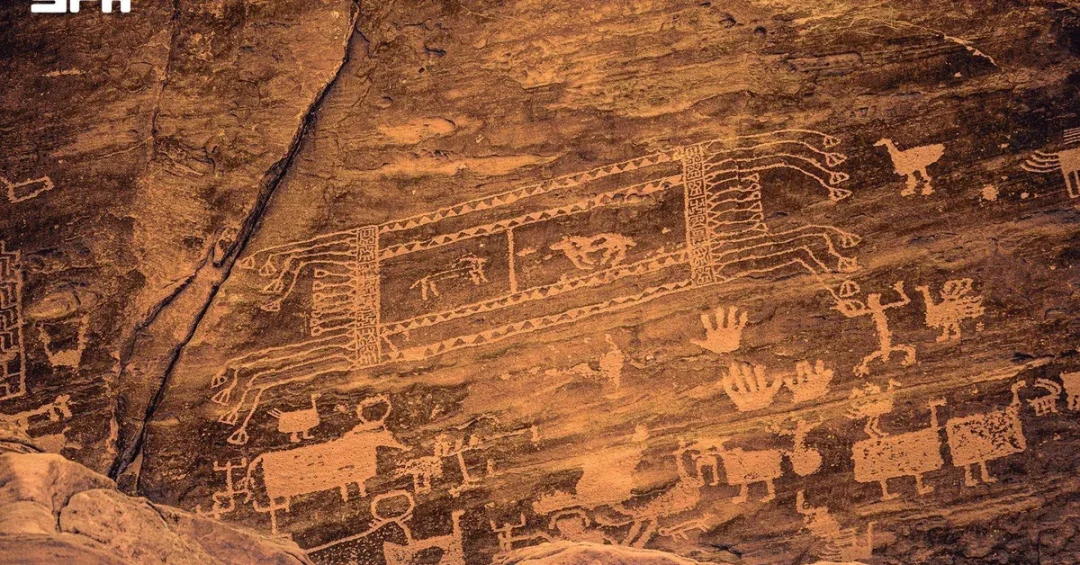
The Royal Commission for AlUla (RCU) has launched a public awareness campaign showcasing approximately 19,802 documented rock art panels across AlUla, featuring more than 66,000 animal figures and over 11,000 human figures, according to an official announcement carried by the Saudi Press Agency (SPA). Running through the end of the year across RCU’s social media platforms, the campaign presents findings drawn from years of archaeological studies and field surveys, offering international audiences an unprecedented window into a human record spanning more than 12,000 years.
The scale of the documentation is remarkable by any global standard. Together, these panels form the largest indexed regional database of rock art in the Arabian Peninsula, chronicling daily life, societal transformation, and the evolving relationship between humans, animals, and the surrounding environment. For readers far from the sandstone canyons of north-west Saudi Arabia, the campaign offers something rare: a chance to follow, in real time, how modern science reconstructs the story of ancient communities who left their mark on stone. Why does a desert valley hold one of the world’s richest archives of prehistoric expression? The answer lies in water, geography, and thousands of years of human passage through a landscape that was once far greener than it is today.
Context and Background
AlUla has long been recognized as one of the most significant archaeological landscapes in the Middle East, home to ancient urban centers such as Dadan, Hegra, and Qurh. The RCU, the government body responsible for the comprehensive regeneration of the AlUla region, has invested heavily in archaeological survey, conservation, and scholarly documentation as part of its wider mandate to protect and interpret the area’s heritage. The new awareness campaign, released through official channels and reported by SPA, distills that effort into ten accessible themes designed for a global audience. What makes this moment different from earlier announcements is the sheer volume of material now catalogued and the systematic scientific method behind it.
The panels represent far more than isolated carvings. They constitute a continuous record of human presence across the Holocene and later periods, documenting the transition from hunting to herding, the shifting climate that reshaped northern Arabia, and the emergence of AlUla as a crossroads for trade and communication. Researchers emphasize that the database is not simply a catalogue of images but a layered historical text, one that must be read through careful dating, comparative analysis, and an understanding of how rock surfaces accumulate meaning over millennia. For international observers, the campaign positions Saudi Arabia at the forefront of rock art research and heritage science.
Key Details of the Documentation Effort
The campaign highlights the scientific methods and collaborative efforts by archaeologists and the local community in AlUla to date the carvings and distinguish between the oldest and most recent examples. The process includes on-foot site surveys, photography, sketching, and detailed descriptions, as well as precise recording of each panel’s coordinates. Researchers also examine the superimposition of images, execution techniques, depicted subjects, and associated inscriptions. In addition, they analyze a dark layer that gradually forms on the rock surface, known as rock patina, to help determine the relative age of the carvings. This combination of fieldwork and laboratory analysis gives the database a level of rigor that supports both scholarly research and public education.
The campaign is organized around ten key themes: rock art as a historical record; evidence of the transition from hunting to herding; environmental and climatic shifts; AlUla as a hub for trade and communication; archaeological survey and documentation efforts; vehicles as symbols of status and influence; locally extinct animals; oasis sustainability and herd ownership; horsemanship, conflict, and survival; and the continuity of this form of expression. Together, these themes allow audiences to move from individual images to broader narratives about how communities adapted to a changing world. How did ancient artists decide what was worth carving into stone? The subjects they chose — from cattle and camels to chariots and battles — reveal what mattered most in their lives.
Among the most striking findings is the role of water in sustaining pastoralism. As aridity increased in surrounding regions, the AlUla Valley remained a sanctuary offering water, oases, and vegetation. The images demonstrate the continued presence of cattle in the area during the Iron Age and pre-Islamic period, when such depictions had become extremely rare at other sites in northern Saudi Arabia. They have also enabled researchers to interpret characteristics of the Holocene, roughly 8000–4000 BCE, when grasslands and lakes were widespread across parts of the northern Arabian Peninsula. This environmental context transforms the carvings into a climate archive as much as an artistic one.
Scenes of Conflict, Travel, and Status
Other scenes depict battles and human efforts to defend against predators, both for self-protection and to safeguard herds. They reveal aspects of horsemanship, warfare, and the struggle for survival. Archaeological surveys have documented 14,670 images of horses and riders and 1,375 battle scenes. In addition, 180 scenes of conflicts with carnivores have been recorded, showing lions, tigers, leopards, and hyenas attacking humans or livestock, as well as people protecting their herds and hunting predators. These images offer a vivid sense of the dangers and responsibilities that shaped daily existence in the ancient oasis.
Caravans traced their paths across the rocks of AlUla long before trade routes were marked on maps. Images believed to represent camel caravans, horses, riders, litters, and chariots appear alongside scenes of travel and combat, reflecting AlUla’s role as a crossroads and hub for communication among communities. With abundant water and flourishing oases, AlUla became a vital stop along regional trade networks, connecting ancient urban centers such as Dadan, Hegra, Qurh, and Umm Hadam. The enduring traces of these routes and travelers attest to AlUla’s historical significance and its role in linking cultures across the peninsula.
The high concentration of chariot depictions highlights their social and cultural significance and provides enduring evidence of the status and influence of their owners thousands of years ago. Archaeological surveys have documented 38 images of horse-drawn chariots, 25 of which were found in Wadi Al-Naam, a site that may represent one of the largest concentrations of such carvings in the Arabian Peninsula. These chariots were likely not suited for long-distance travel and may instead have been used within the oases and associated with individuals of high status. What can modern societies learn from how ancient communities displayed prestige? The chariots suggest that visible symbols of influence are as old as civilization itself.
The documentation also extends into the modern era. Archaeological surveys have documented 395 depictions of motor vehicles, reflecting the enduring use of rock surfaces as a medium for expression and a record of the tools of each era. The rocks of AlUla thus remain an open record of life’s transformations, preserved over time. This continuity — from prehistoric herds to twentieth-century automobiles — underscores how the same surfaces have served generation after generation as a canvas for memory and identity.
International and Regional Impact
For the international research community, the RCU campaign provides a major new dataset for comparative study. Rock art specialists across the world rely on well-documented, precisely dated panels to test hypotheses about migration, trade, and environmental change. The AlUla database, with its tens of thousands of figures and detailed contextual recording, offers a benchmark for similar work in neighboring regions. It also strengthens Saudi Arabia’s position as a leader in heritage science and cultural preservation, attracting scholarly collaboration and global attention. How often does a single region offer a 12,000-year record of human expression? The answer helps explain why researchers are paying close attention.
Regionally, the campaign reinforces AlUla’s identity as a shared cultural treasure of the Arabian Peninsula. The carvings connect the area to broader narratives of pastoralism, trade, and conflict that span modern borders. By presenting its findings through accessible social media content, the RCU ensures that audiences in the Gulf, the wider Middle East, and beyond can engage with this heritage directly. The campaign also supports tourism and educational initiatives, giving visitors a deeper understanding of what they see when they explore AlUla’s landscapes.
Economic and Strategic Significance
Heritage is a central pillar of AlUla’s economic future. The RCU’s work supports a growing ecosystem of museums, guided experiences, and cultural events that draw international visitors to north-west Saudi Arabia. Detailed documentation of rock art adds intellectual depth to the visitor experience, distinguishing AlUla from other heritage destinations. It also creates opportunities for digital products, educational resources, and academic partnerships that extend the region’s reach far beyond its physical boundaries. In this sense, the campaign is both a scholarly exercise and an investment in sustainable tourism.
Strategically, the project aligns with Saudi Arabia’s broader efforts to diversify income sources and promote cultural diplomacy. By making its archaeological record visible and accessible, the Kingdom signals openness to international engagement and confidence in its heritage. The campaign also demonstrates the value of collaboration between archaeologists, government institutions, and local communities — a model that can be applied to other heritage sites across the country. What does it mean for a nation to treat its oldest stories as assets for the future? For Saudi Arabia, it means weaving ancient landscapes into a modern economic vision.
Vision 2030 Alignment
The RCU campaign reflects the objectives of Saudi Vision 2030, which emphasizes the preservation of cultural heritage, the growth of tourism, and the diversification of the economy. AlUla is one of the flagship destinations under this vision, positioned as a living museum where archaeology, nature, and hospitality converge. The documentation of nearly 20,000 rock art panels supports these goals by enriching the region’s cultural offer, generating knowledge, and creating a foundation for educational and commercial initiatives that respect the past while serving future generations.
As the campaign unfolds through the end of the year, it will continue to introduce global audiences to the stories etched into AlUla’s rocks. These panels are more than ancient images; they are evidence of resilience, adaptation, and creativity across millennia. By sharing them widely, the Royal Commission for AlUla invites the world to see the Kingdom not only as a modernizing economy but also as a guardian of deep human history. In doing so, it advances Vision 2030’s promise to connect Saudi Arabia’s heritage with its global future.
20 Questions
Q1. What has the Royal Commission for AlUla launched?
A1. The Royal Commission for AlUla launched an awareness campaign across its social media platforms to highlight findings from archaeological studies and surveys, showcasing the region’s extensive rock art heritage to a global audience.
Q2. How many rock art panels are featured in the campaign?
A2. The campaign showcases approximately 19,802 documented panels, forming the largest indexed regional database of rock art in the Arabian Peninsula and representing more than 12,000 years of human history.
Q3. How many animal and human figures are recorded?
A3. The panels feature more than 66,000 animal figures and over 11,000 human figures, documenting daily life, societal transformations, and the relationship between humans, animals, and their environment.
Q4. How long does the campaign run?
A4. The campaign runs through the end of the year across the Royal Commission for AlUla’s social media platforms, presenting findings in accessible formats for international audiences.
Q5. What scientific methods are used to date the carvings?
A5. Researchers use on-foot site surveys, photography, sketching, descriptions, precise coordinate recording, analysis of superimposition and execution techniques, and study of rock patina to determine relative ages.
Q6. What is rock patina?
A6. Rock patina is a dark layer that gradually forms on rock surfaces over time. Researchers analyze it to help determine the relative age of carvings, supporting accurate dating of the panels.
Q7. What are the ten key themes of the campaign?
A7. The themes include rock art as historical record, hunting to herding transition, environmental shifts, trade and communication, survey efforts, vehicles as status symbols, extinct animals, oasis sustainability, horsemanship and survival, and continuity of expression.
Q8. What does the rock art reveal about water in AlUla?
A8. The carvings show the role of water in sustaining pastoralism. As aridity increased elsewhere, AlUla Valley remained a sanctuary with water, oases, and vegetation, supporting continued human and animal life.
Q9. What do the images say about cattle in the Iron Age?
A9. The images demonstrate the continued presence of cattle in AlUla during the Iron Age and pre-Islamic period, when such depictions had become extremely rare at other sites in northern Saudi Arabia.
Q10. How many horse and rider images were documented?
A10. Archaeological surveys documented 14,670 images of horses and riders, reflecting the importance of horsemanship, travel, and conflict in the region’s ancient societies.
Q11. How many battle scenes were recorded?
A11. Surveys recorded 1,375 battle scenes, along with 180 scenes of conflicts with carnivores, showing lions, tigers, leopards, and hyenas attacking humans or livestock.
Q12. What do the chariot depictions indicate?
A12. The 38 documented horse-drawn chariot images, 25 in Wadi Al-Naam, highlight social and cultural significance, suggesting they were used within oases and associated with high-status individuals.
Q13. How many motor vehicle depictions were found?
A13. Archaeological surveys documented 395 depictions of motor vehicles, reflecting the enduring use of rock surfaces as a medium for expression and a record of the tools of each era.
Q14. What ancient urban centers did AlUla connect?
A14. AlUla connected ancient urban centers such as Dadan, Hegra, Qurh, and Umm Hadam, serving as a vital stop along regional trade networks due to its abundant water and flourishing oases.
Q15. What does the Holocene context reveal?
A15. The carvings help researchers interpret the Holocene, roughly 8000–4000 BCE, when grasslands and lakes were widespread across parts of the northern Arabian Peninsula.
Q16. How does the local community contribute to the research?
A16. The local community in AlUla collaborates with archaeologists in survey and documentation efforts, contributing knowledge that supports dating and interpretation of the carvings.
Q17. Why is AlUla’s rock art database significant globally?
A17. It is the largest indexed regional database of rock art in the Arabian Peninsula, offering a 12,000-year record that supports comparative research on migration, trade, and environmental change.
Q18. How does the campaign support tourism in AlUla?
A18. By documenting and sharing rock art findings, the campaign adds intellectual depth to the visitor experience, supporting museums, guided tours, and cultural events that attract international travelers.
Q19. What is the role of the Royal Commission for AlUla?
A19. The Royal Commission for AlUla is the government body responsible for regenerating the AlUla region, protecting its heritage, and promoting cultural and economic development in line with Saudi Vision 2030.
Q20. How does this campaign align with Vision 2030?
A20. The campaign supports Vision 2030 by preserving cultural heritage, growing tourism, diversifying the economy, and showcasing Saudi Arabia’s role as a guardian of deep human history.
Reader Feedback
We value your thoughts. Please share your feedback on this article.
Your feedback helps us improve our coverage.
Related articles
 KSGAAL Releases Riyadh List of 5,000 Common Arabic Words
 Northern Borders Falconry Season Draws Gulf Falconers
 Taif historic gates preserve cultural and literary heritage
 Aseer Ramadan markets provide economic and social hubs
 AlMidhallah Artistic Space explores Islamic gardens at Islamic Arts Biennale
 AlUla palm farms produce 116,056 tons of dates annually