


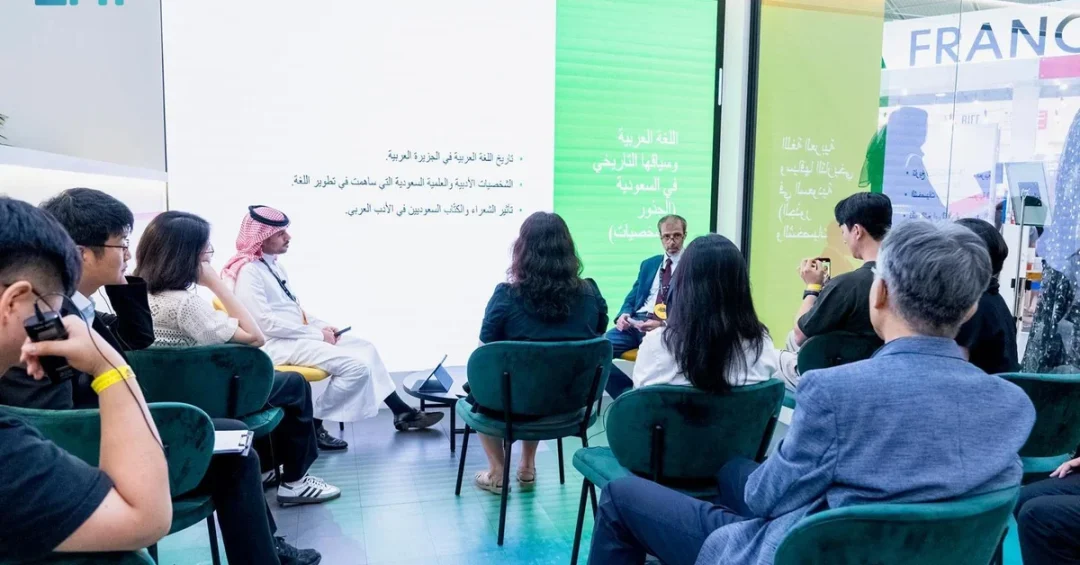
The Saudi Literature, Publishing, and Translation Commission organized a seminar titled “The Role of the Kingdom of Saudi Arabia in Teaching Arabic in Korea” at the Seoul International Book Fair 2024, where Saudi Arabia was the guest of honour. The event, held on June 30, 2024, in Seoul, brought together cultural officials and experts to discuss the Kingdom’s contributions to promoting the Arabic language globally. The seminar featured Dr. Abdulaziz bin Abdulrahman Al-Dayel, Cultural Attaché at the Saudi Embassy, who highlighted Saudi Arabia’s historical and ongoing efforts to serve Arabic.
Context and Background
The Seoul International Book Fair 2024 provided a significant platform for Saudi Arabia to showcase its cultural and linguistic heritage. As the guest of honour, the Kingdom aimed to strengthen cultural ties and share its rich linguistic legacy with an international audience. The seminar, organized by the Saudi Literature, Publishing, and Translation Commission, underscored Saudi Arabia’s commitment to preserving and promoting the Arabic language, a cornerstone of its identity and a key element of its cultural diplomacy.
Dr. Al-Dayel emphasized the historical depth of Arabic, tracing its roots as one of the Semitic languages. He explained how the revelation of the Holy Quran in classical Arabic unified linguistic differences across the Arabian Peninsula, bringing together tribes such as Quraysh, Tamim, Hawazin, and Azd. This historical unity laid the foundation for Arabic’s enduring global influence.
Key Details
Dr. Al-Dayel pointed to Article 1 of the Basic Law of Governance, which identifies the Kingdom as an Arab Islamic state, as clear evidence of Saudi Arabia’s dedication to Arabic. He also highlighted the Kingdom’s pivotal role in securing United Nations recognition of Arabic as an official language in 1973. This milestone led to the annual celebration of UN Arabic Language Day on December 18, commemorating the day Arabic was adopted by the UN. The seminar thus served as a reminder of Saudi Arabia’s proactive efforts to elevate Arabic on the world stage.
The event also provided a venue for discussing strategies to teach Arabic in Korea, sharing best practices, and fostering collaboration between Saudi and Korean educational institutions. Such initiatives align with the Kingdom’s broader cultural outreach under Vision 2030, which seeks to diversify the economy and enhance global engagement.
Implications and Impact
The seminar’s outcomes are expected to bolster Arabic language education in South Korea, where interest in the language and Saudi culture has been growing. By facilitating academic exchanges and cultural programs, Saudi Arabia reinforces its role as a global leader in preserving linguistic heritage. This initiative also strengthens diplomatic and cultural ties between the Kingdom and South Korea, two nations with expanding economic and strategic partnerships.
Furthermore, the recognition of Arabic at the UN and the establishment of UN Arabic Language Day are direct results of Saudi diplomacy. These achievements not only honor the language of the Quran but also facilitate cross-cultural understanding and dialogue, aligning with the Kingdom’s vision of a prosperous and interconnected world.
Vision 2030 Alignment
Saudi Arabia’s efforts to promote Arabic worldwide are integral to Vision 2030, which emphasizes cultural enrichment and global cooperation. By supporting Arabic education in Korea and beyond, the Kingdom showcases its commitment to fostering mutual respect and understanding. Such cultural diplomacy enhances Saudi Arabia’s soft power and positions it as a bridge between civilizations, contributing to a more harmonious global community. Ultimately, these initiatives reflect the Kingdom’s dedication to preserving its heritage while embracing a future of progress and international collaboration.
20 Questions
Q1. What event did the Saudi Literature, Publishing, and Translation Commission organize?
A1. The Commission organized a seminar titled “The Role of the Kingdom of Saudi Arabia in Teaching Arabic in Korea” at the Seoul International Book Fair 2024, where Saudi Arabia was the guest of honour. The event aimed to highlight Saudi efforts in promoting Arabic language education globally.
Q2. When and where did the seminar take place?
A2. The seminar took place on June 30, 2024, in Seoul, South Korea, during the Seoul International Book Fair 2024. This prestigious event provided a platform for cultural exchange and dialogue between Saudi Arabia and Korea.
Q3. Who represented Saudi Arabia at the seminar?
A3. Dr. Abdulaziz bin Abdulrahman Al-Dayel, the Cultural Attaché at the Saudi Embassy, represented the Kingdom. He delivered a presentation on Saudi Arabia’s role in teaching Arabic and its historical commitment to the language.
Q4. What is the significance of Arabic being a Semitic language?
A4. Arabic’s Semitic roots highlight its ancient origins and connection to other languages in the region. Dr. Al-Dayel noted that Arabic evolved into classical Arabic with the revelation of the Holy Quran, unifying linguistic differences among Arabian tribes.
Q5. How did the Holy Quran influence the Arabic language?
A5. The revelation of the Holy Quran in classical Arabic standardized the language, ending linguistic differences among tribes like Quraysh, Tamim, Hawazin, and Azd. This unification helped Arabic become a powerful and cohesive language.
Q6. What does Article 1 of the Basic Law of Governance state?
A6. Article 1 identifies the Kingdom of Saudi Arabia as an Arab Islamic state. This constitutional provision underscores the central role of Arabic in the Kingdom’s identity and governance, reflecting its commitment to the language.
Q7. What role did Saudi Arabia play in recognizing Arabic at the UN?
A7. Saudi Arabia played a prominent role in advocating for Arabic’s recognition as an official UN language. This effort led to Arabic becoming one of the six official languages of the United Nations in 1973.
Q8. When is UN Arabic Language Day celebrated and why?
A8. UN Arabic Language Day is celebrated annually on December 18. This date marks the day in 1973 when the UN General Assembly adopted Arabic as an official language, honoring its global significance.
Q9. How does the seminar contribute to cultural exchange?
A9. The seminar facilitates dialogue between Saudi and Korean educators, sharing best practices in Arabic language teaching. It strengthens cultural ties and promotes mutual understanding between the two nations.
Q10. What is the significance of Saudi Arabia being the guest of honour at the book fair?
A10. Being the guest of honour highlights Saudi Arabia’s cultural prominence and commitment to international engagement. It provides a platform to showcase the Kingdom’s rich heritage and Vision 2030 cultural initiatives.
Q11. How does teaching Arabic in Korea benefit Saudi-Korean relations?
A11. Teaching Arabic in Korea fosters deeper cultural and academic ties. It enhances people-to-people connections and supports diplomatic and economic partnerships between Saudi Arabia and South Korea.
Q12. What are the key objectives of the seminar?
A12. The seminar aimed to discuss strategies for teaching Arabic in Korea, share Saudi expertise, and promote collaboration. It also sought to highlight the Kingdom’s historical contributions to the Arabic language.
Q13. How does Vision 2030 support cultural diplomacy?
A13. Vision 2030 emphasizes cultural enrichment and global outreach. By promoting Arabic worldwide, Saudi Arabia enhances its soft power and positions itself as a leader in cultural diplomacy and international cooperation.
Q14. What historical tribes were mentioned as speakers of early Arabic?
A14. Dr. Al-Dayel mentioned the tribes of Quraysh, Tamim, Hawazin, and Azd. These tribes spoke early forms of Arabic before the Quran standardized the language, unifying linguistic differences in the Arabian Peninsula.
Q15. How does Saudi Arabia support Arabic language education globally?
A15. Saudi Arabia supports Arabic education through cultural attachés, educational programs, and international seminars. These efforts aim to preserve the language and promote its study worldwide, in line with Vision 2030.
Q16. What is the role of the Literature, Publishing, and Translation Commission?
A16. The Commission oversees cultural initiatives, including literature, publishing, and translation. It organizes events like the Seoul seminar to promote Saudi culture and the Arabic language internationally.
Q17. Why is the Seoul International Book Fair important for Saudi Arabia?
A17. The fair offers a global stage for Saudi Arabia to showcase its cultural achievements and literary works. It also strengthens cultural ties with Korea and other nations, supporting the Kingdom’s international outreach.
Q18. How does the seminar reflect Saudi Arabia’s dedication to Arabic?
A18. The seminar demonstrates Saudi Arabia’s ongoing commitment to serving Arabic, as evidenced by its diplomatic efforts at the UN and its support for language education. It reflects the Kingdom’s pride in its linguistic heritage.
Q19. What future collaborations might result from this seminar?
A19. The seminar may lead to joint educational programs, teacher exchanges, and curriculum development between Saudi and Korean institutions. Such collaborations would further promote Arabic learning and cultural exchange.
Q20. How does this event align with Saudi Arabia’s global role?
A20. The event aligns with Saudi Arabia’s role as a cultural bridge, promoting dialogue and understanding. It reinforces the Kingdom’s position as a global leader in preserving Arabic and advancing Vision 2030 goals.
Reader Feedback
We value your thoughts. Please share your feedback on this article.
Your feedback helps us improve our coverage.