


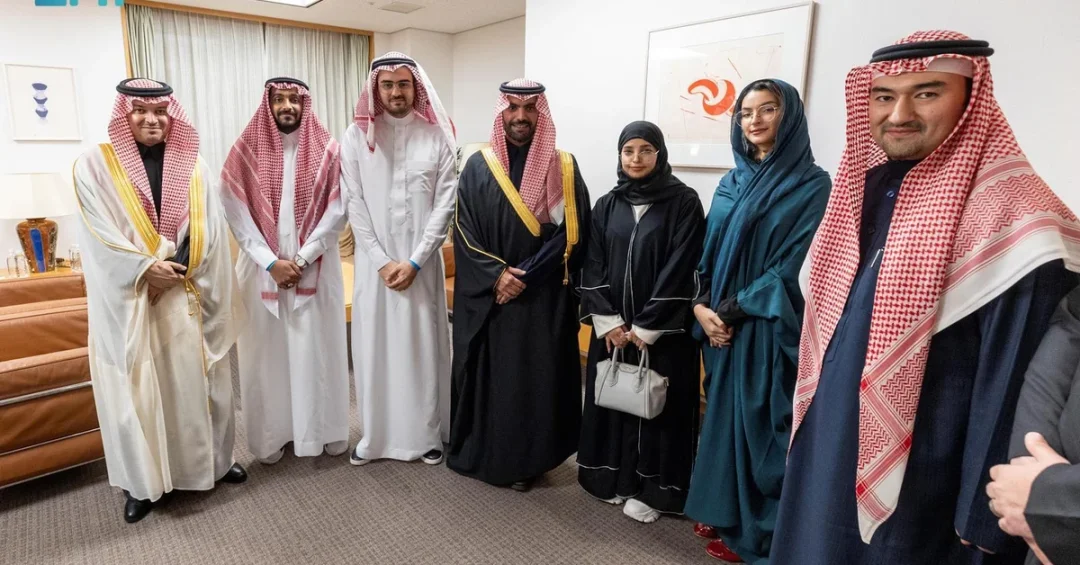
Saudi Minister of Culture and Chairman of the Board of Directors of the Literature, Publishing, and Translation Commission (LPTC), Prince Badr bin Abdullah bin Farhan, met with Saudi scholarship students enrolled in the Manga Production Foundations Program during a visit to Tokyo, in a gathering announced by the Saudi Press Agency on November 23, 2024. The meeting, held at the minister’s residence in the Japanese capital, underscored the Kingdom’s commitment to nurturing national talent in creative and cultural disciplines through international partnerships and professional training.
The program, organized jointly by the Literature, Publishing, and Translation Commission and Manga Productions — a subsidiary of the Mohammed bin Salman Foundation (Misk) — is designed to develop skilled Saudi manga artists through instruction rooted in Japanese techniques, reflecting the art form’s origins in Japan. During the meeting, Prince Badr reaffirmed the Saudi leadership’s steadfast support for human capability development across every field, stressing that academic and professional training in cultural specializations is central to the Kingdom’s cultural transformation. The session was attended by Dr. Mohammed Hasan Alwan, CEO of the Literature, Publishing, and Translation Commission, and Essam Amanullah Bukhari, CEO of Manga Productions, alongside students training at Kadokawa Contents Academy (KCA), one of Japan’s foremost institutions for cultivating and recruiting manga talent. But what does this meeting reveal about Saudi Arabia’s broader cultural ambitions, and why is manga emerging as a bridge between Riyadh and Tokyo?
Context and Background
The Manga Production Foundations Program represents a deliberate extension of Saudi Arabia’s cultural strategy, which seeks to diversify the Kingdom’s creative economy while preserving and promoting its heritage. Manga Productions, established under Misk, has spent years building ties with Japanese studios, publishers, and academic institutions, positioning itself as a conduit for knowledge transfer between the two cultures. The collaboration with Kadokawa Contents Academy, a well-known training ground for manga creators in Japan, gives Saudi participants access to an ecosystem that has produced globally recognized artists and storytellers. Isn’t it significant that a Saudi cultural institution would invest so purposefully in a Japanese art form rather than simply importing finished content?
The program’s structure reflects a phased approach to talent development. It begins with virtual workshops that open participation to a wide pool of aspiring artists, then narrows to an intensive training course for those who demonstrate exceptional promise, and culminates in overseas training in Japan for a select group. This pipeline model ensures that participants are not only exposed to manga techniques but are also immersed in the professional culture of the industry’s birthplace. For Saudi Arabia, the initiative forms part of a wider effort to build a sustainable creative sector capable of contributing to national income and global cultural exchange, in line with the objectives of Vision 2030.
Key Details of the Tokyo Meeting
According to the Saudi Press Agency, Prince Badr bin Abdullah bin Farhan used the meeting to emphasize that the Saudi leadership places human development at the center of its cultural agenda. He highlighted the importance of academic and professional training in cultural disciplines, framing the students’ journey as part of a national investment in creativity. The presence of Dr. Mohammed Hasan Alwan and Essam Amanullah Bukhari signaled institutional alignment between the commission and Manga Productions, reinforcing the program’s role as a flagship initiative for cultural talent development.
The program’s reach has been substantial. More than 1,850 participants have benefited from its virtual workshops, with 115 advancing to the intensive training phase. That phase resulted in the creation of 115 manga stories, demonstrating that the program is not merely educational but productive, generating original content with Saudi perspectives. Of those who completed the intensive training, 21 students were sent to Japan for advanced instruction, where they are now studying at Kadokawa Contents Academy. The competitions launched alongside the program have also drawn notable engagement: “Munjanha” received 133 submissions, “Manga Al-Qaseed” attracted over 70, and “Manga Al-Ibil” gathered more than 50. How often does a single training initiative manage to combine education, cultural preservation, and international exchange so effectively?
These competitions deserve particular attention because they anchor the program in Saudi identity. “Munjanha” transforms Arabic proverbs into manga narratives, giving traditional wisdom a contemporary visual form. “Manga Al-Qaseed” adapts Arabic poetry into manga, connecting the Kingdom’s rich literary heritage with a global storytelling medium. “Manga Al-Ibil” celebrates the cultural symbolism of camels in Saudi Arabia, honoring a symbol deeply woven into the nation’s history and daily life. Together, these themes show that the program is not about imitation but about creative synthesis, producing stories that are unmistakably Saudi while speaking the visual language of manga.
International and Regional Impact
The meeting in Tokyo carries significance beyond the students it honored. It reflects a deepening cultural relationship between Saudi Arabia and Japan, two nations that have built strong economic ties and are now expanding cooperation into creative industries. Japan’s soft power in animation and comics is globally recognized, and Saudi Arabia’s willingness to learn from that expertise demonstrates a pragmatic approach to cultural development. At the same time, the program offers Japan a partner in the Middle East that can help introduce manga to new audiences and open avenues for co-production and market growth.
Regionally, the initiative positions Saudi Arabia as a leader in cultural talent development within the Arab world. By sending students abroad and then supporting them in producing work that draws on Arabic heritage, the Kingdom is building a cohort of creators who can represent the region authentically on international platforms. This approach aligns with the broader pattern of Saudi cultural diplomacy, which emphasizes exchange, mutual respect, and the celebration of shared human creativity. Could this model inspire other Arab nations to pursue similar partnerships in creative education?
Economic and Strategic Significance
The creative industries are increasingly recognized as drivers of economic diversification, and Saudi Arabia’s investment in manga training reflects that understanding. A skilled workforce in animation, illustration, and storytelling can support sectors ranging from entertainment and publishing to advertising and digital media. As the Kingdom develops entertainment destinations, streaming platforms, and publishing houses, the demand for local creative talent will grow. Programs like the Manga Production Foundations Program help ensure that this demand can be met by Saudi professionals rather than relying solely on imported expertise.
Strategically, the initiative also strengthens the knowledge economy that Vision 2030 seeks to build. By equipping young Saudis with specialized skills and international experience, the program contributes to a more diversified and resilient economic base. It also fosters people-to-people ties with Japan, creating networks that can support future collaboration in business, education, and culture. The 21 students currently training in Japan are not only learners; they are cultural ambassadors whose work may one day reach global audiences and showcase the creativity of the Kingdom.
Vision 2030 Alignment
The Manga Production Foundations Program sits squarely within the framework of Saudi Vision 2030, which calls for a vibrant society, a thriving economy, and an ambitious nation. Cultural development is a key pillar of that vision, and initiatives that nurture creative talent contribute directly to the goal of expanding cultural participation and enhancing quality of life. By investing in manga artists, the Kingdom is also investing in storytelling that can carry Saudi values and perspectives to the world, reinforcing the nation’s growing role as a global cultural player.
As Prince Badr’s meeting with the students demonstrated, the leadership’s support for human capability development is not abstract rhetoric but a practical commitment expressed through programs, partnerships, and opportunities. The students studying in Tokyo are part of a generation that will shape the future of Saudi culture, blending international techniques with local identity. Their journey reflects the broader promise of Vision 2030: a Saudi Arabia that is open to the world, confident in its heritage, and determined to excel in every field it enters. Isn’t that the kind of future the Kingdom is working to build?
20 Questions
Q1. What was the purpose of the Saudi Minister of Culture’s meeting in Tokyo?
A1. Prince Badr bin Abdullah bin Farhan met with Saudi scholarship students in the Manga Production Foundations Program to show support for their training and emphasize the leadership’s commitment to developing human capabilities in cultural fields.
Q2. Who is the Saudi Minister of Culture?
A2. Prince Badr bin Abdullah bin Farhan serves as Saudi Minister of Culture and Chairman of the Board of Directors of the Literature, Publishing, and Translation Commission, leading the Kingdom’s cultural transformation efforts.
Q3. What is the Manga Production Foundations Program?
A3. It is a specialized training initiative organized by the Literature, Publishing, and Translation Commission and Manga Productions to nurture Saudi manga artists through Japanese techniques and professional instruction.
Q4. Which organizations collaborated on this program?
A4. The program is a collaboration between the Literature, Publishing, and Translation Commission and Manga Productions, a subsidiary of the Mohammed bin Salman Foundation (Misk).
Q5. Where are the Saudi students training in Japan?
A5. The students are studying manga art at Kadokawa Contents Academy (KCA), described as one of Japan’s leading institutions for training and recruiting talent in manga creation.
Q6. How many participants have benefited from the virtual workshops?
A6. More than 1,850 participants have benefited from the virtual workshops offered through the Manga Production Foundations Program, reflecting its broad reach among aspiring Saudi artists.
Q7. How many students advanced to the intensive training phase?
A7. A total of 115 participants advanced to the intensive training phase after the virtual workshops, demonstrating the program’s competitive and selective nature.
Q8. How many manga stories were created during the intensive training?
A8. The intensive training phase resulted in the creation of 115 manga stories, showing that participants produced original work as part of their learning journey.
Q9. How many students were sent to Japan for advanced training?
A9. Among the participants, 21 students were selected to travel to Japan for advanced training, gaining direct exposure to the birthplace of manga.
Q10. What is the “Munjanha” competition?
A10. “Munjanha” is a competition that transforms Arabic proverbs into manga stories, blending traditional Saudi wisdom with the visual storytelling style of Japanese comics.
Q11. What is “Manga Al-Qaseed”?
A11. “Manga Al-Qaseed” is a competition that adapts Arabic poems into manga, connecting the Kingdom’s literary heritage with the global medium of manga art.
Q12. What is “Manga Al-Ibil”?
A12. “Manga Al-Ibil” celebrates the cultural symbolism of camels in Saudi Arabia, using manga to honor an animal deeply rooted in the nation’s history and identity.
Q13. How many submissions did the competitions receive?
A13. “Munjanha” received 133 submissions, “Manga Al-Qaseed” attracted over 70, and “Manga Al-Ibil” gathered more than 50, showing strong engagement across all three competitions.
Q14. Who attended the meeting alongside Prince Badr?
A14. Dr. Mohammed Hasan Alwan, CEO of the Literature, Publishing, and Translation Commission, and Essam Amanullah Bukhari, CEO of Manga Productions, attended the meeting with the students.
Q15. What did Prince Badr emphasize during the meeting?
A15. He emphasized the Saudi leadership’s unwavering support for developing human capabilities across all fields and highlighted the importance of academic and professional training in cultural disciplines.
Q16. Why is Japan significant for this program?
A16. Japan is the birthplace of manga, making it the ideal location for Saudi students to learn authentic techniques and immerse themselves in the professional culture of the industry.
Q17. How does the program support Saudi cultural identity?
A17. Through competitions like “Munjanha,” “Manga Al-Qaseed,” and “Manga Al-Ibil,” the program encourages students to blend manga techniques with Saudi heritage, proverbs, poetry, and symbols.
Q18. What economic benefits can this program bring to Saudi Arabia?
A18. It builds a skilled creative workforce that can support entertainment, publishing, and digital media sectors, contributing to economic diversification and the growth of the knowledge economy.
Q19. How does the program align with Vision 2030?
A19. It supports Vision 2030’s goals of a vibrant society and thriving economy by nurturing cultural talent, expanding creative industries, and enhancing Saudi Arabia’s global cultural presence.
Q20. What does this initiative say about Saudi Arabia’s global cultural role?
A20. It demonstrates the Kingdom’s commitment to international cultural exchange, learning from global expertise, and empowering Saudi creators to share their stories with audiences worldwide.
Reader Feedback
We value your thoughts. Please share your feedback on this article.
Your feedback helps us improve our coverage.