


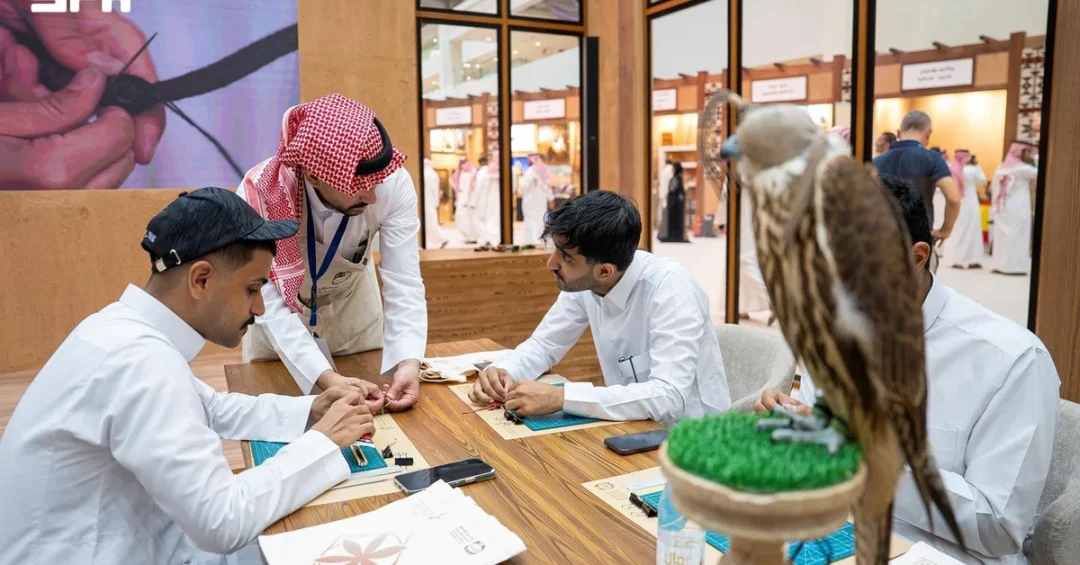
The Royal Institute of Traditional Arts (Wrth) is welcoming visitors to the International Saudi Falcons and Hunting Exhibition 2026 with a series of hands-on workshops designed to bring the Kingdom’s traditional crafts to life, according to an announcement released through official Saudi channels. The workshops are being held at the Riyadh Exhibition and Convention Center in Malham, where the exhibition runs until October 10, 2026, and they invite members of the public to move beyond observation and take part directly in the making of heritage objects.
Organized by Wrth, a specialized cultural institution established to safeguard and sustain Saudi Arabia’s traditional arts, the programme offers two distinct craft experiences across the exhibition’s run. The first, held from October 1 to 5, focused on making a falcon hood medal, while the second, running from October 6 to 10, centres on making prayer beads. In both cases, participants are guided through the tools and techniques associated with each craft before creating pieces of their own. The initiative reflects a broader national effort to make heritage accessible, participatory, and relevant to contemporary audiences.
Context and Background
Why does a craft workshop at a falconry exhibition matter beyond the walls of a convention centre? The answer lies in the scale of the Kingdom’s cultural transformation and the deliberate way Saudi Arabia has placed heritage at the centre of its modernization story. Falconry and hunting are among the most deeply rooted traditions in Arabian life, long associated with patience, skill, and a close relationship with the natural environment. The International Saudi Falcons and Hunting Exhibition has grown into a major gathering for enthusiasts, breeders, and craftspeople, and Wrth’s presence ensures that the intangible knowledge behind the objects on display is passed on rather than simply admired.
Since 2021, Wrth has operated as a specialized cultural institution dedicated to training national talent passionate about learning and practising traditional arts. Its strategy focuses on empowering, supporting, and developing the traditional crafts and arts sector, contributing to the preservation and sustainability of the Kingdom’s cultural heritage. That mandate is not limited to museums or archives. By taking part in specialized exhibitions and events that attract enthusiasts of Saudi heritage, Wrth promotes direct engagement with traditional arts and makes them more accessible to the public. The falconry exhibition, with its natural audience of heritage lovers, offers an ideal setting for that mission.
The timing is significant. As Saudi Arabia hosts an expanding calendar of international cultural, sporting, and business events, institutions such as Wrth are using those platforms to introduce global visitors to Saudi craftsmanship. A visitor who spends twenty minutes shaping a prayer bead or assembling a falcon hood medal leaves with a tangible connection to the country’s identity, an experience that no display case can replicate. This approach aligns with a wider recognition that cultural sustainability depends on participation, not preservation alone.
Key Details
What exactly do participants learn inside these workshops? The two experiences are designed to be accessible to beginners while remaining faithful to authentic methods. In the falcon hood medal workshop, held from October 1 to 5, participants are introduced to the materials and techniques used in crafting a medal associated with the falcon hood, an essential piece of falconry equipment traditionally made with precision and care. The second workshop, running from October 6 to 10, shifts focus to prayer beads, guiding participants through the process of creating their own strands. In both cases, the emphasis is on understanding the tools, the sequence of steps, and the patience that traditional craft demands.
Wrth’s participation reflects its commitment to taking part in specialized exhibitions and events that attract enthusiasts of Saudi heritage and traditional crafts. The institute does not simply set up a booth; it creates a working space where visitors become makers. This hands-on model has become a signature of Wrth’s public engagement, allowing it to reach audiences who may never have visited a dedicated craft studio. The workshops also serve as an informal introduction to the institute’s longer-term training programmes, which cultivate national talent in fields ranging from metalwork and woodwork to textile and leather crafts.
The venue itself adds to the experience. The Riyadh Exhibition and Convention Center in Malham hosts a broad cross-section of exhibitors, from falconry equipment specialists to heritage retailers and cultural organizations. Within that environment, Wrth’s workshops function as a living demonstration of how traditional knowledge is transmitted. Visitors can watch a craftsperson at work, ask questions, and then attempt the technique themselves. For families, students, and international guests alike, the format lowers the barrier to entry and turns cultural heritage into a shared activity.
International and Regional Impact
How does a craft workshop in Riyadh resonate beyond the Kingdom’s borders? Saudi Arabia’s cultural diplomacy has increasingly become a pillar of its international engagement, complementing its economic and diplomatic roles. Events such as the International Saudi Falcons and Hunting Exhibition draw participants and visitors from across the Gulf, the wider Middle East, and beyond. When international guests participate in a Wrth workshop, they carry away not only a handmade object but also a personal story about Saudi hospitality, skill, and heritage. That kind of soft-power exchange is difficult to manufacture and highly effective.
Regionally, the initiative reinforces the Kingdom’s position as a custodian of Arabian heritage at a time when interest in traditional crafts is growing across the Gulf. Falconry itself is recognized as a shared cultural practice across the region, and Saudi Arabia has invested in its promotion through dedicated exhibitions, competitions, and educational programmes. By pairing falconry with craft instruction, Wrth connects two dimensions of the same heritage: the living practice and the material culture that supports it. For neighbouring countries and international cultural organizations, the model offers a practical example of how heritage can be activated through public participation rather than confined to academic study.
For international audiences unfamiliar with Saudi Arabia, these workshops also challenge outdated perceptions. They present a country that is modernizing rapidly while remaining deeply connected to its roots, a theme that runs through many of the Kingdom’s cultural initiatives. The presence of Wrth at a major exhibition signals that traditional arts are not a nostalgic side project but an integral part of the national identity being projected to the world.
Economic and Strategic Significance
What economic value can traditional crafts generate in a diversified economy? The crafts sector supports artisans, trainers, suppliers, and event organizers, and it contributes to the growing cultural tourism market that Saudi Arabia is actively developing. Visitors who attend exhibitions such as the International Saudi Falcons and Hunting Exhibition often extend their stay to explore Riyadh’s cultural offerings, generating demand for hospitality, retail, and transport services. Wrth’s workshops add a participatory dimension that can increase dwell time and deepen visitor satisfaction, both of which have measurable economic effects.
Strategically, the institute’s work supports the sustainability of heritage crafts by creating pathways for skilled practitioners to earn a livelihood. Training national talent is central to this effort. When young Saudis learn traditional techniques and see them presented at major public events, the crafts acquire contemporary relevance and commercial potential. This in turn encourages the development of small enterprises, limited-edition product lines, and collaborations with designers and retailers. The result is a heritage sector that can stand on its own while preserving techniques that might otherwise fade.
The exhibition context also strengthens ties between cultural institutions and the private sector. Exhibitors, sponsors, and organizers all benefit from programming that attracts diverse audiences and generates media interest. Wrth’s contribution enhances the overall visitor experience and reinforces the exhibition’s reputation as a destination for both enthusiasts and families. Over time, such partnerships can expand into year-round programming, apprenticeships, and craft-focused tourism products.
Vision 2030 Alignment
How does a series of craft workshops connect to Saudi Arabia’s long-term national plan? Vision 2030 places quality of life, cultural enrichment, and economic diversification at the heart of the Kingdom’s future, and heritage preservation is explicitly recognized as part of that agenda. Wrth’s mandate, active since 2021, directly supports these objectives by training national talent, sustaining traditional crafts, and making the arts accessible to the public. Its presence at the International Saudi Falcons and Hunting Exhibition 2026 demonstrates how Vision 2030 ambitions are translated into everyday experiences for residents and visitors alike.
The workshops also contribute to the broader goal of strengthening national identity and pride. By inviting people to create with their own hands, Wrth transforms heritage from something observed into something lived. That participatory approach supports the cultural components of Vision 2030, including efforts to increase community engagement, expand cultural offerings across the Kingdom, and position Saudi Arabia as a global destination for heritage tourism. As the exhibition continues through October 10, the institute’s workshops stand as a clear example of how tradition and modernization can advance together, enriching the present while preserving the past for future generations.
20 Questions
Q1. What is the Royal Institute of Traditional Arts (Wrth)?
A1. Wrth is a specialized Saudi cultural institution established to preserve, sustain, and promote the Kingdom’s traditional arts. Since 2021, it has trained national talent and supported the crafts sector.
Q2. What event is Wrth participating in during October 2026?
A2. Wrth is participating in the International Saudi Falcons and Hunting Exhibition 2026, held at the Riyadh Exhibition and Convention Center in Malham, which runs until October 10.
Q3. What kind of activities is Wrth offering at the exhibition?
A3. Wrth is offering interactive, hands-on workshops in traditional Saudi crafts, allowing visitors to learn techniques and create their own pieces under guidance.
Q4. What was the focus of the first workshop, held October 1 to 5?
A4. The first workshop focused on making a falcon hood medal, introducing participants to the tools and techniques associated with this traditional falconry-related craft.
Q5. What is the focus of the second workshop, running October 6 to 10?
A5. The second workshop focuses on making prayer beads, guiding participants through the materials and steps needed to create their own strands.
Q6. Where are the workshops taking place?
A6. The workshops are taking place at the Riyadh Exhibition and Convention Center in Malham, the venue hosting the International Saudi Falcons and Hunting Exhibition 2026.
Q7. Why is Wrth participating in this exhibition?
A7. Wrth participates to engage audiences interested in Saudi heritage and traditional crafts, promoting direct interaction and making traditional arts more accessible to the public.
Q8. What do participants learn in these workshops?
A8. Participants learn about the tools, materials, and techniques used in each craft before creating their own pieces, gaining practical insight into traditional methods.
Q9. Since when has Wrth been operating as a specialized cultural institution?
A9. Wrth has been operating as a specialized cultural institution since 2021, focusing on training national talent and developing the traditional crafts sector.
Q10. What is the main goal of Wrth’s strategy?
A10. Its strategy aims to empower, support, and develop the traditional crafts and arts sector, contributing to the preservation and sustainability of Saudi cultural heritage.
Q11. How does Wrth make traditional arts more accessible?
A11. Wrth takes part in specialized exhibitions and events, offering hands-on workshops that let the public engage directly with crafts rather than only observing them.
Q12. What is the significance of falconry in Saudi culture?
A12. Falconry is a deeply rooted Arabian tradition associated with skill, patience, and heritage, and it remains a celebrated practice across the Kingdom and the region.
Q13. Who can participate in the Wrth workshops?
A13. The workshops are open to visitors to the exhibition, including families, students, enthusiasts, and international guests interested in Saudi heritage and crafts.
Q14. What is the duration of the International Saudi Falcons and Hunting Exhibition 2026?
A14. The exhibition runs until October 10, 2026, with Wrth’s workshops scheduled in two phases across the first ten days of the month.
Q15. How does Wrth support national talent?
A15. Wrth trains Saudis passionate about traditional arts, helping them develop skills that sustain crafts and create livelihood opportunities within the heritage sector.
Q16. What role do such workshops play in cultural tourism?
A16. They enrich the visitor experience, encourage longer stays, and give tourists a tangible connection to Saudi culture, supporting the Kingdom’s cultural tourism goals.
Q17. How does this initiative align with Vision 2030?
A17. It supports Vision 2030 goals for cultural enrichment, quality of life, heritage preservation, and economic diversification by sustaining traditional crafts and public engagement.
Q18. What materials are used in the prayer beads workshop?
A18. Participants work with materials and tools typical of traditional prayer bead making, learning the steps and techniques required to produce a finished strand.
Q19. What is a falcon hood medal in traditional craft?
A19. It is a crafted medal associated with the falcon hood, a key piece of falconry equipment, made with precision and reflecting traditional craftsmanship.
Q20. What message does Wrth’s participation send internationally?
A20. It shows that Saudi Arabia is modernizing while preserving its heritage, presenting traditional arts as a living, accessible part of its national identity and global engagement.
Reader Feedback
We value your thoughts. Please share your feedback on this article.
Your feedback helps us improve our coverage.