


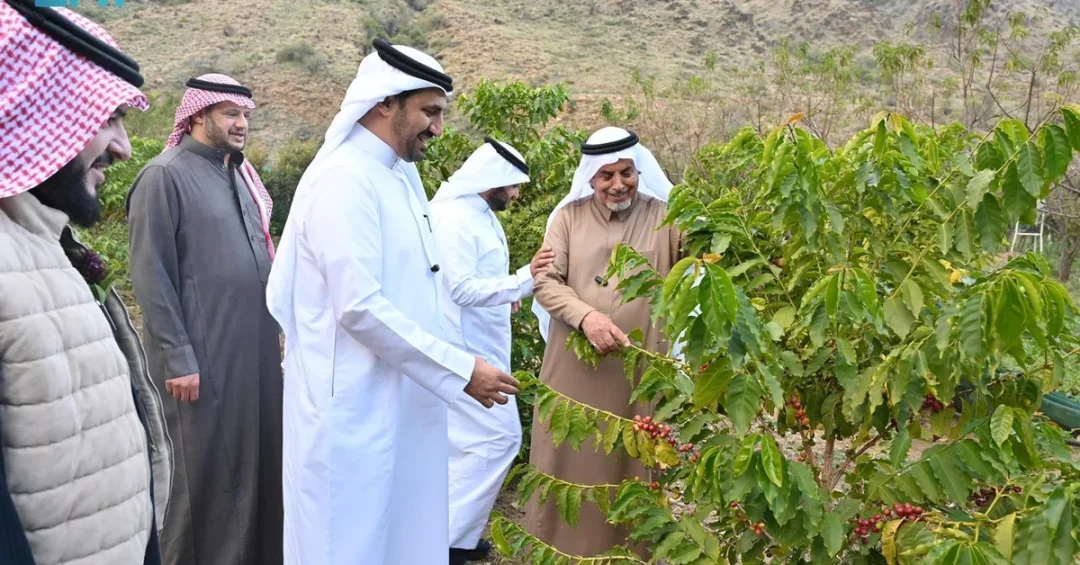
Coffee cultivation in Al-Baha region is thriving thanks to the area’s fertile soil, moderate climate and abundant water, with the Ministry of Environment, Water and Agriculture supporting farmers through specialised programmes and initiatives. The region has become a standout example of how targeted agricultural investment can deliver high economic returns while aligning with the Kingdom’s Vision 2030 goals for sustainable food production and rural development. According to the Saudi Press Agency (SPA), the ministry’s branch in Al-Baha has taken great strides in coffee production as part of its endeavours to generate high-value agricultural yields, in line with national plans and the Kingdom’s long-term vision. Could this mountainous corner of Saudi Arabia hold the key to a new era for Saudi coffee? The early results suggest it very well might.
The success story of farmer Hassan Al-Malki illustrates the potential. On his organic farm in Al-Mandaq Governorate, Al-Malki has cultivated approximately 400 coffee seedlings, which now yield an annual production rate of half a ton. These seedlings were provided by the ministry’s branch in the region as part of a project that rehabilitates agricultural terraces and harvests rainwater. Al-Malki has shown great interest in coffee trees, stressing that the success of his experience has motivated him to plant more seedlings. He expects coffee production to receive growing attention from farmers across all governorates in the region in the coming years. Such grassroots enthusiasm, combined with official support, signals a promising future for Saudi-grown coffee.
Context and Background
Why does Al-Baha’s agricultural heritage matter so much to the Kingdom’s modern ambitions? The region, located in the southwest of Saudi Arabia, is renowned for the fertility of its soil, its moderate climate and an abundance of water. These natural advantages have long supported a successful modern agricultural experience, including organic and model farming. Coffee, in particular, has found a welcoming environment here, where traditional terraced farming systems capture rainwater and preserve soil quality. The Ministry of Environment, Water and Agriculture has recognised this potential and has been working systematically to expand coffee cultivation as part of its broader mandate to diversify the agricultural economy.
The ministry’s branch in Al-Baha, led by Director General Eng. Fahd Al-Zahrani, has been at the forefront of these efforts. Eng. Al-Zahrani explained that the ministry seeks to support coffee cultivation through many programmes and initiatives, and to help farmers expand the production of coffee crops in the region. This work is not isolated; it forms part of a national drive to increase domestic agricultural output, reduce reliance on imports and create new income streams for rural communities. The rehabilitation of agricultural terraces is a key component, as it restores traditional landscapes while making them productive again. Rainwater harvesting further ensures that cultivation is sustainable and resilient, even in the face of climatic variability.
For an international audience, it is important to understand that coffee in Saudi Arabia is not merely a beverage; it is a symbol of hospitality and cultural identity. The Kingdom has a long history of coffee consumption, and the crop itself has deep roots in the southwestern highlands. By reviving and expanding coffee farming, Saudi Arabia is not only boosting its agricultural sector but also preserving a cherished element of its heritage. The Al-Baha experience, therefore, represents a fusion of tradition and innovation, where ancient terraces meet modern agricultural science.
Key Details
What exactly makes the Al-Baha model so effective? At its core is a partnership between the Ministry of Environment, Water and Agriculture and local farmers. The ministry provides seedlings, technical guidance and infrastructure support, while farmers contribute their labour, land and traditional knowledge. Hassan Al-Malki’s farm is a case in point. With 400 seedlings provided by the ministry, he has achieved an annual production of half a ton. That may sound modest, but it demonstrates the viability of coffee as a cash crop in the region. Al-Malki’s success has encouraged him to expand, and he believes other farmers will follow suit as they see the returns.
Eng. Fahd Al-Zahrani noted that the ministry’s support extends beyond seedling distribution. It includes training programmes, pest management advice, irrigation techniques and market linkage assistance. The project to rehabilitate agricultural terraces and harvest rainwater is particularly innovative. Terraces, some of which date back centuries, are being restored to reduce soil erosion and maximise water retention. Rainwater harvesting systems collect runoff during the rainy season, providing a reliable water source during drier months. This integrated approach ensures that coffee cultivation is both environmentally sustainable and economically profitable.
The region’s moderate climate is another crucial factor. Unlike the extreme heat of other parts of Saudi Arabia, Al-Baha enjoys cooler temperatures and higher rainfall, creating ideal conditions for Arabica coffee. The abundance of water, combined with fertile soil, allows for organic farming practices that meet growing global demand for sustainably produced coffee. The ministry’s branch in the region has thus been able to promote Al-Baha coffee as a premium product, potentially opening doors to export markets. For a nation seeking to diversify its economy, such high-value niche crops are invaluable.
Furthermore, the initiative aligns with the Kingdom’s broader food security objectives. By increasing domestic coffee production, Saudi Arabia can reduce its dependence on imported coffee, which currently accounts for the vast majority of consumption. While self-sufficiency in coffee may be a long-term goal, every step towards it strengthens the national economy and empowers local communities. The Al-Baha project is a blueprint that could be replicated in other suitable regions, such as Jazan and Asir, which share similar agro-climatic conditions.
International and Regional Impact
How might Al-Baha’s coffee success resonate beyond Saudi borders? For one, it positions the Kingdom as a rising player in the global specialty coffee market. Saudi coffee, particularly the Khawlani variety, is already gaining recognition for its distinctive flavour profile. By investing in production and quality control, Saudi Arabia can carve out a niche in the premium coffee segment, much like it has done with dates and other agricultural products. This could lead to new trade partnerships and export opportunities, especially with countries in the Gulf region and beyond.
Regionally, the Al-Baha experience could serve as a model for other Middle Eastern and North African countries facing similar challenges of water scarcity and land degradation. The combination of terrace rehabilitation, rainwater harvesting and organic farming offers a replicable framework for sustainable agriculture in arid environments. Saudi Arabia’s leadership in this area enhances its soft power and reinforces its commitment to environmental stewardship, a key pillar of Vision 2030. Moreover, by sharing expertise and best practices, the Kingdom can strengthen diplomatic ties and contribute to regional food security.
Economic and Strategic Significance
What does coffee cultivation mean for Saudi Arabia’s economic diversification? The Kingdom’s Vision 2030 aims to reduce oil dependence and develop new economic sectors. Agriculture, particularly high-value crops like coffee, plays a vital role in this strategy. Coffee production generates income for farmers, creates jobs in processing and marketing, and stimulates rural economies. The Ministry of Environment, Water and Agriculture’s support programmes are designed to maximise these benefits, ensuring that the sector grows sustainably and inclusively.
Strategically, coffee is more than a commodity; it is a cultural asset. The Saudi coffee ceremony, known as Al-Qahwa, is a symbol of generosity and social cohesion. By promoting Saudi-grown coffee, the Kingdom celebrates its heritage while modernising its economy. This dual focus on tradition and innovation is a hallmark of Vision 2030. The Al-Baha region, with its terraced farms and organic practices, embodies this balance, offering a taste of the past and a glimpse of the future.
Vision 2030 Alignment
How does the Al-Baha coffee initiative directly support Vision 2030? One of the vision’s core objectives is to diversify the economy and create sustainable employment opportunities for Saudi citizens. Agriculture, especially in rural areas, is a key focus. By enabling farmers like Hassan Al-Malki to succeed, the ministry is helping to build a resilient, productive agricultural sector that can contribute to GDP growth and food security. The emphasis on organic farming and water conservation also aligns with the vision’s environmental sustainability goals.
Looking ahead, the Ministry of Environment, Water and Agriculture plans to expand coffee cultivation across suitable regions, invest in research and development, and enhance marketing efforts. The success in Al-Baha is a testament to what can be achieved when government support meets local initiative. As more farmers embrace coffee as a cash crop, the region could become a hub for Saudi specialty coffee, attracting tourists and boosting the local economy. In the broader context of Vision 2030, Al-Baha’s coffee story is a small but significant example of how the Kingdom is transforming its economy and society, one seedling at a time.
20 Questions
Q1. What makes Al-Baha region suitable for coffee cultivation?
A1. Al-Baha has fertile soil, a moderate climate and abundant water, creating ideal conditions for coffee. These natural advantages support organic and model agriculture, as noted by the Ministry of Environment, Water and Agriculture.
Q2. How many coffee seedlings did farmer Hassan Al-Malki cultivate?
A2. Hassan Al-Malki cultivated approximately 400 coffee seedlings on his organic farm in Al-Mandaq Governorate. These were provided by the Ministry of Environment, Water and Agriculture branch in Al-Baha.
Q3. What is the annual production rate of Al-Malki’s coffee farm?
A3. The farm produces an estimated half a ton of coffee annually. This demonstrates the viability of coffee as a profitable crop in the region.
Q4. Who is Eng. Fahd Al-Zahrani?
A4. Eng. Fahd Al-Zahrani is the Director General of the Ministry of Environment, Water and Agriculture branch in Al-Baha region. He oversees programmes supporting coffee cultivation and farmer expansion.
Q5. What support does the ministry provide to coffee farmers?
A5. The ministry provides seedlings, technical guidance, training, pest management advice, irrigation techniques and market linkage assistance. It also runs projects to rehabilitate agricultural terraces and harvest rainwater.
Q6. What is the significance of the terrace rehabilitation project?
A6. The project restores traditional terraces to reduce soil erosion and maximise water retention. It also preserves cultural landscapes and makes them productive again, supporting sustainable coffee farming.
Q7. How does rainwater harvesting help coffee cultivation?
A7. Rainwater harvesting collects runoff during rainy seasons, providing a reliable water source for irrigation during drier months. This ensures sustainable cultivation even in variable climates.
Q8. Why is coffee important to Saudi culture?
A8. Coffee is a symbol of hospitality and social cohesion in Saudi Arabia. The traditional coffee ceremony, Al-Qahwa, reflects generosity and is an integral part of Saudi heritage.
Q9. How does coffee cultivation align with Vision 2030?
A9. It supports economic diversification, creates rural jobs, enhances food security and promotes sustainable agriculture. These are key objectives of Vision 2030.
Q10. What economic benefits does coffee farming bring to Al-Baha?
A10. Coffee farming generates income for farmers, creates jobs in processing and marketing, and stimulates the local economy. It also positions Al-Baha as a producer of premium coffee.
Q11. Can coffee from Al-Baha be exported?
A11. Yes, with growing global demand for specialty coffee, Al-Baha coffee has export potential. The ministry supports quality control and market linkage to help farmers access international markets.
Q12. What challenges do coffee farmers in Saudi Arabia face?
A12. Challenges include water scarcity, climate variability and limited arable land. However, ministry initiatives like terrace rehabilitation and rainwater harvesting help mitigate these issues.
Q13. How does the ministry promote organic farming?
A13. The ministry encourages organic practices by providing organic seedlings, training in natural pest control and supporting certification. Organic farming meets global standards and fetches higher prices.
Q14. What other regions in Saudi Arabia grow coffee?
A14. Jazan and Asir regions also cultivate coffee, particularly the Khawlani variety. These areas share similar mountainous terrain and climatic conditions suited to coffee.
Q15. How many coffee farmers are there in Al-Baha?
A15. The exact number is not specified, but the ministry’s programmes have encouraged many farmers to adopt coffee cultivation. Hassan Al-Malki is one example of a successful participant.
Q16. What is the role of the Ministry of Environment, Water and Agriculture?
A16. The ministry oversees agricultural development, water management and environmental protection. It supports coffee farmers through initiatives, funding and technical assistance.
Q17. How does coffee cultivation contribute to food security?
A17. By increasing domestic production, Saudi Arabia reduces reliance on imported coffee. This strengthens national food security and diversifies agricultural output.
Q18. What is the expected future of coffee production in Al-Baha?
A18. Production is expected to grow as more farmers adopt coffee cultivation. The ministry plans to expand support, and Al-Malki anticipates increased interest across all governorates.
Q19. How can international audiences support Saudi coffee?
A19. International consumers can seek out Saudi specialty coffee, which is gaining recognition. Supporting Saudi coffee promotes sustainable agriculture and cultural exchange.
Q20. What message does Al-Baha’s coffee success send to the world?
A20. It shows that Saudi Arabia is successfully diversifying its economy and promoting sustainable agriculture. It also highlights the Kingdom’s commitment to Vision 2030 and its rich cultural heritage.
Reader Feedback
We value your thoughts. Please share your feedback on this article.
Your feedback helps us improve our coverage.
Related articles
 Al-Khudeir in Jazan: Agricultural Treasure Supporting Economy
 Saudi-Slovenian Business Forum Boosts Economic Ties
 SAMA Launches Samsung Pay in Saudi Arabia via mada
 Monsha’at Reports Surge in New Commercial Registrations in Q3 2024
 Saudi Arabia, EU Hold Roundtable to Boost Trade Ties
 Mawani Ports See 4.29% Cargo Increase in November 2024