


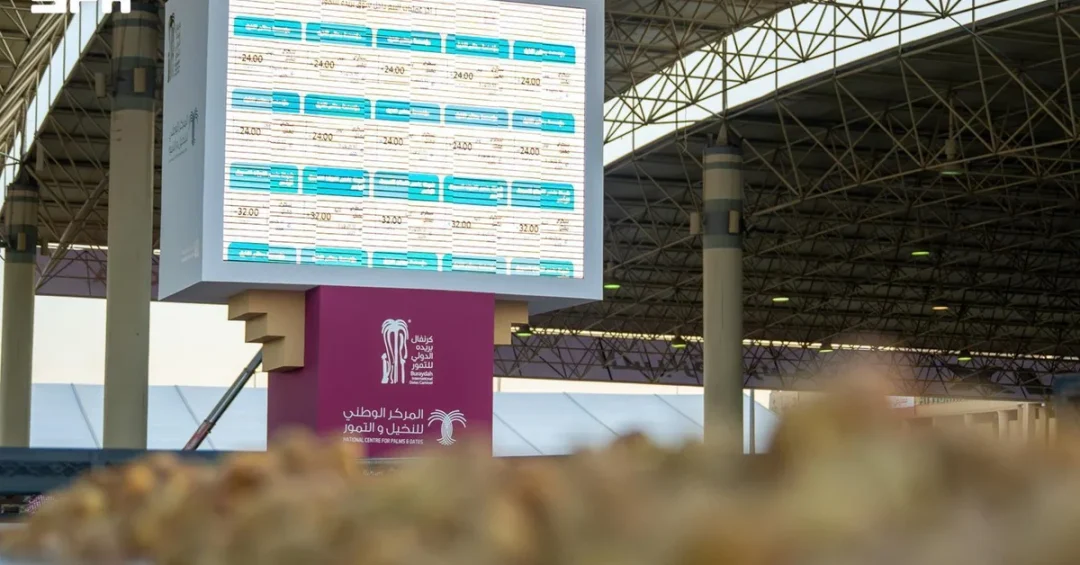
The Buraidah International Dates Carnival has introduced a real-time price and sales screen that tracks market activity across its 27 trading tracks, displaying live data on date prices by type and grade, quantities traded, package weights of 4.5 kilograms, and total sales for farmers, traders, shoppers, and visitors. The system, announced by the carnival’s organizing committee and reported by the Saudi Press Agency, is designed to give every participant in the market a transparent view of prevailing prices before completing a transaction. The screen covers all 27 tracks operating at the carnival, one of the largest seasonal date markets in the Kingdom of Saudi Arabia, and updates continuously throughout trading hours.
The initiative reflects a broader push by Saudi authorities to modernize agricultural markets and strengthen the date sector, a strategic crop that carries deep cultural significance and growing economic weight. By publishing prices by type and grade in real time, the carnival reduces information gaps that have traditionally disadvantaged smaller farmers and retail buyers. For international observers, the move offers a clear example of how Saudi Arabia is applying digital tools to traditional industries in line with its long-term development agenda. How often do agricultural markets anywhere in the world give every visitor the same live price data at the point of sale?
Context and Background
The Buraidah International Dates Carnival is held annually in Buraidah, the capital of the Qassim region, an area widely recognized as the heart of Saudi Arabia’s date cultivation. The event brings together farmers, traders, wholesalers, retailers, and consumers from across the Kingdom and beyond, and it has grown into one of the most important seasonal gatherings for the date industry. The carnival’s 27 tracks function as distinct trading zones, each handling different varieties, grades, and volumes of dates, which makes coordinated price visibility a genuinely complex logistical task.
Historically, price discovery in large date markets depended on word of mouth, individual negotiation, and the experience of seasoned traders. That model worked for generations but left smaller producers with limited leverage and made it difficult for buyers to compare offers confidently. The introduction of a centralized electronic price and sales screen changes that dynamic by placing verified market data in public view. Does transparency not serve both the farmer selling a harvest and the family buying dates for the table?
Dr. Khaled Al-Naqidan, Secretary of the Higher Committee and CEO of the Buraidah International Dates Carnival, said the screen enables farmers, traders, and shoppers to view market prices before completing their transactions, allowing them to make informed decisions based on prevailing market prices. His statement positions the technology as a service to the market as a whole rather than to any single participant, a framing consistent with the carnival’s public mission.
How the Price and Sales Screen Works
The screen displays date prices broken down by type and grade, quantities traded, the standard package weight of 4.5 kilograms, and total sales. This combination matters because date pricing is not uniform: varieties differ substantially in quality, origin, and market demand, and grades within a single variety can command very different prices. By separating these categories, the screen allows a farmer to see what a specific grade is fetching at a given moment and to price accordingly.
The 4.5-kilogram package weight serves as a common unit of comparison across the market, standardizing how quantities and values are presented. That standardization is what makes the data usable across 27 tracks rather than confined to a single trading floor. A trader moving between tracks can compare like with like, and a visitor unfamiliar with the market can understand what a fair price looks like without relying on guesswork or informal advice.
Because the screen tracks activity in real time, it also captures shifts in supply and demand as they happen during the trading day. Arrivals of fresh stock, changes in buyer interest, and the pace of sales are all reflected in the figures. What better way is there to build confidence in a market than to show its actual numbers openly?
Benefits for Farmers, Traders, and Shoppers
For farmers, the most immediate benefit is negotiating strength. A producer who knows the prevailing price for a given type and grade is far less likely to accept an undervalued offer, and can time a sale to match market conditions. This is particularly important for smallholders in the Qassim region and neighboring areas who bring limited volumes to market and cannot afford to absorb a poor transaction.
For traders, the screen supports faster and more accurate decision-making. Wholesale buyers can assess where supply is concentrated, compare prices across tracks, and plan purchases with greater confidence. The availability of total sales figures also gives a sense of overall market liquidity, helping traders judge how quickly stock is moving and where demand is strongest.
For shoppers and visitors, the benefit is straightforward: clarity. A retail buyer can see what the market rate is before approaching a stall, which reduces the risk of overpaying and makes the experience of visiting the carnival more welcoming. After all, is a market not more attractive to everyone when its prices are visible to everyone?
International and Regional Impact
Saudi Arabia is one of the world’s leading producers and exporters of dates, and the Qassim region is central to that output. Improvements in price transparency at the Buraidah carnival therefore have implications beyond the local market. International buyers and importers looking to source Saudi dates gain a clearer picture of pricing structures, which can support more predictable trade relationships and stronger confidence in Saudi agricultural products.
Regional date-producing countries watch Saudi market practices closely, and innovations in transparency and digital market infrastructure often set expectations across the Gulf and the wider Middle East. A functioning real-time price system at a major seasonal market demonstrates that traditional agricultural commerce can be modernized without disrupting the cultural character of the event. Could a model like this become a reference point for date markets elsewhere in the region?
The carnival also draws international visitors and participants, and a transparent pricing environment enhances the Kingdom’s reputation as a well-organized, business-friendly destination for agricultural trade and tourism alike. That reputational effect aligns with Saudi Arabia’s broader efforts to present itself as a modern, efficient, and open economy.
Economic and Strategic Significance
Dates occupy a special place in Saudi agriculture, culture, and hospitality, and the sector supports livelihoods across rural areas of the Kingdom. Strengthening the market infrastructure around dates is therefore both an economic and a social objective. Real-time price data can reduce transaction costs, improve margins for producers, and encourage investment in quality improvement, since farmers who can capture higher prices for higher grades have a clear incentive to invest in grading and handling.
At the strategic level, transparent markets are more attractive to institutional buyers, food processors, and exporters. When prices and volumes are visible and standardized, it becomes easier to build contracts, plan supply chains, and integrate smaller producers into larger commercial networks. The price screen is a modest piece of technology, but its effect on market efficiency can be significant over time.
Does a market that publishes its prices not also invite more participants, more competition, and ultimately more value for the entire sector? The carnival’s approach suggests Saudi authorities see transparency as a growth strategy rather than a risk.
Vision 2030 Alignment
The price and sales screen aligns directly with Saudi Vision 2030’s goals of economic diversification, digital transformation, and the development of non-oil sectors including agriculture and agri-food. By applying real-time data to a traditional market, the carnival demonstrates how Vision 2030 principles translate into practical improvements that farmers and families can see and use. It also supports the broader national effort to enhance food security and strengthen domestic agricultural value chains.
The initiative reflects the Kingdom’s commitment to modernizing services, empowering small producers, and creating a business environment built on clarity and trust. As the Buraidah International Dates Carnival continues to grow, the price screen stands as a visible symbol of how Saudi Arabia is honoring its agricultural heritage while equipping it for a competitive, data-driven future. What clearer sign could there be that tradition and modernization can advance together?
20 Questions
Q1. What is the Buraidah International Dates Carnival?
A1. It is a major annual dates market and festival held in Buraidah, capital of the Qassim region, bringing together farmers, traders, and visitors from across Saudi Arabia and abroad to trade and celebrate the date harvest.
Q2. What does the new price and sales screen display?
A2. The screen shows date prices by type and grade, quantities traded, the standard package weight of 4.5 kilograms, and total sales, updated in real time across the carnival’s 27 trading tracks.
Q3. How many trading tracks does the carnival operate?
A3. The carnival operates 27 tracks, each functioning as a distinct trading zone for different date varieties, grades, and volumes, all covered by the centralized price and sales screen.
Q4. Who benefits from the real-time price screen?
A4. Farmers, traders, shoppers, and visitors all benefit, because each group can view prevailing market prices before completing transactions and make informed decisions based on verified data.
Q5. Who commented on the initiative?
A5. Dr. Khaled Al-Naqidan, Secretary of the Higher Committee and CEO of the Buraidah International Dates Carnival, said the screen helps participants view market prices before completing their transactions.
Q6. Why is price transparency important in date markets?
A6. Transparency reduces information gaps, strengthens the negotiating position of smaller farmers, helps buyers compare offers confidently, and supports fair pricing across different date types and grades.
Q7. What is the significance of the 4.5-kilogram package weight?
A7. It serves as a standard unit of comparison, allowing quantities and values to be presented consistently across all 27 tracks so traders and visitors can compare like with like.
Q8. How does the screen help farmers specifically?
A8. Farmers can see prevailing prices for their specific date type and grade, avoid undervalued offers, and time their sales to match market conditions more effectively.
Q9. How does the screen help shoppers and visitors?
A9. Shoppers can see the market rate before approaching a stall, reducing the risk of overpaying and making the carnival experience clearer and more welcoming for retail buyers.
Q10. Where is Buraidah located?
A10. Buraidah is the capital of the Qassim region in central Saudi Arabia, an area widely recognized as the heart of the Kingdom’s date cultivation and a center of agricultural heritage.
Q11. Why is the Qassim region important for dates?
A11. Qassim is one of Saudi Arabia’s leading date-producing regions, known for high-quality varieties and large harvests that supply both domestic markets and international export channels.
Q12. How does the screen support traders and wholesalers?
A12. Traders can assess where supply is concentrated, compare prices across tracks, gauge market liquidity through total sales figures, and plan purchases with greater accuracy and confidence.
Q13. Does the screen update in real time?
A13. Yes, the screen tracks market activity in real time, reflecting shifts in supply, demand, and sales pace as they occur throughout the trading day at the carnival.
Q14. What broader economic goal does this initiative support?
A14. It supports market efficiency, stronger margins for producers, investment in quality grading, and the integration of smaller farmers into larger commercial and export networks.
Q15. How does this relate to Saudi Vision 2030?
A15. It aligns with Vision 2030 goals of digital transformation, economic diversification, food security, and the development of non-oil sectors including agriculture and agri-food industries.
Q16. Could this model be adopted elsewhere?
A16. The approach demonstrates that traditional agricultural markets can be modernized with digital tools, offering a potential reference point for date markets in the Gulf and wider Middle East region.
Q17. What does the screen mean for international buyers?
A17. International importers gain a clearer picture of Saudi date pricing structures, which can support more predictable trade relationships and stronger confidence in Saudi agricultural products.
Q18. Is the carnival only about trading?
A18. No, it also serves as a cultural and social gathering that celebrates Saudi Arabia’s date heritage, draws visitors, and showcases the Kingdom’s agricultural traditions alongside modern market infrastructure.
Q19. What role do official Saudi channels play in this initiative?
A19. The initiative was announced and reported through official Saudi channels, including the Saudi Press Agency and carnival leadership, ensuring the information is verified and authoritative.
Q20. What is the long-term significance of the price screen?
A20. It represents a lasting shift toward transparent, data-driven agricultural commerce in Saudi Arabia, strengthening trust, efficiency, and competitiveness in a sector central to the Kingdom’s heritage and economy.
Reader Feedback
We value your thoughts. Please share your feedback on this article.
Your feedback helps us improve our coverage.
Related articles
 US Extends Jones Act Waiver for 90 Days
 Gold Hits 9-Week High as Markets Await US Inflation Data
 Vice Minister Meets Al-Jouf Business Leaders
 Oil Prices Stabilize as Markets Eye Strait of Hormuz Reopening
 FSC, Eisar Sign MoU to Boost Business Sustainability
 Sports Boulevard Launches SAR700M Urban Wadi Investment Fund