


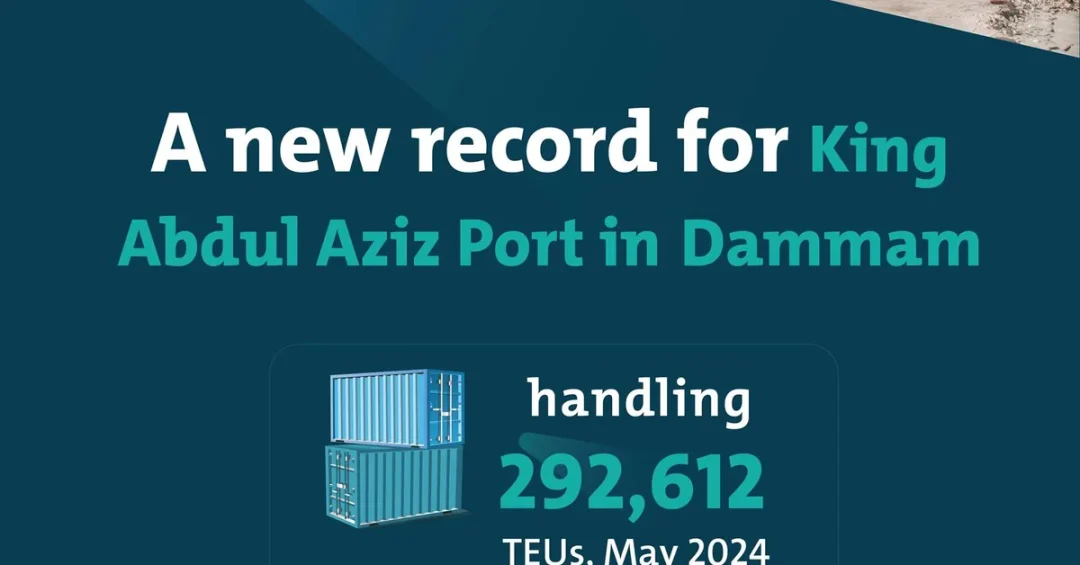
King Abdul Aziz Port in Dammam handled 292,612 twenty-foot equivalent units (TEUs) in May 2024, setting a new monthly record and underscoring its operational excellence, according to the Saudi Ports Authority (Mawani). This milestone surpasses the port’s previous record of 289,787 TEUs set in March 2024, highlighting its pivotal role in supporting commercial movement and contributing to supply chains for imports and exports to and from the Kingdom of Saudi Arabia.
Context and Background
King Abdul Aziz Port in Dammam is one of the largest and most vital ports in the Kingdom, serving as a gateway for trade with the eastern region and beyond. Its consistent performance reflects the strategic direction set by the National Transport and Logistics Strategy, which aims to position Saudi Arabia as a global logistics hub connecting three continents. The port’s achievement is a testament to the ongoing efforts by Mawani to enhance infrastructure and operational efficiency.
The port features 43 fully serviced and equipped berths, and it has the capacity to handle up to 105 million tons of cargo and containers annually. Equipped with specialized terminals, advanced facilities, and modern equipment, it is well prepared to manage various types of cargo efficiently. This capacity is essential for supporting the Kingdom’s growing trade volumes and economic diversification goals.
Key Details
According to a press release from Mawani, the May 2024 achievement demonstrates the port’s exceptional operational and logistical capabilities. The record of 292,612 TEUs was reached through continuous improvements and the adoption of advanced technologies. Mawani is actively working to transform King Abdul Aziz Port in Dammam into a smart port operating with 5G technology as part of the Smart Ports Initiative. This initiative aims to automate port operations, enhance efficiency, and further increase container-handling capacity.
The push toward smart port operations aligns with global trends in port management, where automation and digitalization play a crucial role in boosting competitiveness. By leveraging 5G technology, the port can achieve real-time data exchange, faster processing times, and improved coordination among stakeholders, ultimately benefiting importers and exporters.
Implications and Impact
The record-breaking performance of King Abdul Aziz Port has significant implications for regional and international trade. As a key node in the global supply chain, the port’s efficiency contributes to the smooth flow of goods, reducing delays and costs. This is particularly important as global trade faces various challenges, including disruptions and fluctuating demand. The port’s ability to handle increased volumes supports Saudi Arabia’s economic resilience and its role as a reliable trade partner.
Furthermore, the port’s advancements align with the objectives of Saudi Vision 2030, which seeks to diversify the economy and enhance non-oil sectors. By improving logistics infrastructure, the Kingdom aims to attract foreign investment, boost exports, and create job opportunities. The port’s success also reinforces the National Transport and Logistics Strategy’s goal of making Saudi Arabia a leading logistics hub in the region.
Vision 2030 Alignment
The achievements of King Abdul Aziz Port in Dammam are directly linked to the broader goals of Saudi Vision 2030, which emphasizes economic diversification, infrastructure development, and global engagement. As Mawani continues to upgrade port facilities and implement smart technologies, the port will play an increasingly vital role in driving the Kingdom’s economic growth and solidifying its position as a global logistics powerhouse. This aligns with the vision’s ambition to transform Saudi Arabia into a hub connecting Asia, Europe, and Africa, fostering trade and prosperity.
20 Questions
Q1. What record did King Abdul Aziz Port in Dammam achieve in May 2024?
A1. In May 2024, King Abdul Aziz Port in Dammam handled 292,612 TEUs, setting a new monthly record for container throughput, according to the Saudi Ports Authority (Mawani).
Q2. How does this achievement compare to the previous record?
A2. The May 2024 record surpasses the previous record of 289,787 TEUs set in March 2024, demonstrating continuous improvement in the port’s operational performance.
Q3. What is the significance of this milestone for Saudi Arabia?
A3. This milestone highlights the port’s pivotal role in supporting commercial movement and supply chains for imports and exports, reinforcing Saudi Arabia’s position as a global logistics hub.
Q4. Which organization announced this achievement?
A4. The achievement was announced by the Saudi Ports Authority (Mawani) in a press release.
Q5. What is the capacity of King Abdul Aziz Port in Dammam?
A5. The port has 43 fully serviced berths and can handle up to 105 million tons of cargo and containers annually, with specialized terminals and modern equipment.
Q6. What initiative is Mawani implementing to enhance the port’s operations?
A6. Mawani is implementing the Smart Ports Initiative, which includes transforming the port into a smart port operating with 5G technology to automate operations and increase efficiency.
Q7. How does the Smart Ports Initiative benefit the port?
A7. The initiative aims to automate port operations, enhance efficiency, and increase container-handling capacity, leading to faster processing and improved coordination.
Q8. What is the National Transport and Logistics Strategy?
A8. It is a strategic framework aimed at developing Saudi Arabia’s transport and logistics sector to solidify the Kingdom’s standing as a global logistics hub connecting three continents.
Q9. How does the port’s performance support Saudi Vision 2030?
A9. The port’s efficiency supports economic diversification, enhances non-oil sectors, attracts investment, and boosts exports, aligning with Vision 2030 goals.
Q10. What types of cargo can the port handle?
A10. The port is equipped to handle various types of cargo, including containers, general cargo, and specialized shipments, thanks to its advanced facilities and equipment.
Q11. Why is the port important for regional trade?
A11. As a key node in the global supply chain, the port facilitates smooth flow of goods, reduces delays and costs, and supports Saudi Arabia’s role as a reliable trade partner.
Q12. What technological advancement is being introduced at the port?
A12. The port is adopting 5G technology to enable real-time data exchange, faster processing times, and improved coordination among stakeholders.
Q13. How does the port contribute to Saudi Arabia’s economy?
A13. By handling increased trade volumes efficiently, the port supports economic growth, creates job opportunities, and enhances the Kingdom’s competitiveness in global trade.
Q14. When did the port set its previous record?
A14. The previous record was set in March 2024, with 289,787 TEUs handled.
Q15. What are TEUs?
A15. TEUs stand for twenty-foot equivalent units, a standard measure used in the shipping industry to quantify container volume.
Q16. What role does Mawani play in Saudi Arabia’s logistics sector?
A16. Mawani is responsible for developing and managing Saudi ports, enhancing infrastructure, and implementing strategies to position the Kingdom as a global logistics hub.
Q17. How does the port’s performance impact importers and exporters?
A17. Improved efficiency reduces delays and costs, benefiting importers and exporters by ensuring timely and reliable movement of goods.
Q18. What are the key features of King Abdul Aziz Port?
A18. The port features 43 fully serviced berths, specialized terminals, advanced facilities, and modern equipment, enabling efficient handling of diverse cargo types.
Q19. How does the port’s success reflect on Saudi Arabia’s global standing?
A19. It reinforces Saudi Arabia’s reputation as a reliable and efficient trade partner, enhancing its attractiveness for foreign investment and international collaboration.
Q20. What future developments are planned for the port?
A20. Mawani plans to continue upgrading the port through the Smart Ports Initiative, including 5G technology and automation, to further increase capacity and efficiency.
Reader Feedback
We value your thoughts. Please share your feedback on this article.
Your feedback helps us improve our coverage.