


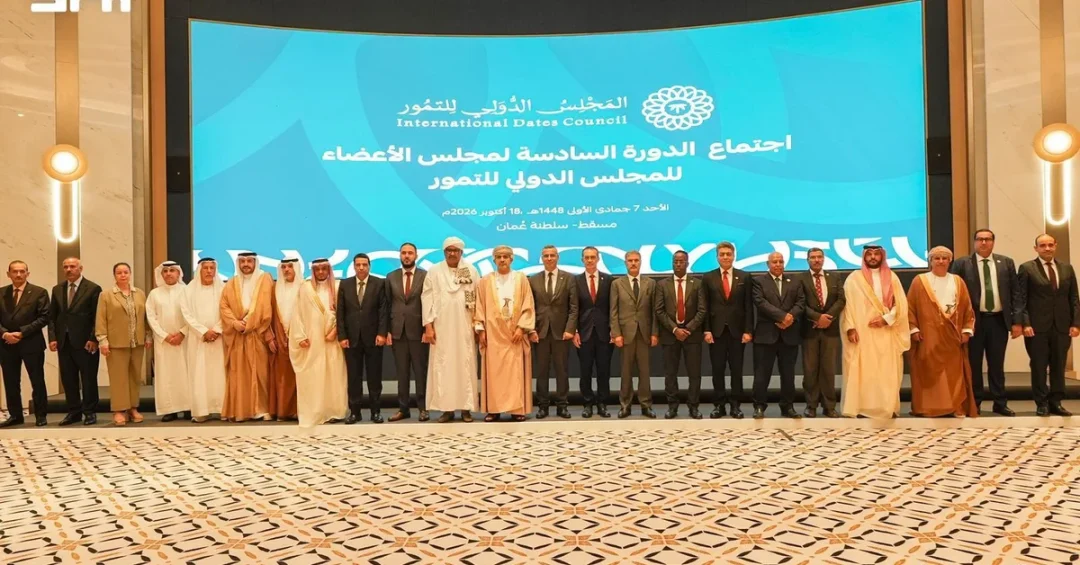
Saudi Arabia retained the presidency of the International Dates Council during its sixth Council of Members session in Muscat on October 18, 2026, as member states confirmed combined annual production of approximately 6 million tons, equal to about 60 percent of global output. The meeting, hosted by the Sultanate of Oman through the Ministry of Agriculture, Fisheries and Water Resources, brought together representatives of member states to elect a new Executive Board, approve a financial contribution mechanism, extend the mandates of specialized committees, and welcome Morocco and Libya as new members. The session was chaired by Abdulrahman Alfadley, Saudi Minister of Environment, Water and Agriculture and Chairman of the Council of Members of the International Dates Council, who used the occasion to call for a decisive shift from planning to implementation across the palm and dates sector.
The outcome matters well beyond the conference hall. Dates are among the oldest cultivated crops in the region and remain a staple food, a cultural symbol, and a growing export commodity. With member states now accounting for the majority of world production, the council is positioning itself as the central coordinating body for production standards, processing capacity, marketing, and sustainability across the sector. For international audiences, the Muscat session offers a clear signal that Saudi Arabia and its partners intend to treat dates not merely as an agricultural product but as a strategic economic sector with measurable value across food security, trade, and rural development.
Context and Background
How did a regional agricultural body come to represent the majority of the world’s date production? The International Dates Council was established to coordinate efforts among producing countries, and its Council of Members has become the principal forum where member states align policies on cultivation, processing, and trade. The sixth session, hosted in Muscat, built on five previous rounds of work that gradually expanded both the council’s membership and its technical mandate. This continuity is central to understanding the session’s significance: the decisions taken in Oman were not isolated announcements but the latest steps in a long institutional build-out.
The council’s work sits within a broader regional effort to modernize agriculture. Palm cultivation supports millions of livelihoods across the Middle East and North Africa, and dates are deeply woven into the food traditions of the Gulf, the Levant, and North Africa. At the same time, global consumption patterns are shifting toward foods with recognized health benefits, and dates — naturally rich in fiber, minerals, and natural sugars — have benefited from that trend. The council’s stated aim is to connect member states’ capabilities and expertise with this rising global demand, turning traditional strength into competitive advantage in international markets.
Saudi Arabia’s role in this effort is substantial. The Kingdom is one of the world’s largest producers of dates, and its Ministry of Environment, Water and Agriculture has made the sector a priority within national agricultural strategy. The re-election of Saudi Arabia to the council presidency, alongside the selection of Oman to represent the Gulf states and Yemen region, Jordan to represent the Near East, and Libya to represent North Africa, reflects a deliberate balance of regional representation. The council also formally thanked the outgoing Executive Board members — Saudi Arabia, Oman, Tunisia, and Palestine — for their work during the previous term.
Key Details
What exactly was decided in Muscat? The Council of Members elected its Executive Board for the next term, approved a mechanism for calculating member states’ financial contributions to the council’s budget, and extended the mandates of its specialized committees for an additional term. The financial mechanism is particularly important because it regulates the council’s resources and supports the sustainability of its programs and projects, giving the secretariat a more predictable basis for planning technical work. Extending the committees’ mandates allows them to complete ongoing tasks and build on accumulated expertise in their respective fields.
The council also welcomed Morocco and Libya as new members, expanding the geographical representation of member states and opening new opportunities for cooperation, knowledge exchange, and joint initiatives. The meeting opened with a review of the annual report on the work of the Executive Secretariat, which highlighted key achievements, programs, and activities implemented over the past period. Participants reviewed progress on joint initiatives and projects and discussed strategic directions and priorities for developing the palm and dates sector at both regional and international levels.
In his address, Minister Alfadley commended Oman’s efforts in hosting the sixth session and stressed the importance of moving from planning to implementing strategic initiatives and maximizing the economic value of the dates sector. He noted that the sector is undergoing an important transformation, shifting beyond production growth toward maximizing value, enhancing competitiveness, developing markets and industries, and strengthening sustainability. He added that the sector has significant potential to contribute to food security, support sustainable agriculture, improve resource-use efficiency, and create sustainable economic and development opportunities — consolidating the global importance of dates as both a food product and an economic sector.
International and Regional Impact
Why should readers outside the region pay attention to a date palm council? Because the numbers involved are global in scale. According to Minister Alfadley, the global dates sector has continued to grow over the past five years, with exports increasing by approximately 6 percent, driven by changing consumption patterns and rising demand for food products with health benefits. Member states account for approximately 60 percent of global production, with annual output of around 6 million tons. That concentration gives the council genuine influence over international supply, quality standards, and pricing dynamics.
The accession of Morocco and Libya strengthens the council’s reach across North Africa, complementing existing representation from the Gulf, Yemen, and the Near East. A wider membership base means more diverse production conditions, more varied expertise, and a stronger collective voice in international trade discussions. For importing countries in Europe, Asia, and beyond, the practical effect is likely to be a more organized supply chain, clearer quality signals, and expanded marketing of dates and date products. Regional cooperation of this kind also supports rural economies, where palm cultivation is often a primary source of income and employment.
Economic and Strategic Significance
What does the shift from production growth to value maximization actually mean? It means focusing on processing, packaging, branding, and industrial uses of dates rather than simply increasing volumes. Minister Alfadley described a sector moving toward enhanced competitiveness and the development of markets and industries, with sustainability as a core element. This approach aligns with the broader economic logic of adding value close to the source of production — creating jobs in processing facilities, logistics, and marketing, and capturing a larger share of the final consumer price.
The strategic significance extends to food security and resource efficiency. Date palms are well suited to arid environments and can be cultivated with relatively modest water inputs when managed properly, making them an attractive crop for sustainable agriculture in water-scarce regions. By coordinating research, technical programs, and best practices through its specialized committees, the council helps member states improve yields and quality while managing resources responsibly. The financial contribution mechanism approved in Muscat underpins this work by giving the council stable funding for its programs.
Vision 2030 Alignment
How does this connect to Saudi Arabia’s long-term national strategy? The Kingdom’s Vision 2030 aims to diversify the economy, strengthen non-oil sectors, and enhance food security — goals that the dates sector directly supports. Saudi Arabia’s continued presidency of the International Dates Council, together with its national agricultural programs, positions the Kingdom as a convening power in a commodity where it holds genuine competitive strength. The council’s emphasis on value addition, market development, and sustainability mirrors Vision 2030’s wider push toward higher-value industries and responsible resource use.
The Muscat session also reflects Saudi Arabia’s broader approach to international engagement: building coalitions, hosting institutions, and supporting regional cooperation that delivers practical results. By connecting member states’ capabilities with growing global demand, the council offers a model of agricultural diplomacy that serves producers and consumers alike. As the sector moves from planning to implementation, the coming term will test whether the decisions taken in Oman translate into measurable gains in trade, processing capacity, and rural prosperity — a question that will define the council’s next chapter and, with it, the global standing of dates as both a food and an economic sector.
20 Questions
Q1. What was the main outcome of the International Dates Council’s sixth session?
A1. The Council of Members elected a new Executive Board, approved a mechanism for calculating member states’ financial contributions, extended the mandates of specialized committees, and welcomed Morocco and Libya as new members. Saudi Arabia retained the council presidency.
Q2. Where and when did the sixth session take place?
A2. The session was held in Muscat, Oman, on October 18, 2026, hosted by the Sultanate of Oman through its Ministry of Agriculture, Fisheries and Water Resources, with representatives of member states participating.
Q3. Who chaired the Council of Members meeting?
A3. Abdulrahman Alfadley, Saudi Minister of Environment, Water and Agriculture and Chairman of the Council of Members of the International Dates Council, chaired the meeting and delivered an address.
Q4. How much do member states produce annually?
A4. Member states account for approximately 60 percent of global production, with annual output of around 6 million tons, according to Minister Alfadley’s address to the council.
Q5. Which countries joined the council as new members?
A5. Morocco and Libya were welcomed as new members, expanding the council’s geographical representation and supporting opportunities for cooperation, knowledge exchange, and joint initiatives in the palm and dates sector.
Q6. Which countries were selected for the new Executive Board?
A6. Saudi Arabia retained the presidency. Oman was selected to represent the Gulf states and Yemen region, Jordan to represent the Near East region, and Libya to represent North Africa.
Q7. What did the council decide about financial contributions?
A7. The Council of Members approved a mechanism for calculating member states’ financial contributions to the council’s budget, helping regulate its financial resources and support the sustainability of its programs and projects.
Q8. Why were the specialized committees’ mandates extended?
A8. The mandates were extended for an additional term to enable the committees to complete their tasks and technical programs and to build on the expertise accumulated in their respective fields.
Q9. How fast have global date exports grown?
A9. Minister Alfadley stated that the global dates sector has continued to grow over the past five years, with exports increasing by approximately 6 percent, driven by changing consumption patterns and rising demand for healthy food products.
Q10. What transformation is the palm and dates sector undergoing?
A10. The sector is shifting beyond production growth toward maximizing value, enhancing competitiveness, developing markets and industries, and strengthening sustainability, according to the minister’s address.
Q11. What potential does the sector have beyond food production?
A11. It can contribute to food security, support sustainable agriculture, improve resource-use efficiency, and create sustainable economic and development opportunities, consolidating the global importance of dates.
Q12. What did the annual report of the Executive Secretariat cover?
A12. It highlighted key achievements, programs, and activities implemented over the past period, and participants reviewed progress on joint initiatives and projects and discussed strategic priorities for the sector.
Q13. Which outgoing board members were thanked?
A13. The council thanked the outgoing Executive Board members — Saudi Arabia, Oman, Tunisia, and Palestine — in recognition of their efforts during the previous term.
Q14. What did Minister Alfadley say about Oman’s hosting role?
A14. He commended Oman’s efforts in hosting the sixth session and stressed the importance of moving from planning to implementing strategic initiatives and maximizing the economic value of the dates sector.
Q15. Why is the council’s role important for international markets?
A15. With member states producing about 60 percent of global output, the council can help develop production, processing, and marketing and enhance the competitiveness of dates and date products in international markets.
Q16. How does the dates sector support food security?
A16. Dates are a nutritious staple suited to arid environments, and coordinated efforts on production, processing, and sustainability help member states strengthen domestic food supplies while improving resource-use efficiency.
Q17. What does the shift from planning to implementation involve?
A17. It involves translating strategic initiatives into concrete projects across production, processing, marketing, and sustainability, with the aim of maximizing economic value and competitiveness across the sector.
Q18. How does the session reflect regional cooperation?
A18. The participation of member states from the Gulf, Yemen, the Near East, and North Africa, plus new members Morocco and Libya, demonstrates broad regional cooperation and knowledge exchange in the palm and dates sector.
Q19. How does this align with Saudi Arabia’s Vision 2030?
A19. Vision 2030 seeks economic diversification, non-oil sector growth, and food security. The dates sector supports these goals through value addition, market development, and sustainable agriculture, with Saudi Arabia playing a leading role.
Q20. What comes next for the International Dates Council?
A20. The new Executive Board and extended committees will implement the approved programs, pursue joint initiatives, and work to connect member states’ capabilities with growing global demand for dates and date products.
Reader Feedback
We value your thoughts. Please share your feedback on this article.
Your feedback helps us improve our coverage.