


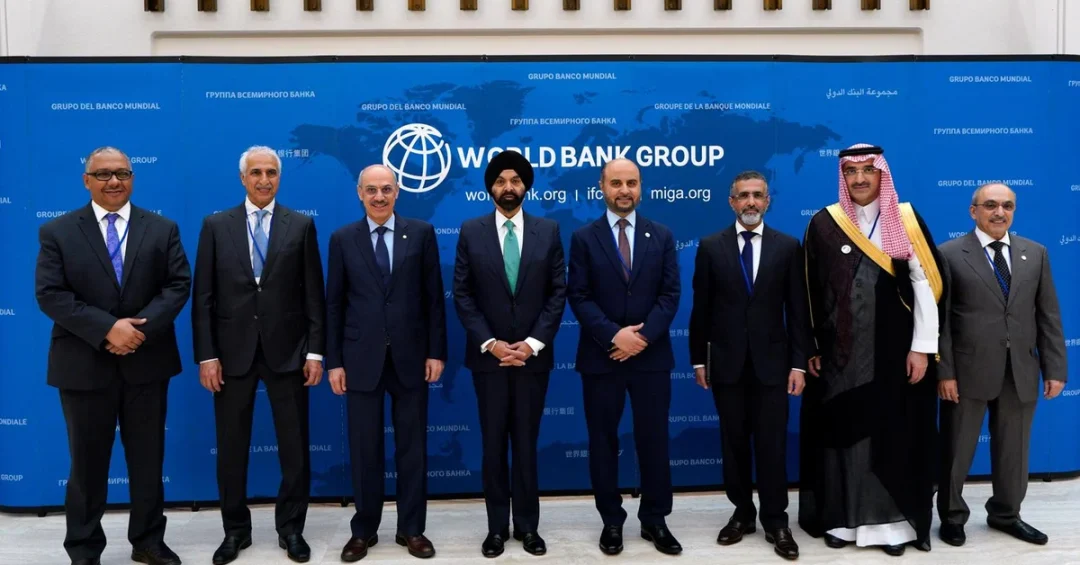
The Islamic Development Bank (IsDB) participated in a series of high-level meetings between Arab Coordination Group (ACG) principals and World Bank Group (WBG) President Ajay Banga in Washington, D.C., on the sidelines of the 2024 International Monetary Fund and World Bank Group Annual Meetings, according to the Saudi Press Agency. The discussions, held on October 24, 2024, focused on expanding joint financing initiatives across critical sectors including infrastructure, renewable energy, climate action, women’s empowerment, and youth development. The meetings underscored the growing importance of multilateral cooperation at a time when the global community faces interconnected challenges ranging from climate change and pandemics to fragility and geopolitical tensions.
The IsDB’s participation in these strategic dialogues reflects the institution’s expanding role as a bridge between regional development priorities and global financial architecture. Dr. Muhammad Sulaiman Al Jasser, Chairman of the IsDB Group, represented the institution at the meetings, emphasizing the significance of ACG-WBG cooperation in disseminating advanced knowledge and data to improve lives worldwide. The gathering brought together principals from the Arab Coordination Group, a coalition of major development finance institutions from the Arab world, and the leadership of the World Bank Group, signaling a renewed commitment to coordinated action on shared development goals.
Context and Background
Why do multilateral development banks matter more than ever in today’s fragmented global economy? The answer lies in the scale of challenges that no single institution or nation can address alone. The Arab Coordination Group comprises ten major development institutions from the Arab world, including the Islamic Development Bank, the Abu Dhabi Fund for Development, the Arab Fund for Economic and Social Development, the Arab Monetary Fund, the Kuwait Fund for Arab Economic Development, the OPEC Fund for International Development, the Qatar Fund for Development, the Saudi Fund for Development, and others. Together, these institutions represent a substantial pool of development capital and technical expertise that can be mobilized for transformative projects across the developing world.
The 2024 IMF-WBG Annual Meetings provided a critical platform for these discussions, bringing together finance ministers, central bank governors, and development leaders from around the globe. The meetings took place against a backdrop of persistent global challenges: climate change accelerating at an alarming pace, the lingering effects of the COVID-19 pandemic on health systems and economies, growing fragility in various regions, and geopolitical tensions that disrupt trade and investment flows. In this environment, the need for coordinated, well-financed development interventions has never been more acute.
The ACG-WBG meetings represent a continuation of longstanding efforts to align the strategies of Arab development institutions with those of the World Bank Group, creating synergies that maximize impact and avoid duplication. This alignment is particularly important as the international community works toward the Sustainable Development Goals, many of which remain off-track. By pooling resources, sharing knowledge, and coordinating project pipelines, these institutions can achieve far more together than they could separately.
Key Details of the Discussions
What specific areas of cooperation emerged from these high-level talks? According to information released through official Saudi channels, the discussions centered on expanding joint financing initiatives in several priority areas. Infrastructure development remains a cornerstone of ACG-WBG cooperation, with a focus on projects that enhance connectivity, facilitate trade, and improve access to basic services in developing countries. Renewable energy emerged as a critical area of shared interest, reflecting the global transition toward sustainable energy systems and the Arab world’s growing investments in solar, wind, and other clean energy technologies.
Climate action featured prominently in the conversations, with participants exploring mechanisms to scale up climate finance and support countries in adapting to the impacts of a warming planet. The meetings also addressed women’s empowerment, recognizing that gender equality and female economic participation are essential drivers of sustainable development. Youth development was another key focus, acknowledging the demographic realities of many developing nations where young people constitute a majority of the population and represent both a tremendous opportunity and a pressing challenge.
Dr. Al Jasser highlighted the significance of ACG-WBG cooperation in disseminating advanced knowledge and data to improve the lives of people worldwide. His statement reflects the IsDB’s dual role as both a financier of development projects and a knowledge institution that generates research, data, and best practices to inform policy and investment decisions. The IsDB has long emphasized that development is not merely about capital flows but also about building capacity, transferring technology, and fostering innovation in its member countries.
The meetings took place amid global challenges posed by climate change, pandemics, fragility, and geopolitical tensions, as noted in the official statement. These interconnected crises have strained the resources of developing countries and threatened to reverse decades of progress in poverty reduction, health, and education. The ACG-WBG dialogue represents a recognition that addressing these challenges requires unprecedented levels of international cooperation and innovative financing mechanisms.
International and Regional Impact
How will these discussions translate into tangible benefits for communities across the developing world? The impact of ACG-WBG cooperation extends far beyond the meeting rooms of Washington. By aligning their financing strategies, these institutions can mobilize larger volumes of capital for projects that might otherwise struggle to attract funding. This is particularly important for infrastructure projects, which often require long-term financing and carry significant risks that private investors may be reluctant to bear alone.
For the Arab world, the meetings represent an opportunity to shape the global development agenda in ways that reflect regional priorities and expertise. The ACG institutions have deep experience in financing projects across the Middle East, North Africa, and beyond, and their insights can inform the World Bank Group’s approach to similar challenges. Conversely, the WBG brings global reach, technical expertise, and convening power that can amplify the impact of Arab development finance.
The focus on renewable energy and climate action is particularly significant given the Arab world’s position as both a major energy producer and a region highly vulnerable to climate impacts. By cooperating on clean energy financing, the ACG and WBG can accelerate the energy transition in developing countries, creating jobs, reducing emissions, and enhancing energy security. This aligns with Saudi Arabia’s own ambitious renewable energy targets under Vision 2030, which aim to generate 50 percent of the Kingdom’s electricity from clean sources by 2030.
Women’s empowerment and youth development are also areas where the ACG-WBG partnership can drive meaningful change. Investing in women’s economic participation and youth skills development generates high returns in terms of economic growth, social stability, and human development. These investments are particularly critical in regions where demographic pressures and limited economic opportunities have contributed to instability and migration.
Economic and Strategic Significance
What makes this moment particularly important for the future of development finance? The scale of global development needs far exceeds the resources currently available from any single source. Estimates suggest that achieving the Sustainable Development Goals will require trillions of dollars in annual investment, a gap that cannot be filled by governments or traditional development institutions alone. The ACG-WBG cooperation represents a recognition that innovative approaches, including blended finance, risk mitigation, and private sector mobilization, are essential to closing this gap.
The strategic significance of these meetings also lies in their timing. As the global economy navigates a period of uncertainty, with rising debt levels in many developing countries and tightening fiscal space, the role of development banks in providing countercyclical financing becomes increasingly important. By coordinating their efforts, the ACG and WBG can ensure that their resources are deployed where they are needed most, avoiding fragmentation and maximizing impact.
For Saudi Arabia, the Kingdom’s leadership in the Islamic Development Bank and its strong relationship with the World Bank Group position it as a key player in shaping the future of development finance. The Kingdom’s Vision 2030 includes a strong emphasis on international cooperation and development assistance, reflecting its commitment to global stability and prosperity. Saudi Arabia has consistently been one of the largest providers of development assistance relative to GDP, and its support for multilateral institutions like the IsDB amplifies its global impact.
The meetings also underscore the growing importance of South-South cooperation and triangular partnerships in the development landscape. The IsDB, with its membership spanning Africa, Asia, and the Middle East, is uniquely positioned to facilitate knowledge exchange and technology transfer among developing countries. This South-South dimension adds a valuable layer to the ACG-WBG partnership, ensuring that solutions are tailored to local contexts and that developing countries have a voice in shaping their own development paths.
Vision 2030 Alignment
How does Saudi Arabia’s Vision 2030 connect to these international development efforts? The Kingdom’s ambitious reform agenda is not only about transforming Saudi Arabia’s domestic economy but also about positioning the Kingdom as a responsible global leader and partner. Vision 2030 emphasizes the importance of international cooperation, sustainable development, and the diversification of the economy away from oil dependence. Saudi Arabia’s active participation in institutions like the Islamic Development Bank and its engagement with the World Bank Group reflect these priorities.
The ACG-WBG meetings align with several key Vision 2030 objectives, including the development of renewable energy, the empowerment of women and youth, and the promotion of sustainable economic growth. Saudi Arabia’s own experience in implementing Vision 2030 reforms—from expanding women’s participation in the workforce to investing in renewable energy and digital infrastructure—provides valuable lessons that can inform development efforts in other countries. By sharing this expertise through platforms like the ACG-WBG dialogue, the Kingdom contributes to global development while also strengthening its own international partnerships.
Looking ahead, the IsDB’s continued engagement with the ACG and WBG will be instrumental in advancing the shared goals of sustainable development, climate action, and inclusive growth. The meetings in Washington represent not an endpoint but a milestone in an ongoing journey of cooperation. As global challenges evolve, so too must the mechanisms of international cooperation, and the ACG-WBG partnership provides a model for how institutions from different regions and with different mandates can work together effectively.
Saudi Arabia, through its leadership in the Islamic Development Bank and its commitment to Vision 2030, remains at the forefront of these efforts. The Kingdom’s vision of a diversified, sustainable, and globally engaged economy is inseparable from its role as a bridge between the developed and developing worlds. The ACG-WBG meetings in Washington are a testament to the power of collective action and a reminder that the challenges of our time demand nothing less than coordinated, generous, and forward-looking international cooperation.
20 Questions
Q1. What was the main purpose of the IsDB’s participation in the ACG-WBG meetings?
A1. The IsDB participated to discuss expanding joint financing initiatives in infrastructure, renewable energy, climate action, women’s empowerment, and youth development, strengthening cooperation between Arab and global development institutions.
Q2. Where and when did the ACG-WBG meetings take place?
A2. The meetings took place in Washington, D.C., on October 24, 2024, on the sidelines of the 2024 International Monetary Fund and World Bank Group Annual Meetings.
Q3. Who represented the Islamic Development Bank at these meetings?
A3. Dr. Muhammad Sulaiman Al Jasser, Chairman of the IsDB Group, represented the institution and highlighted the significance of ACG-WBG cooperation in improving lives worldwide.
Q4. What is the Arab Coordination Group?
A4. The ACG is a coalition of ten major development finance institutions from the Arab world, including the IsDB, the Saudi Fund for Development, and the Abu Dhabi Fund for Development.
Q5. What sectors were prioritized in the discussions?
A5. The discussions prioritized infrastructure, renewable energy, climate action, women’s empowerment, and youth development as key areas for joint financing initiatives.
Q6. Why are these meetings significant amid current global challenges?
A6. They are significant because climate change, pandemics, fragility, and geopolitical tensions require coordinated international responses that no single institution or country can address alone.
Q7. How does the IsDB define its role beyond financing?
A7. The IsDB emphasizes disseminating advanced knowledge and data to improve lives, positioning itself as both a financier and a knowledge institution that builds capacity and fosters innovation.
Q8. What is the World Bank Group’s role in these discussions?
A8. The WBG, led by President Ajay Banga, brings global reach, technical expertise, and convening power to amplify the impact of Arab development finance through partnership.
Q9. How does ACG-WBG cooperation benefit developing countries?
A9. It mobilizes larger volumes of capital for projects, aligns financing strategies to avoid duplication, and ensures resources are deployed where they are needed most.
Q10. What is the connection between these meetings and Saudi Vision 2030?
A10. The meetings align with Vision 2030 objectives including renewable energy development, women’s and youth empowerment, sustainable growth, and international cooperation.
Q11. Why is renewable energy a key focus area for the ACG and WBG?
A11. Renewable energy is critical for the global transition to sustainable systems, and the Arab world’s growing investments in solar and wind make it a natural area for cooperation.
Q12. How does the IsDB support women’s empowerment?
A12. The IsDB supports women’s empowerment through financing projects that enhance female economic participation, recognizing gender equality as a driver of sustainable development.
Q13. What demographic factors make youth development a priority?
A13. In many developing nations, young people constitute a majority of the population, representing both a tremendous opportunity and a pressing challenge for economic development.
Q14. How does Saudi Arabia’s development assistance compare globally?
A14. Saudi Arabia has consistently been one of the largest providers of development assistance relative to GDP, reflecting its commitment to global stability and prosperity.
Q15. What is South-South cooperation in this context?
A15. South-South cooperation refers to knowledge exchange and technology transfer among developing countries, a dimension the IsDB facilitates given its membership across Africa, Asia, and the Middle East.
Q16. What financing mechanisms are needed to close the development gap?
A16. Innovative approaches including blended finance, risk mitigation, and private sector mobilization are essential to close the trillion-dollar annual gap in development financing.
Q17. How does the ACG-WBG partnership address global fragility?
A17. By coordinating efforts, the partnership ensures resources reach fragile regions, supporting stability through infrastructure, energy, and human development investments.
Q18. What lessons can Saudi Arabia share from Vision 2030 reforms?
A18. Saudi Arabia can share lessons from expanding women’s workforce participation, investing in renewable energy and digital infrastructure, and diversifying its economy away from oil dependence.
Q19. What does the future hold for ACG-WBG cooperation?
A19. The partnership will continue evolving to address global challenges, with the Washington meetings representing a milestone in an ongoing journey of coordinated development action.
Q20. How does the IsDB’s participation reflect Saudi Arabia’s global role?
A20. Saudi Arabia’s leadership in the IsDB and its engagement with the WBG reflect the Kingdom’s position as a bridge between developed and developing worlds, advancing Vision 2030 globally.
Reader Feedback
We value your thoughts. Please share your feedback on this article.
Your feedback helps us improve our coverage.
Related articles
 Biban24 Forum Hosts 100+ Speakers to Spark Entrepreneurship
 GASTAT: Saudi Non-Oil Exports Rise 7.4% in August 2024
 IsDB President Meets IMF Managing Director in Washington
 Saudi Agriculture Exhibition Concludes with 12 Deals
 IsDB President Commends ACG-World Bank Dialogue
 Saudi Electricity Company Signs SAR 54.7 Billion Energy Localization Agreements