


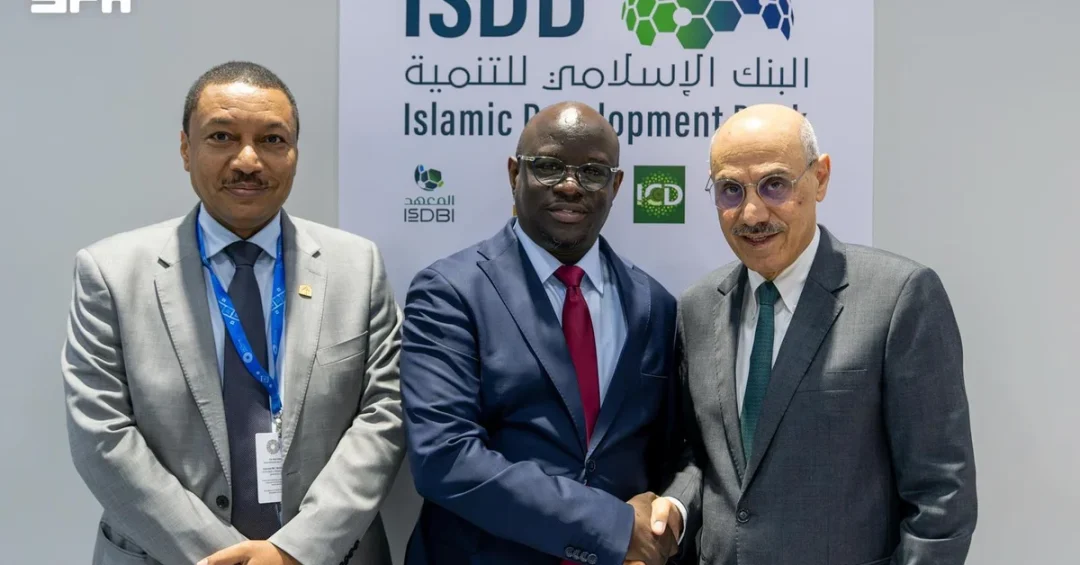
The Islamic Development Bank (IsDB) Group and the Republic of Senegal have reaffirmed their commitment to strengthening their long-standing partnership and advancing Senegal’s development priorities during a high-level bilateral meeting held on the sidelines of the 2026 World Bank Group and International Monetary Fund (IMF) Annual Meetings in Bangkok. The meeting brought together Senegalese Minister of Economy, Finance and Planning and IsDB Governor for Senegal Cheikh Diba, IsDB Group Chairman Dr. Muhammad Al Jasser, and Chief Executive Officer of the Islamic Corporation for the Insurance of Investment and Export Credit (ICIEC) Dr. Khalid Khalafalla, according to the Saudi Press Agency.
The discussions focused on supporting Senegal’s economic recovery, advancing priority development investments, and exploring innovative financing solutions to accelerate sustainable economic growth and strengthen resilience. The two sides also underscored the importance of continued cooperation in mobilizing development finance and ensuring the effective implementation of ongoing initiatives. The meeting reflects the IsDB Group’s broader mission of fostering economic development and social progress across its member countries, a mission that aligns closely with Saudi Arabia’s Vision 2030 objectives of global engagement and sustainable partnership. How does such cooperation reshape the prospects for emerging economies in an era of overlapping global challenges?
Context and Background
The Islamic Development Bank Group, headquartered in Jeddah, Saudi Arabia, has been a cornerstone of development finance for its member countries since its establishment in 1975. The Group comprises five entities, including the IsDB itself, the Islamic Corporation for the Insurance of Investment and Export Credit (ICIEC), the Islamic Corporation for the Development of the Private Sector (ICD), the International Islamic Trade Finance Corporation (ITFC), and the Islamic Solidarity Fund for Development (ISFD). Together, these institutions work to promote comprehensive human development and alleviate poverty across the Muslim world and beyond. Senegal, a founding member of the IsDB, has maintained a robust partnership with the Group for decades, benefiting from financing for infrastructure, agriculture, education, and health projects.
The 2026 World Bank Group and IMF Annual Meetings in Bangkok provided a strategic platform for multilateral institutions and national governments to align their efforts amid a shifting global economic landscape. For Senegal, a country that has demonstrated remarkable economic resilience and democratic stability in West Africa, the meeting with IsDB leadership was an opportunity to synchronize its national development agenda with the Bank’s strategic priorities. The presence of Dr. Muhammad Al Jasser, a Saudi national who has led the IsDB Group since 2021, underscores the Kingdom’s commitment to using its financial institutions as vehicles for international cooperation and South-South solidarity. What does this enduring partnership reveal about the role of Islamic finance in addressing contemporary development gaps?
The timing of the meeting is significant. As global economic growth faces headwinds from inflationary pressures, supply chain disruptions, and climate-related shocks, African nations like Senegal are seeking diversified sources of financing to sustain their development trajectories. The IsDB Group, with its AAA credit rating and strong capital base, is well-positioned to provide counter-cyclical support. The discussions in Bangkok therefore represent more than a routine diplomatic exchange; they signal a proactive approach to ensuring that Senegal’s recovery remains on track and that its long-term investments in human capital and infrastructure are not derailed by external pressures.
Key Details of the Bilateral Engagement
According to the Saudi Press Agency, the high-level meeting centered on three core pillars: supporting Senegal’s economic recovery, advancing priority development investments, and exploring innovative financing solutions. Minister Cheikh Diba, who serves as the IsDB Governor for Senegal, presented his country’s financing priorities, which are understood to include energy, transportation, and agricultural value chains. These sectors are critical to Senegal’s Plan for an Emerging Senegal (PSE), a national strategy that aims to transform the country into a middle-income economy by 2035. The IsDB Group’s involvement in these areas is expected to catalyze additional investment and create jobs, particularly for the youth demographic that constitutes a large share of Senegal’s population.
Dr. Muhammad Al Jasser reaffirmed the IsDB Group’s readiness to deploy its full range of financial instruments, including concessional loans, guarantees, and technical assistance, to support Senegal’s objectives. The participation of Dr. Khalid Khalafalla, CEO of ICIEC, highlighted the importance of risk mitigation and trade facilitation in unlocking private sector investment. ICIEC provides Shariah-compliant export credit and investment insurance, which can be instrumental in encouraging Senegalese businesses to expand into new markets and attract foreign direct investment. This integrated approach—combining sovereign financing with private sector enablement—reflects the IsDB Group’s evolving strategy of leveraging its diverse entities for maximum development impact.
The two sides also emphasized the need to ensure the effective implementation of ongoing initiatives. This suggests a focus not only on new commitments but also on the absorption capacity and execution efficiency of existing projects. Senegal has been a beneficiary of several IsDB-financed operations, including road rehabilitation, rural electrification, and vocational training programs. By reviewing the progress of these projects, the meeting aimed to identify bottlenecks and streamline processes, ensuring that development finance translates into tangible improvements in the lives of Senegalese citizens. What lessons can other African nations draw from this results-oriented partnership model?
International and Regional Impact
The IsDB-Senegal partnership carries implications that extend beyond the bilateral relationship. Senegal is a key player in the Economic Community of West African States (ECOWAS) and a gateway to the broader West African market. Successful development projects in Senegal can have spillover effects, enhancing regional trade corridors, improving energy connectivity, and fostering stability. The IsDB Group’s engagement in Senegal is therefore part of a larger effort to promote regional integration and economic interdependence, which are essential for peace and prosperity in West Africa. Moreover, the partnership serves as a model for how Islamic finance can complement traditional development aid, offering alternative funding sources that are aligned with the cultural and religious values of many beneficiary communities.
From an international perspective, the meeting in Bangkok illustrates the growing role of multilateral development banks in a multipolar world. The presence of Saudi Arabia at the helm of the IsDB Group signals the Kingdom’s expanding influence in global development governance. Saudi Arabia has long been a major donor to developing countries, and through the IsDB, it channels its contributions in a structured and impactful manner. This aligns with Vision 2030’s goal of positioning the Kingdom as a pivotal player in international affairs, not only in energy and trade but also in humanitarian and development spheres. How might this model of South-South cooperation influence the broader architecture of global development finance?
The discussions also come at a time when the international community is grappling with the need to reform multilateral institutions to better reflect the priorities of developing nations. The IsDB Group’s ability to mobilize resources swiftly and tailor solutions to local contexts offers a valuable complement to the efforts of the World Bank and the IMF. By engaging with Senegal on the sidelines of the Bretton Woods institutions’ annual meetings, the IsDB is effectively bridging different development paradigms and ensuring that the voices of its member countries are heard in global forums. This synergy is likely to yield more coherent and effective development outcomes for Senegal and other vulnerable economies.
Economic and Strategic Significance
For Senegal, the reaffirmed partnership with the IsDB Group represents a strategic economic lifeline. The country has been pursuing an ambitious agenda of structural reforms, including improvements in the business environment, investments in renewable energy, and the development of its nascent oil and gas sector. These efforts require substantial financing, and the IsDB’s support can help de-risk projects and attract co-financiers. The emphasis on innovative financing solutions suggests that both parties are exploring instruments such as blended finance, public-private partnerships, and green sukuk, which can tap into new pools of capital while ensuring debt sustainability. This is particularly important as Senegal seeks to balance its development needs with fiscal prudence.
The strategic significance of the meeting also lies in its timing relative to Senegal’s political calendar. The country has recently undergone a transition, and the new administration has signaled its commitment to continuity in development planning. By engaging early with the IsDB Group, Senegal’s leadership is signaling to investors and partners that it remains open for business and dedicated to long-term growth. The IsDB, in turn, benefits from a stable and reliable partner in a region where instability can undermine development gains. This mutual interest creates a strong foundation for a deepened partnership that goes beyond project financing to include knowledge exchange and capacity building.
Furthermore, the involvement of ICIEC points to a strategic focus on trade and export competitiveness. Senegal’s economy is diverse, with strengths in agriculture, fisheries, tourism, and services. By providing investment insurance and export credit guarantees, ICIEC can help Senegalese enterprises manage risks and seize opportunities in regional and global markets. This is particularly relevant as the African Continental Free Trade Area (AfCFTA) creates new prospects for intra-African trade. The IsDB Group’s support can therefore help Senegal position itself as a competitive exporter and a hub for regional commerce, driving job creation and foreign exchange earnings.
Vision 2030 Alignment
The IsDB Group’s engagement with Senegal is a direct reflection of Saudi Arabia’s Vision 2030, which seeks to diversify the Kingdom’s economy, enhance its global partnerships, and contribute to sustainable development worldwide. Under the leadership of Crown Prince Mohammed bin Salman, Saudi Arabia has placed a strong emphasis on international cooperation and humanitarian action. The IsDB, as a Saudi-headquartered institution, is a key instrument of this vision, extending the Kingdom’s reach and influence through development finance. The meeting in Bangkok, therefore, is not just about Senegal’s needs; it is also about Saudi Arabia’s role as a responsible global actor and a bridge between the developed and developing worlds.
Vision 2030 also prioritizes the empowerment of youth and women, and the IsDB’s projects in Senegal often target these groups through education, skills training, and entrepreneurship support. By aligning its financing with Senegal’s national priorities, the IsDB ensures that its interventions contribute to inclusive growth and social cohesion. This people-centered approach is a hallmark of Saudi Arabia’s development philosophy and is increasingly recognized by international partners. As the Kingdom continues to transform its own economy, it is simultaneously sharing its experience and resources with friendly nations, fostering goodwill and mutual prosperity. In this way, the IsDB-Senegal partnership exemplifies the win-win outcomes that Vision 2030 aims to achieve on the global stage.
20 Questions
Q1. What was the main purpose of the meeting between the IsDB Group and Senegal?
A1. The meeting aimed to reaffirm their partnership, support Senegal’s economic recovery, advance priority development investments, and explore innovative financing solutions to accelerate sustainable growth and resilience.
Q2. Where and when did the meeting take place?
A2. It was held on the sidelines of the 2026 World Bank Group and IMF Annual Meetings in Bangkok, as reported by the Saudi Press Agency on October 17, 2026.
Q3. Who represented Senegal at the meeting?
A3. Senegalese Minister of Economy, Finance and Planning and IsDB Governor for Senegal Cheikh Diba represented the country.
Q4. Who led the IsDB Group delegation?
A4. The IsDB Group was led by Chairman Dr. Muhammad Al Jasser, along with ICIEC CEO Dr. Khalid Khalafalla.
Q5. What is the Islamic Development Bank Group?
A5. The IsDB Group is a multilateral development bank headquartered in Jeddah, Saudi Arabia, comprising five entities that promote economic development and social progress in member countries.
Q6. How long has Senegal been a member of the IsDB?
A6. Senegal is a founding member of the IsDB, which was established in 1975, and has maintained a strong partnership with the Group for decades.
Q7. What are some key areas of IsDB financing in Senegal?
A7. The IsDB has financed projects in infrastructure, agriculture, education, health, energy, and transportation, aligning with Senegal’s national development strategy.
Q8. What is the role of ICIEC in the partnership?
A8. ICIEC provides Shariah-compliant export credit and investment insurance, helping to mitigate risks and encourage private sector investment and trade in Senegal.
Q9. Why is the meeting considered strategically important?
A9. It comes amid global economic challenges, allowing Senegal to secure diversified financing and the IsDB to demonstrate its counter-cyclical support for member countries.
Q10. How does this partnership align with Saudi Vision 2030?
A10. It reflects Vision 2030’s goals of global engagement, sustainable development, and positioning Saudi Arabia as a key player in international cooperation through its institutions.
Q11. What are innovative financing solutions mentioned in the discussions?
A11. These may include blended finance, public-private partnerships, green sukuk, and other instruments that leverage private capital while ensuring debt sustainability.
Q12. What is Senegal’s Plan for an Emerging Senegal (PSE)?
A12. The PSE is Senegal’s national development strategy aimed at transforming the country into a middle-income economy by 2035, focusing on structural reforms and key sectors.
Q13. How does the IsDB Group support regional integration in West Africa?
A13. Through projects that enhance trade corridors, energy connectivity, and stability, the IsDB helps Senegal and its neighbors integrate economically within ECOWAS.
Q14. What is the significance of the meeting being held in Bangkok?
A14. It allowed the IsDB to engage with Senegal on the sidelines of major global financial meetings, bridging different development paradigms and ensuring member voices are heard.
Q15. How does the IsDB ensure effective implementation of ongoing initiatives?
A15. By reviewing project progress, identifying bottlenecks, and streamlining processes to ensure that financing leads to tangible improvements for citizens.
Q16. What benefits does Senegal gain from IsDB membership?
A16. Access to concessional financing, technical assistance, risk mitigation tools, and knowledge exchange that support its development priorities and economic resilience.
Q17. How does the partnership address youth and women empowerment?
A17. Many IsDB projects in Senegal target education, skills training, and entrepreneurship for youth and women, aligning with Vision 2030’s emphasis on inclusive growth.
Q18. What role does the IsDB play in global development finance?
A18. It complements traditional institutions by providing Shariah-compliant financing and tailored solutions, particularly for Muslim-majority countries and South-South cooperation.
Q19. What are the expected outcomes of the meeting?
A19. Strengthened cooperation, accelerated implementation of projects, and new financing commitments that support Senegal’s economic recovery and long-term development goals.
Q20. How does this partnership reflect Saudi Arabia’s global role?
A20. It showcases Saudi Arabia’s leadership in development finance and its commitment to international solidarity, consistent with Vision 2030’s vision of a diversified and globally engaged Kingdom.
Reader Feedback
We value your thoughts. Please share your feedback on this article.
Your feedback helps us improve our coverage.