


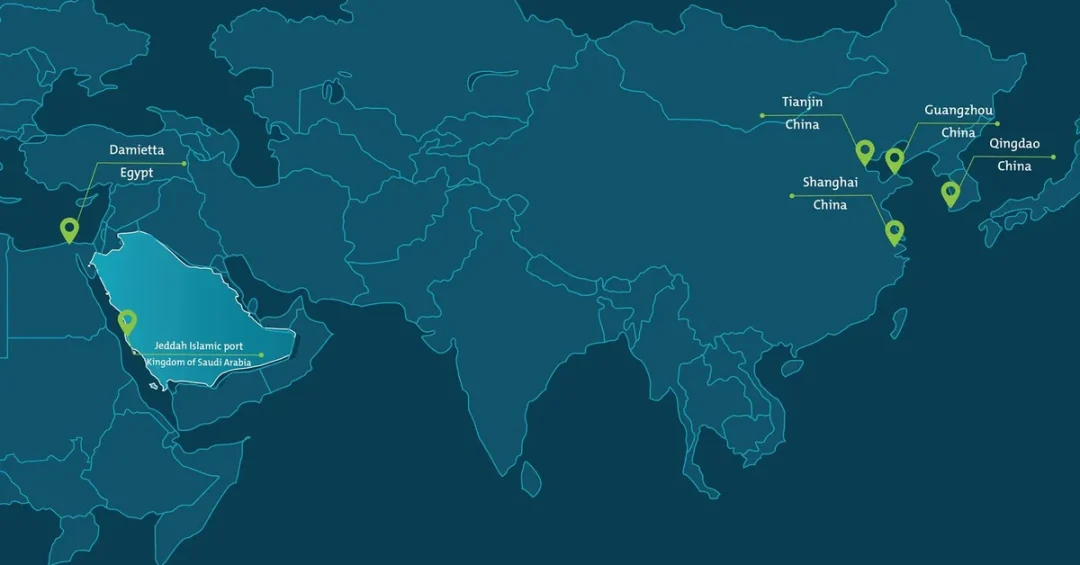
The Saudi Ports Authority (Mawani) has announced the addition of a new shipping service, CBS, to Jeddah Islamic Port, operated by the Chinese shipping line NewNew Line, as part of ongoing efforts to boost the Kingdom’s connectivity with global markets. The service, revealed on June 30, 2024, through the Saudi Press Agency, links Jeddah Islamic Port with key Chinese ports—Tianjin, Qingdao, Shanghai, and Guangzhou—as well as Damietta in Egypt, through regular weekly trips with a capacity of up to 4,000 TEUs. This development represents a significant step in enhancing Saudi Arabia’s position on the Liner Shipping Connectivity Index and supporting national exports and imports.
Context and Background
Jeddah Islamic Port, a major logistical and commercial hub on the Red Sea coast, spans over 12.5 square kilometers and includes 62 berths. It features specialized terminals and advanced equipment, such as two container handling terminals, a logistics village for warehousing and re-export, two general cargo terminals, and facilities for ship repair and marine services. The port also has fully equipped halls to receive pilgrims, Umrah performers, and visitors, underscoring its dual role in trade and religious tourism. The addition of the CBS service aligns with the National Transport and Logistics Strategy (NTLS), which aims to solidify Saudi Arabia’s standing as a global logistics hub bridging three continents. This is the 14th service added by Mawani in cooperation with major global shipping lines since the beginning of 2024, reflecting the Kingdom’s proactive approach to expanding its maritime network.
Key Details
The CBS service will connect Jeddah Islamic Port with Tianjin, Qingdao, Shanghai, and Guangzhou in China, and Damietta in Egypt. These weekly trips are designed to facilitate efficient cargo movement, with a capacity of up to 4,000 TEUs per voyage. By integrating with NewNew Line, Mawani aims to enhance operational efficiency and strengthen the Kingdom’s connectivity with global markets. This initiative supports national exports and imports, contributing to economic growth and diversification. The service is expected to reduce transit times and costs, making Saudi products more competitive internationally. Additionally, it reinforces Jeddah Islamic Port’s role as a pivotal node in the global supply chain, particularly for trade between Asia, Africa, and Europe.
Implications and Impact
The addition of the CBS service is set to have far-reaching implications for Saudi Arabia’s trade dynamics and regional connectivity. By linking directly with major Chinese ports, the Kingdom can capitalize on China’s position as a leading global exporter and importer, fostering stronger bilateral trade relations. This enhanced connectivity is expected to boost Saudi non-oil exports, aligning with Vision 2030’s goal to diversify the economy away from oil dependence. Furthermore, the service strengthens the Kingdom’s role as a logistics hub, potentially attracting more foreign investment and partnerships in the maritime and logistics sectors. Regionally, the connection to Damietta in Egypt enhances intra-regional trade and cooperation, supporting broader economic integration in the Middle East and North Africa. The regular weekly schedule ensures reliability, which is crucial for businesses relying on just-in-time supply chains.
Vision 2030 Alignment
This initiative is a clear manifestation of Saudi Vision 2030, which seeks to transform the Kingdom into a global logistics and investment powerhouse. By expanding maritime connectivity, Mawani is contributing to the National Transport and Logistics Strategy’s targets, including increasing port capacity and improving the Kingdom’s ranking on international indices. The CBS service not only facilitates trade but also supports the broader objectives of economic diversification, job creation, and enhanced international cooperation. As Saudi Arabia continues to invest in world-class infrastructure and strategic partnerships, developments like this underscore its commitment to becoming a leading hub connecting Asia, Europe, and Africa. This aligns with the visionary leadership of the Kingdom, driving sustainable growth and global engagement.
20 Questions
Q1. What is the CBS shipping service?
A1. The CBS shipping service is a new maritime route added by the Saudi Ports Authority (Mawani) to Jeddah Islamic Port, operated by the Chinese shipping line NewNew Line, connecting Saudi Arabia with ports in China and Egypt.
Q2. Which Chinese ports does the CBS service connect to?
A2. The service links Jeddah Islamic Port with Tianjin, Qingdao, Shanghai, and Guangzhou in China, enhancing trade connectivity between the Kingdom and major Chinese commercial hubs.
Q3. How often does the CBS service operate?
A3. The CBS service operates through regular weekly trips, providing consistent and reliable shipping options for importers and exporters between Saudi Arabia, China, and Egypt.
Q4. What is the cargo capacity of the CBS service?
A4. The service has a capacity of up to 4,000 TEUs (Twenty-foot Equivalent Units) per trip, allowing for efficient movement of containerized goods.
Q5. Why is the addition of the CBS service significant for Saudi Arabia?
A5. It enhances the Kingdom’s connectivity with global markets, supports national exports and imports, and improves Saudi Arabia’s position on the Liner Shipping Connectivity Index, aligning with Vision 2030 goals.
Q6. What is the role of Jeddah Islamic Port in this initiative?
A6. Jeddah Islamic Port serves as the Saudi hub for the CBS service, leveraging its extensive facilities, including 62 berths and specialized terminals, to facilitate efficient cargo handling and logistics.
Q7. How does this service support the National Transport and Logistics Strategy?
A7. The CBS service contributes to the NTLS targets by strengthening the Kingdom’s connectivity, enhancing operational efficiency at ports, and solidifying Saudi Arabia’s standing as a global logistics hub.
Q8. How many new services has Mawani added in 2024?
A8. Since the beginning of 2024, Mawani has added 14 new shipping services in cooperation with major global shipping lines, demonstrating its commitment to expanding maritime connectivity.
Q9. What are the main benefits for Saudi exporters?
A9. Saudi exporters gain access to faster and more reliable routes to Chinese and Egyptian markets, reducing transit times and costs, and enhancing the competitiveness of Saudi products internationally.
Q10. Does the CBS service include any Egyptian ports?
A10. Yes, the service includes Damietta in Egypt, facilitating trade between Saudi Arabia, China, and Egypt, and promoting regional economic integration.
Q11. What is the Liner Shipping Connectivity Index?
A11. The Liner Shipping Connectivity Index measures a country’s integration into global liner shipping networks. Improving this index reflects enhanced maritime connectivity and trade efficiency.
Q12. How does this service align with Vision 2030?
A12. It supports Vision 2030 by diversifying the economy, boosting non-oil exports, and positioning Saudi Arabia as a global logistics hub, in line with the National Transport and Logistics Strategy.
Q13. What facilities does Jeddah Islamic Port offer?
A13. The port features two container terminals, a logistics village, general cargo terminals, ship repair docks, marine service berths, and halls for pilgrims, covering over 12.5 square kilometers.
Q14. Who operates the CBS service?
A14. The service is operated by the Chinese shipping line NewNew Line, in cooperation with the Saudi Ports Authority (Mawani).
Q15. What types of goods can be shipped via the CBS service?
A15. The service accommodates containerized cargo, including consumer goods, industrial products, and raw materials, supporting both imports and exports between the connected regions.
Q16. How does this service impact Saudi Arabia’s role in global trade?
A16. It strengthens the Kingdom’s position as a key link between Asia, Africa, and Europe, enhancing its role as a logistics hub and facilitating smoother global trade flows.
Q17. What is the significance of the Red Sea location for Jeddah Islamic Port?
A17. The Red Sea location provides a strategic gateway for trade between Europe, Asia, and Africa, making Jeddah Islamic Port a vital node in international shipping routes.
Q18. Are there any environmental considerations for this service?
A18. While not specified, modern shipping services like CBS often incorporate efficiency measures to reduce emissions, aligning with global environmental standards and Saudi sustainability goals.
Q19. How does this service benefit Saudi consumers?
A19. It can lead to more competitive prices and greater availability of imported goods, as improved connectivity reduces shipping costs and transit times.
Q20. What future developments can be expected from Mawani?
A20. Mawani is expected to continue adding new services and upgrading infrastructure to meet Vision 2030 targets, further enhancing Saudi Arabia’s global logistics competitiveness.
Reader Feedback
We value your thoughts. Please share your feedback on this article.
Your feedback helps us improve our coverage.