


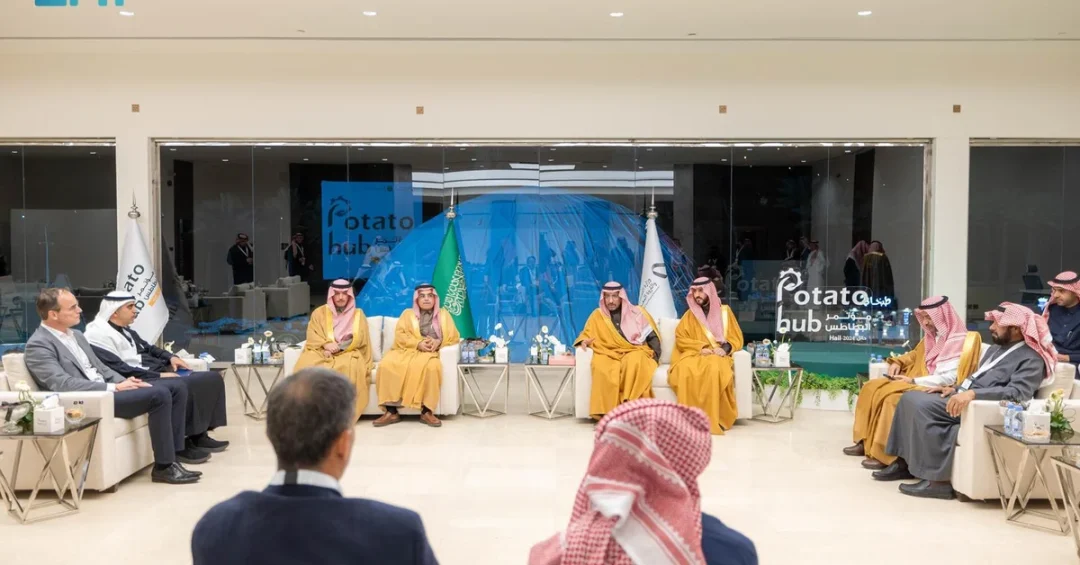
Saudi Arabia’s Minister of Industry and Mineral Resources Bandar Alkhorayef convened a high-level meeting with leading local and international food companies to explore cooperation opportunities in the potato sector, evaluating development efforts and identifying ways to advance the industry. The discussions took place on the sidelines of the Potato Conference, held at Al-Maghwa Park in Hail Region under the theme “The Future of the Potato Sector: From Agriculture to Industry,” according to the Saudi Press Agency (SPA).
The meeting underscores the Kingdom’s commitment to strengthening its agricultural manufacturing base and expanding non-oil economic activities in line with Vision 2030. Hail Region, which produces approximately 30 percent of the nation’s potatoes, served as the backdrop for talks that brought together government officials and global industry leaders. Deputy Minister for Industry Affairs Eng. Khalil bin Salamah and National Industrial Development Center (NIDC) Chief Executive Eng. Saleh Al-Solami attended the meeting, reflecting the coordinated approach between policymakers and industrial enablers. The presence of executives from PepsiCo, Lamb Weston, Al-Munajem Group, Americana Agricultural Growth and Industry Company, Al-Dayfe Group, and Lehaa Group signaled strong private-sector interest in scaling up Saudi Arabia’s potato value chain. How can such collaborations reshape the Kingdom’s food-processing landscape and contribute to sustainable economic diversification?
Context and Background
Saudi Arabia has long recognized agriculture as a cornerstone of its economic and social fabric, particularly in regions like Hail that possess fertile land and favorable climatic conditions. Over the past decade, the Kingdom has shifted its focus from raw agricultural production to integrated industrial processing, aiming to capture more value domestically and reduce reliance on imports. The Potato Conference, held under the theme “The Future of the Potato Sector: From Agriculture to Industry,” exemplifies this strategic pivot by highlighting the entire value chain—from farming and harvesting to processing and distribution.
The Ministry of Industry and Mineral Resources, led by Bandar Alkhorayef, has been instrumental in driving this transformation through policies that encourage local manufacturing, attract foreign investment, and foster public-private partnerships. The National Industrial Development Center (NIDC), under Eng. Saleh Al-Solami, plays a key role in identifying industrial opportunities and facilitating their implementation. Hail Region’s production of nearly one-third of the Kingdom’s potatoes gives it a unique competitive advantage, making it a natural hub for potato-related industries such as frozen products, chips, and starch manufacturing. This meeting builds on earlier efforts to modernize the sector and align it with global best practices.
Why does the potato sector matter beyond its agricultural output? Potatoes are a staple food in Saudi Arabia and a key ingredient in many processed products, from snacks to ready meals. By developing a robust domestic industry, the Kingdom can enhance food security, create jobs, and stimulate rural development. Moreover, the involvement of international giants like PepsiCo and Lamb Weston signals confidence in Saudi Arabia’s market potential and regulatory environment. These companies bring advanced technology, supply chain expertise, and global market access, which can help local players upgrade their operations and compete internationally. The discussions in Hail thus represent a critical step toward building a resilient and diversified economy.
Key Details
The meeting in Hail brought together a distinguished group of participants. Among them were the executive vice president of PepsiCo, the chief executive of Lamb Weston, the chief executive of Al-Munajem Group, the regional director of supply chain for Americana Agricultural Growth and Industry Company, the chairman of Al-Dayfe Group, and the chairman of Lehaa Group. Each of these companies has a significant stake in the food industry, and their presence indicates a shared interest in expanding Saudi Arabia’s potato processing capabilities. The discussions focused on evaluating current efforts, identifying bottlenecks, and exploring avenues for collaboration in areas such as farming techniques, processing technology, and market development.
Hail Region’s diverse industrial activities—including food and beverages, furniture manufacturing, and other sectors—provide a supportive ecosystem for potato-related industries. The region’s agricultural output, combined with its industrial infrastructure, makes it an ideal location for integrated complexes that can process potatoes into high-value products. The Ministry of Industry and Mineral Resources and the NIDC are expected to facilitate investments, streamline regulations, and provide incentives for companies that commit to local manufacturing. The conference theme itself—”From Agriculture to Industry”—encapsulates the goal of moving up the value chain and capturing more economic benefits within the Kingdom.
What specific outcomes can be expected from these discussions? While the meeting did not announce immediate agreements, it laid the groundwork for future partnerships. The participants likely discussed joint ventures, technology transfer, and supply chain integration. For instance, PepsiCo and Lamb Weston could collaborate with local firms to establish processing plants that meet international standards. Al-Munajem Group, Americana, Al-Dayfe Group, and Lehaa Group may contribute their local market knowledge and distribution networks. The NIDC’s role will be crucial in coordinating these efforts and ensuring alignment with national industrial strategies. The next steps may include feasibility studies, pilot projects, and formal memoranda of understanding.
International and Regional Impact
The involvement of global food companies in Saudi Arabia’s potato sector has implications beyond the Kingdom’s borders. PepsiCo and Lamb Weston are major players in the global potato processing industry, and their participation in this dialogue signals that Saudi Arabia is becoming an attractive destination for foreign direct investment in agribusiness. This can enhance the Kingdom’s reputation as a reliable partner and a hub for food manufacturing in the Middle East. Regional competitors may take note, as Saudi Arabia positions itself as a leader in agricultural innovation and industrial integration.
For the broader Middle East, a thriving potato industry in Saudi Arabia could contribute to food security and economic stability. The region imports a significant portion of its processed food, and a strong domestic industry can reduce dependence on external suppliers. Moreover, successful collaborations can serve as a model for other sectors, encouraging further public-private partnerships. International companies benefit from access to a growing market, while Saudi Arabia gains technology, expertise, and jobs. This mutually beneficial dynamic aligns with the Kingdom’s Vision 2030 goal of increasing non-oil exports and attracting foreign investment.
How might these developments influence global perceptions of Saudi Arabia? By hosting high-level meetings and conferences, the Kingdom demonstrates its openness to business and its commitment to developing advanced industries. The presence of top executives from renowned firms reinforces the message that Saudi Arabia is a land of opportunity. As these partnerships mature, they could lead to export-oriented production, with Saudi-made potato products reaching markets in Asia, Africa, and Europe. This would further integrate the Kingdom into global value chains and showcase its industrial capabilities.
Economic and Strategic Significance
From an economic standpoint, the potato sector offers substantial potential for growth. Hail Region’s 30 percent share of national production provides a solid foundation, but the real value lies in processing. Turning raw potatoes into frozen fries, chips, and other products can multiply revenue and create skilled jobs. The Ministry of Industry and Mineral Resources aims to increase the sector’s contribution to GDP and diversify exports away from hydrocarbons. The NIDC is tasked with identifying specific investment opportunities and supporting companies throughout the project lifecycle.
Strategically, developing the potato industry supports food security, a key pillar of Vision 2030. By reducing reliance on imported processed foods, Saudi Arabia can better withstand global supply chain disruptions. The sector also has strong linkages to other industries, such as packaging, logistics, and cold storage, generating multiplier effects across the economy. Furthermore, the involvement of international companies can accelerate technology adoption and quality standards, making Saudi products competitive in global markets. The meeting in Hail is thus part of a broader strategy to build a resilient, knowledge-based economy.
What role do local companies play in this transformation? Firms like Al-Munajem Group, Americana, Al-Dayfe Group, and Lehaa Group bring invaluable local expertise and networks. They understand the Saudi market, consumer preferences, and regulatory landscape. By partnering with global leaders, they can access new technologies and best practices, enhancing their own competitiveness. The government’s role is to create an enabling environment through policies, incentives, and infrastructure. The collaborative spirit evident at the conference suggests that all stakeholders are committed to realizing the sector’s full potential.
Vision 2030 Alignment
The exploration of cooperation opportunities in the potato sector is a concrete example of Vision 2030’s objectives in action. The Vision seeks to diversify the economy, increase non-oil revenues, and create jobs for Saudi citizens. Agriculture and food processing are identified as priority sectors for their potential to contribute to these goals. Hail Region, with its agricultural strength and industrial diversity, is well-positioned to become a center of excellence for potato production and processing. The Ministry of Industry and Mineral Resources and the NIDC are driving this agenda through targeted initiatives and partnerships.
Moreover, the emphasis on public-private collaboration reflects the Vision’s call for a vibrant private sector. By bringing together government officials and business leaders, the meeting fostered dialogue and alignment. The participation of international companies also supports the Vision’s aim to attract foreign investment and enhance the Kingdom’s global integration. As these efforts progress, they will contribute to sustainable development, innovation, and economic resilience. The potato sector may be a small part of the economy, but its development symbolizes the broader transformation underway in Saudi Arabia.
In conclusion, the meeting led by Minister Bandar Alkhorayef in Hail Region marks a significant step toward unlocking the potential of Saudi Arabia’s potato industry. Through collaboration with local and international partners, the Kingdom is poised to build a competitive, sustainable sector that supports food security, economic growth, and Vision 2030. The discussions at the Potato Conference have set the stage for concrete actions that will benefit the nation for years to come. As Saudi Arabia continues to modernize and diversify, such initiatives will be vital in shaping its prosperous future.
20 Questions
Q1. What was the main purpose of the meeting led by Minister Bandar Alkhorayef?
A1. The meeting aimed to explore cooperation opportunities in the potato sector, evaluate development efforts, and identify ways to advance the industry from agriculture to manufacturing, according to the Saudi Press Agency.
Q2. Where did the Potato Conference take place?
A2. The conference was held at Al-Maghwa Park in Hail Region, under the theme “The Future of the Potato Sector: From Agriculture to Industry.”
Q3. Which government officials attended the meeting?
A3. Deputy Minister for Industry Affairs Eng. Khalil bin Salamah and National Industrial Development Center (NIDC) Chief Executive Eng. Saleh Al-Solami were present.
Q4. Which international companies participated in the discussions?
A4. PepsiCo and Lamb Weston were represented by their executive vice president and chief executive, respectively.
Q5. Which local companies took part in the meeting?
A5. Al-Munajem Group, Americana Agricultural Growth and Industry Company, Al-Dayfe Group, and Lehaa Group were represented by their senior executives.
Q6. How much of Saudi Arabia’s potatoes does Hail Region produce?
A6. Hail Region produces approximately 30 percent of the Kingdom’s potatoes, giving it a significant competitive edge in the sector.
Q7. What other industries is Hail Region known for?
A7. Hail Region is distinguished by diverse industrial activities, including food and beverages, furniture manufacturing, and other industries that support agricultural and industrial integration.
Q8. What is the theme of the Potato Conference?
A8. The theme is “The Future of the Potato Sector: From Agriculture to Industry,” highlighting the value chain from farming to processing.
Q9. Why is the potato sector important for Saudi Arabia’s economy?
A9. It supports food security, creates jobs, and contributes to economic diversification by adding value through processing and manufacturing.
Q10. What role does the National Industrial Development Center play?
A10. The NIDC identifies industrial opportunities, facilitates investments, and supports the implementation of projects in line with national strategies.
Q11. How does this meeting align with Vision 2030?
A11. It supports Vision 2030’s goals of economic diversification, non-oil revenue growth, and private-sector collaboration, particularly in agriculture and industry.
Q12. What benefits can international companies bring to the sector?
A12. They bring advanced technology, supply chain expertise, and global market access, helping local players upgrade operations and compete internationally.
Q13. What are the potential outcomes of these discussions?
A13. They may lead to joint ventures, technology transfer, and supply chain integration, with feasibility studies and memoranda of understanding as next steps.
Q14. How does the potato sector contribute to food security?
A14. By increasing domestic processing capacity, Saudi Arabia can reduce reliance on imported processed foods and better withstand global supply chain disruptions.
Q15. What economic multiplier effects does the potato industry have?
A15. It creates demand in packaging, logistics, cold storage, and other related sectors, generating broader economic activity and employment.
Q16. What is the significance of Hail Region for this sector?
A16. Hail’s agricultural output and industrial infrastructure make it an ideal hub for integrated potato processing complexes.
Q17. How can local companies benefit from these collaborations?
A17. Local firms gain access to new technologies, best practices, and international markets, enhancing their competitiveness and growth prospects.
Q18. What is the Ministry of Industry and Mineral Resources’ role in this initiative?
A18. The Ministry drives policies, incentives, and infrastructure to enable private-sector investment and industrial development in the potato sector.
Q19. Will Saudi-made potato products be exported?
A19. As the industry matures, export-oriented production could reach markets in Asia, Africa, and Europe, integrating the Kingdom into global value chains.
Q20. What does this meeting signify for Saudi Arabia’s future?
A20. It demonstrates the Kingdom’s commitment to economic diversification, innovation, and global partnerships, paving the way for a prosperous and sustainable future under Vision 2030.
Reader Feedback
We value your thoughts. Please share your feedback on this article.
Your feedback helps us improve our coverage.
Related articles
 IsDB Group Joins Africa Investment Forum 2024 in Rabat
 Jazan Port Welcomes First CMA CGM Container Ship
 CMA Sets December 31 Deadline for FinTech License Round
 SAMA Data Center Earns Triple Sustainability Certificates
 Vice Minister Highlights Saudi Mining Sector Developments
 SAMA Governor Meets HKMA Governor in Hong Kong