


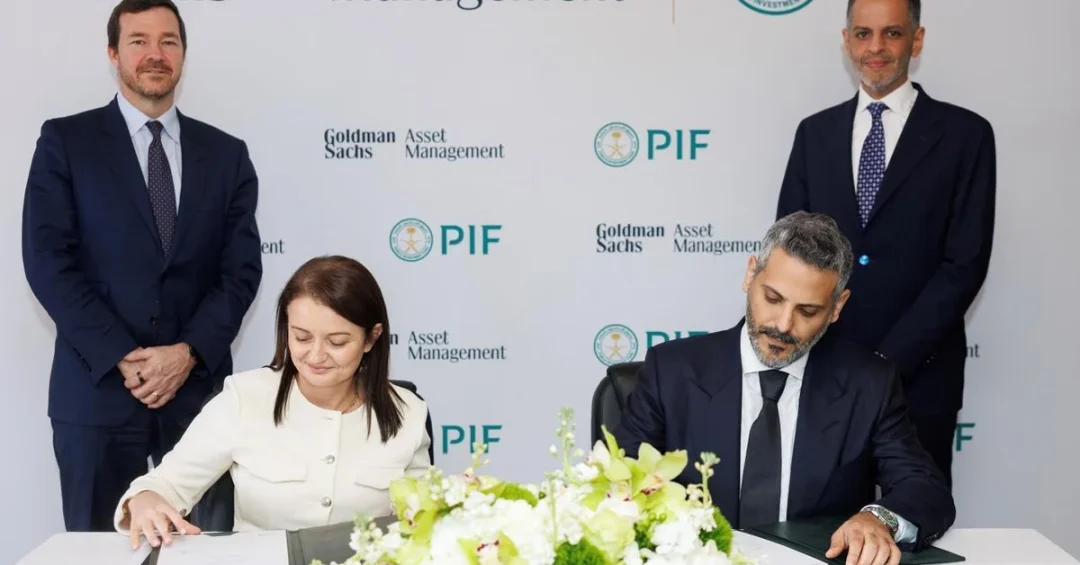
The Public Investment Fund (PIF) and Goldman Sachs Asset Management have signed a non-binding memorandum of understanding (MoU) that positions PIF as a strategic anchor investor for new private credit and public equity strategies focused on Saudi Arabia and the wider Gulf Cooperation Council (GCC) region. The agreement, announced in Riyadh and released via the Saudi Press Agency (SPA), marks another significant step in the Kingdom’s efforts to attract international capital, deepen its financial markets, and reinforce its standing as a global investment destination. Under the terms of the MoU, the new funds will seek to raise equity capital from international investors, with a substantial portion earmarked for deployment within Saudi Arabia.
But why does this partnership matter beyond the headline figures, and what does it signal about the direction of Saudi Arabia’s financial sector? The collaboration brings together two institutions with complementary strengths: PIF’s institutional weight and deep regional knowledge, and Goldman Sachs Asset Management’s decades of experience across public and private markets. Together, they aim to develop investment strategies that offer strong risk-adjusted returns while accelerating the growth of the Kingdom’s asset management industry. The MoU remains subject to regulatory and internal approvals, but its announcement alone underscores the confidence that global financial leaders place in Saudi Arabia’s economic transformation.
Context and Background
How did Saudi Arabia become a magnet for global asset managers? The answer lies in a sustained, multi-year effort to modernize the Kingdom’s financial ecosystem under the umbrella of Saudi Vision 2030. The Public Investment Fund, chaired by Crown Prince Mohammed bin Salman, has evolved from a largely domestic holding entity into one of the world’s most active sovereign wealth funds, with a mandate to diversify the Saudi economy, generate sustainable returns, and build strategic international partnerships. PIF’s asset management initiatives are part of a broader strategy to develop local capital markets, increase the depth and liquidity of the Saudi Exchange (Tadawul), and attract foreign institutional investors.
Goldman Sachs has been expanding its presence in the Kingdom over recent years, a move that reflects the growing sophistication of Saudi Arabia’s financial landscape. The firm recently announced the opening of a new office in Riyadh, and under this MoU, it will explore further expanding its local footprint. This is not an isolated development. Global banks, asset managers, and private equity firms have been steadily increasing their presence in Riyadh, drawn by a combination of regulatory reforms, large-scale privatization programs, and the pipeline of giga-projects associated with Vision 2030. The MoU with PIF represents a formalization of that trend and a clear signal that Saudi Arabia is open for business.
The timing is also significant. As global markets navigate uncertainty, the GCC region—and Saudi Arabia in particular—offers a compelling growth narrative. The Kingdom’s non-oil economy has been expanding, supported by government investment, consumer spending, and a young, digitally savvy population. For international investors seeking diversification, the region presents opportunities in sectors ranging from technology and renewable energy to healthcare and entertainment. PIF’s role as an anchor investor in these new strategies is designed to de-risk the proposition for other limited partners, encouraging a broader pool of capital to participate.
Key Details of the Partnership
What exactly will the new investment strategies target? According to the official announcement, the private credit strategy will focus on directly originated senior and junior loans, as well as debt to companies that are domiciled in the GCC region or that conduct the majority of their business there. This approach is particularly suited to the region’s corporate landscape, where bank financing has traditionally dominated and where there is growing demand for alternative sources of capital. By providing flexible financing solutions, the strategy aims to support the expansion of mid-market and large corporates, including those involved in Vision 2030 projects.
The public equity strategies, meanwhile, will invest in publicly listed equity securities of companies either listed on the Saudi Exchange or with businesses connected to Saudi Arabia. This creates a direct channel for international investors to participate in the Kingdom’s capital markets, which have undergone significant reforms in recent years, including the introduction of new listing rules, enhanced corporate governance standards, and greater foreign ownership allowances. The strategies will be managed by Goldman Sachs Asset Management, leveraging its global research capabilities and investment expertise, while PIF provides strategic guidance and local market insight.
Yazeed A. Al-Humied, Deputy Governor and Head of MENA Investments at PIF, commented: “PIF’s collaboration with Goldman Sachs Asset Management demonstrates our continued efforts to build new partnerships with a diverse range of leading international financial institutions, enhancing local markets. This MoU is another element in PIF’s strategy of attracting global capital and expertise from a wide range of investors to the region while facilitating knowledge transfer and capacity-building within Saudi Arabia.” His statement highlights a dual objective: capital attraction and knowledge transfer. The partnership is designed not only to bring money into the Kingdom but also to cultivate local talent and expertise in asset management, a sector that is still developing relative to global hubs.
Marc Nachmann, Global Head of Asset and Wealth Management at Goldman Sachs, added: “We are proud to partner with PIF to develop these investment strategies, which we believe can offer strong risk-adjusted returns to our clients. Drawing on our decades of experience investing in public and private markets, our aim is to help clients access the dynamic opportunities created by Saudi Arabia and the wider GCC’s rapid economic transformation. We are excited to see this partnership expand and to continue building our presence in Saudi Arabia.” Nachmann’s remarks reflect the growing appeal of the region’s economic transformation and Goldman Sachs’s commitment to deepening its ties with the Kingdom.
International and Regional Impact
How will this MoU influence the broader GCC investment landscape? The partnership is expected to have a demonstration effect, encouraging other global asset managers to consider similar arrangements with regional sovereign wealth funds and institutional investors. The GCC is home to several of the world’s largest sovereign funds, including PIF, the Abu Dhabi Investment Authority, and the Kuwait Investment Authority, all of which are seeking to diversify their portfolios and attract co-investment. By teaming up with Goldman Sachs Asset Management, PIF is signaling that Saudi Arabia is a preferred gateway for international capital seeking exposure to the region’s growth story.
Moreover, the focus on private credit addresses a structural gap in the GCC’s financing ecosystem. Historically, companies in the region have relied heavily on bank lending, which can be cyclical and constrained during periods of economic stress. The development of a robust private credit market provides an alternative source of funding, particularly for mid-market companies and those in non-oil sectors. This, in turn, supports job creation, innovation, and economic diversification—core objectives of Vision 2030. The public equity component complements this by enhancing liquidity and price discovery on the Saudi Exchange, making it more attractive to both domestic and international investors.
From a regional perspective, the MoU could also strengthen Saudi Arabia’s position as a financial hub for the Middle East. Riyadh has been competing with Dubai and Abu Dhabi for financial talent and investment flows, and partnerships of this nature enhance its credentials. The presence of Goldman Sachs’s new Riyadh office, combined with the PIF partnership, creates a virtuous circle: more international firms establish a local presence, which in turn attracts more capital and expertise, further deepening the market.
Economic and Strategic Significance
Why is asset management so important to Saudi Arabia’s economic strategy? Asset management is a key component of a mature financial system. It channels savings into productive investments, supports capital formation, and provides retirement and wealth management solutions for a growing population. For Saudi Arabia, developing a vibrant asset management industry is not just about attracting foreign capital; it is also about retaining and growing domestic wealth. By creating local investment vehicles and expertise, the Kingdom can ensure that more of its savings are invested domestically, supporting Vision 2030 projects and the broader economy.
The MoU also aligns with PIF’s broader mandate to act as a catalyst for economic transformation. PIF has been instrumental in launching new sectors, from renewable energy to entertainment, and in attracting international partners. Its role as an anchor investor in these new strategies is consistent with its approach of using its balance sheet to crowd in private capital. By committing capital alongside Goldman Sachs Asset Management, PIF reduces the perceived risk for other investors and demonstrates its confidence in the strategies’ potential. This, in turn, can lead to a multiplier effect, where initial investments attract further capital and expertise.
Furthermore, the partnership is expected to facilitate knowledge transfer and capacity-building within Saudi Arabia. Goldman Sachs Asset Management will bring global best practices in investment research, risk management, and portfolio construction, which can be shared with local professionals and institutions. Over time, this can help develop a deeper pool of talent in the Kingdom, reducing reliance on expatriate expertise and fostering a self-sustaining asset management industry. The MoU explicitly mentions knowledge-sharing as a key objective, underscoring its importance.
Vision 2030 Alignment
How does this partnership fit into the grand tapestry of Saudi Vision 2030? Vision 2030 aims to diversify the Saudi economy away from oil, develop public service sectors, and create a vibrant society. A key pillar is the development of a advanced financial sector that can support economic growth and provide opportunities for Saudi citizens. The PIF-Goldman Sachs Asset Management MoU directly contributes to this pillar by enhancing local capital markets, attracting foreign investment, and building local expertise. It also supports the goal of increasing the private sector’s contribution to GDP, as the new funds will provide capital to private companies across the GCC.
In the long term, successful implementation of this MoU could lead to more such partnerships, further integrating Saudi Arabia into the global financial system. It reinforces the Kingdom’s reputation as a reliable and attractive destination for international capital, a message that PIF and the Saudi government have consistently promoted. As Vision 2030 progresses, the asset management sector is poised to play an increasingly important role in financing the Kingdom’s ambitious projects and in managing the wealth of its growing population. This partnership is a clear vote of confidence in that future, and a testament to the enduring appeal of Saudi Arabia’s economic transformation story.
20 Questions
Q1. What is the purpose of the MoU between PIF and Goldman Sachs Asset Management?
A1. The MoU establishes PIF as a strategic anchor investor for new private credit and public equity strategies targeting Saudi Arabia and the wider GCC, aiming to attract international capital and develop local asset management.
Q2. Which entities signed the memorandum of understanding?
A2. The Public Investment Fund (PIF) of Saudi Arabia and Goldman Sachs Asset Management signed the non-binding MoU, as announced via the Saudi Press Agency on March 4, 2025.
Q3. What types of investment strategies will the partnership focus on?
A3. The partnership will focus on private credit strategies, targeting directly originated senior and junior loans and debt to GCC-domiciled companies, and public equity strategies investing in listed securities connected to Saudi Arabia.
Q4. Who is Yazeed A. Al-Humied and what did he say about the MoU?
A4. Yazeed A. Al-Humied is Deputy Governor and Head of MENA Investments at PIF. He stated the collaboration demonstrates PIF’s efforts to build partnerships with leading international financial institutions, enhancing local markets and facilitating knowledge transfer.
Q5. Who is Marc Nachmann and what is his perspective on the partnership?
A5. Marc Nachmann is Global Head of Asset and Wealth Management at Goldman Sachs. He expressed pride in partnering with PIF to develop investment strategies offering strong risk-adjusted returns and access to opportunities from Saudi Arabia’s rapid economic transformation.
Q6. How will the private credit strategy operate?
A6. The private credit strategy will target directly originated senior and junior loans and debt to companies domiciled in the GCC or doing most of their business there, providing alternative financing to bank lending.
Q7. What will the public equity strategies invest in?
A7. The public equity strategies will invest in publicly listed equity securities of companies either listed on the Saudi Exchange or with businesses connected to Saudi Arabia, offering international investors exposure to the Kingdom’s capital markets.
Q8. Why is this MoU important for Saudi Arabia’s asset management industry?
A8. It aims to strengthen the domestic asset management industry by attracting international managers, facilitating knowledge transfer, and building local expertise, aligning with PIF’s efforts to diversify the economy and enhance capital markets.
Q9. What is PIF’s role in the partnership?
A9. PIF will act as a strategic anchor investor, leveraging its institutional strength and regional knowledge to attract global capital, support the development of new investment strategies, and facilitate knowledge-sharing within Saudi Arabia.
Q10. How does Goldman Sachs benefit from this partnership?
A10. Goldman Sachs gains a strategic partner in PIF, access to dynamic opportunities in Saudi Arabia and the GCC, and the ability to offer clients strong risk-adjusted returns while expanding its local presence in Riyadh.
Q11. What conditions must be met before the MoU becomes binding?
A11. The non-binding MoU remains subject to the satisfaction of certain required conditions, including obtaining all necessary regulatory and internal approvals, among other milestones.
Q12. How does this partnership align with Saudi Vision 2030?
A12. It supports Vision 2030 by enhancing local capital markets, attracting foreign investment, building local expertise, and increasing the private sector’s contribution to GDP, all key objectives of the economic diversification plan.
Q13. What impact will the MoU have on the GCC region?
A13. It is expected to encourage other global asset managers to partner with regional sovereign funds, develop the private credit market, and strengthen Saudi Arabia’s position as a financial hub for the Middle East.
Q14. How does Goldman Sachs plan to expand its presence in Saudi Arabia?
A14. Goldman Sachs recently opened a new office in Riyadh and will explore expanding its local footprint as part of the partnership, reflecting its growing commitment to the Kingdom.
Q15. What is the significance of private credit in the GCC context?
A15. Private credit provides an alternative source of financing to bank lending, supporting mid-market and large corporates, including those involved in Vision 2030 projects, and contributes to economic diversification.
Q16. How will knowledge transfer occur between the two organizations?
A16. The partnership will facilitate knowledge-sharing through joint investment strategies, training, and capacity-building initiatives, helping to develop local talent and expertise in asset management within Saudi Arabia.
Q17. What are the expected benefits for international investors?
A17. International investors will gain access to new investment opportunities in Saudi Arabia and the GCC, with the potential for strong risk-adjusted returns, guided by PIF’s local insight and Goldman Sachs’s global expertise.
Q18. How does this MoU fit into PIF’s broader strategy?
A18. It is part of PIF’s strategy to attract global capital and expertise, diversify the Saudi economy, enhance local capital markets, and position Saudi Arabia as a hub for global investment.
Q19. What is the timeline for implementing the new investment strategies?
A19. The MoU is non-binding and subject to regulatory and internal approvals. Specific timelines for fundraising and deployment will be determined as the partnership progresses and conditions are met.
Q20. What does this partnership signal about Saudi Arabia’s financial sector?
A20. It signals that Saudi Arabia’s financial sector is increasingly attractive to global institutions, supported by regulatory reforms, economic diversification, and a growing pipeline of investment opportunities under Vision 2030.
Reader Feedback
We value your thoughts. Please share your feedback on this article.
Your feedback helps us improve our coverage.
Related articles
 ZATCA Urges February Withholding Tax Filing by March 10
 Dairy Abundance Boosts Saudi Food Security During Ramadan
 Saudi Non-Profit Sector Surpasses SAR 100 Billion Milestone
 AlUla Oasis Produces Over 116,000 Tons of Dates Annually
 SME Bank Launches Phase Two of Agency Model for 2025
 IsDB Wins DFI of the Year 2025 Award in Türkiye