


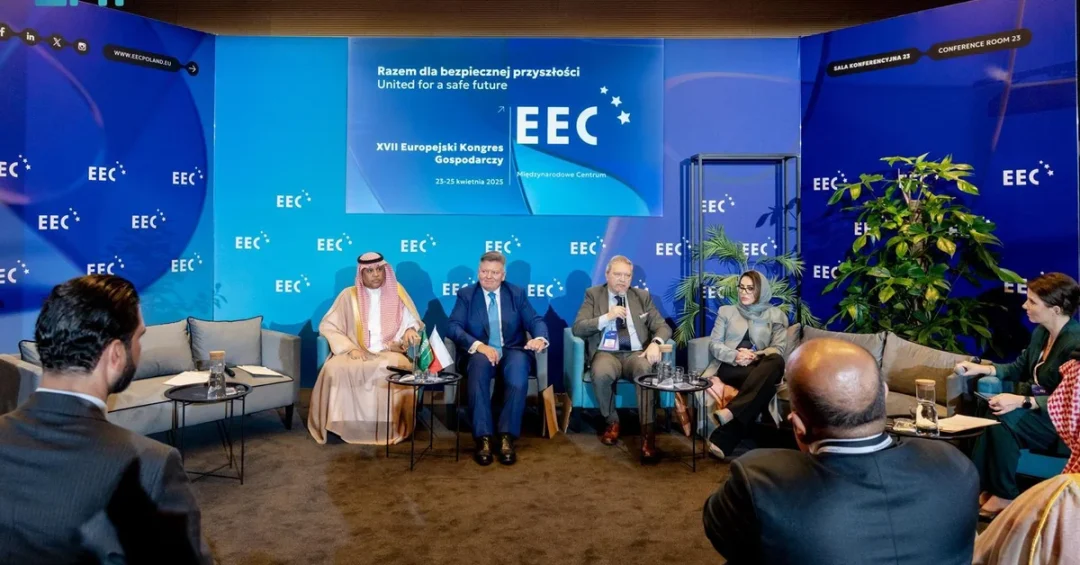
Saudi Arabia participated in the 17th European Economic Congress in Katowice, Poland, from April 23 to 25, 2025, with a high-level delegation led by Ambassador Saad bin Saleh Al-Saleh, Undersecretary of the Ministry of Investment for International Relations Sara Al-Sayed, and Deputy Governor of the Saudi General Authority for Foreign Trade Abdulaziz Al-Sakran. The delegation, which also included representatives from the Federation of Saudi Chambers of Commerce and the Saudi-Polish Business Council, engaged in a series of meetings, workshops, and dialogue sessions aimed at strengthening economic ties between the Kingdom and Poland. The congress, one of Europe’s largest economic forums, provided a platform for Saudi Arabia to showcase its investment opportunities and highlight the economic transformations underway as part of Saudi Vision 2030.
What does Saudi Arabia’s active participation in such a prestigious European economic gathering signal about its global economic ambitions? It underscores the Kingdom’s commitment to diversifying its economy and building robust international partnerships. By sending a delegation of senior officials and business leaders, Saudi Arabia demonstrated its seriousness about expanding trade and investment flows with Europe, a key region for its long-term economic strategy. The meetings in Katowice are part of a broader push to attract foreign investment, share expertise, and position the Kingdom as a pivotal player in the global economy. As the world’s attention turns to emerging markets and sustainable development, Saudi Arabia’s presence at the European Economic Congress reinforces its role as a proactive and reliable partner.
Context and Background
Why has the European Economic Congress become such a vital platform for Saudi Arabia’s international economic engagement? Held annually in Katowice, Poland, the congress brings together thousands of business leaders, policymakers, and experts from across Europe and beyond. For Saudi Arabia, participation in this forum is a strategic opportunity to engage with European counterparts, particularly as the Kingdom seeks to deepen its economic ties with the European Union. Poland, as one of the fastest-growing economies in Europe, represents a key partner for Saudi Arabia in areas such as trade, investment, and technology transfer. The 17th edition of the congress focused on themes like digital transformation, energy transition, and global supply chains—all areas where Saudi Arabia is making significant strides.
The Saudi delegation’s presence in Katowice is also a reflection of the Kingdom’s broader outreach to Europe under the framework of Saudi Vision 2030. Since the launch of the Vision in 2016, Saudi Arabia has sought to diversify its economy away from oil dependence, and Europe has emerged as a crucial source of investment, technology, and expertise. The European Economic Congress provides a unique setting for Saudi officials and business leaders to engage directly with European companies, understand their priorities, and present the Kingdom’s own value proposition. Moreover, the participation of the Saudi-Polish Business Council highlights the importance of bilateral business networks in facilitating trade and investment. This year’s congress was particularly significant as it coincided with ongoing global efforts to reshape supply chains and foster sustainable economic growth.
Key Details
What concrete outcomes and discussions took place during the Saudi delegation’s visit to Katowice? The delegation held a high-level meeting with the Polish Deputy Minister of Economic Development and Technology to discuss bilateral economic relations and strategies to enhance investment and trade exchange. They also conducted meetings and workshops with representatives from various companies attending the congress, presenting the investment opportunities available in the Kingdom. These workshops provided a platform for Saudi officials to highlight sectors such as renewable energy, tourism, technology, and manufacturing, where Saudi Arabia offers attractive incentives for foreign investors. The delegation also engaged in a dialogue session focused on Saudi-Polish economic and trade relations, where they discussed areas of cooperation, examined available opportunities, and reviewed the economic transformations occurring in the Kingdom under Saudi Vision 2030.
The dialogue session was particularly notable for its emphasis on the Kingdom’s economic reforms and the enabling environment for foreign investment. Sara Al-Sayed, Undersecretary of the Ministry of Investment for International Relations, underscored the regulatory changes and incentives that have made Saudi Arabia a top destination for global investors. Abdulaziz Al-Sakran, Deputy Governor of the Saudi General Authority for Foreign Trade, highlighted the growing trade volume between Saudi Arabia and Poland and the potential for further expansion. The delegation also met with Polish companies interested in entering the Saudi market, discussing joint ventures and partnerships in areas such as food security, logistics, and advanced manufacturing. These interactions are expected to pave the way for new agreements and collaborations in the near future.
International and Regional Impact
How does Saudi Arabia’s engagement with Europe at the European Economic Congress influence its broader international standing? The Kingdom’s active participation in Katowice sends a strong signal that it is open for business and committed to multilateral economic cooperation. It reinforces Saudi Arabia’s position as a bridge between Europe, Asia, and Africa, leveraging its strategic location and economic weight. For Europe, Saudi Arabia represents not only a reliable energy supplier but also a growing market for European goods and services, as well as a partner in addressing global challenges such as climate change and digital transformation. The meetings in Katowice also contribute to the diversification of Saudi Arabia’s international partnerships, reducing reliance on any single region and enhancing its resilience in a multipolar world.
Regionally, the congress provided an opportunity for Saudi Arabia to showcase its leadership in the Middle East and its role as a stabilizing economic force. By engaging with European policymakers and business leaders, the Kingdom can help shape perceptions and build alliances that support its Vision 2030 goals. The presence of the Saudi-Polish Business Council underscores the importance of people-to-people ties and institutional linkages in fostering long-term economic relationships. Moreover, the discussions on investment and trade align with Saudi Arabia’s efforts to attract foreign direct investment (FDI) as part of its National Investment Strategy, which aims to increase FDI to 5.7% of GDP by 2030. The congress thus served as a vital platform for advancing these objectives on a European stage.
Economic and Strategic Significance
What makes the European Economic Congress strategically important for Saudi Arabia’s economic diversification agenda? The congress offers direct access to European investors, innovators, and market leaders—key partners in the Kingdom’s quest to develop new sectors and create jobs for its young population. The meetings in Katowice focused on sectors that are central to Vision 2030, such as renewable energy, where Saudi Arabia aims to generate 50% of its electricity from clean sources by 2030. European companies possess cutting-edge technologies in solar, wind, and green hydrogen, and the congress facilitated discussions on potential collaborations. Similarly, in tourism, Saudi Arabia is opening up to the world, and European tour operators and hospitality firms can play a major role in developing the Kingdom’s tourism infrastructure, aligned with the goal of attracting 150 million visitors annually by 2030.
The strategic significance also lies in the opportunity to learn from Poland’s own economic transformation. Poland has successfully transitioned to a market economy and achieved sustained growth, becoming a key player in Europe. Saudi Arabia can draw lessons from Poland’s experience in areas such as small and medium enterprise development, innovation ecosystems, and industrial modernization. The dialogue session allowed for an exchange of best practices and identified areas where Polish expertise could support Saudi Arabia’s own reform journey. Furthermore, the congress enabled Saudi Arabia to promote its mega-projects, including NEOM, the Red Sea Project, and Qiddiya, which offer vast investment opportunities for European firms. These projects are not only economic engines but also symbols of the Kingdom’s ambition and openness.
Vision 2030 Alignment
How does Saudi Arabia’s participation in the European Economic Congress directly support the objectives of Saudi Vision 2030? The Vision, launched by Crown Prince Mohammed bin Salman in 2016, aims to transform the Kingdom into a diversified, innovation-driven economy. International engagement is a cornerstone of this strategy, and the congress provided a platform to promote the Kingdom’s investment climate, highlight reforms, and build partnerships that can accelerate progress. The delegation’s meetings with Polish officials and business leaders align with the Vision’s goals of increasing non-oil exports, boosting FDI, and enhancing the competitiveness of Saudi industries. By presenting the economic transformations underway, the delegation reinforced the message that Saudi Arabia is a land of opportunity, open to collaboration and committed to sustainable development.
Looking ahead, the connections made in Katowice are expected to yield tangible results, from joint ventures to knowledge-sharing agreements. The Saudi-Polish Business Council will continue to play a vital role in facilitating these partnerships. As Saudi Arabia marches toward 2030, its active participation in global economic forums like the European Economic Congress will remain essential to achieving its ambitious targets. The Kingdom’s presence in Katowice is a testament to its forward-looking vision and its determination to build a prosperous future in partnership with the world. With each such engagement, Saudi Arabia strengthens its position as a global economic leader and a catalyst for regional and international growth.
20 Questions
Q1. What was the 17th European Economic Congress and where was it held?
A1. The 17th European Economic Congress was a major economic forum held in Katowice, Poland, from April 23 to 25, 2025. It brought together business leaders, policymakers, and experts from Europe and beyond to discuss key economic issues.
Q2. Who led the Saudi delegation to the congress?
A2. The Saudi delegation was led by Ambassador Saad bin Saleh Al-Saleh, Undersecretary of the Ministry of Investment for International Relations Sara Al-Sayed, and Deputy Governor of the Saudi General Authority for Foreign Trade Abdulaziz Al-Sakran.
Q3. Which Saudi organizations were represented in the delegation?
A3. The delegation included representatives from the Federation of Saudi Chambers of Commerce and the Saudi-Polish Business Council, highlighting the involvement of both government and private sector entities.
Q4. What was the purpose of the Saudi delegation’s meeting with the Polish Deputy Minister of Economic Development and Technology?
A4. The meeting aimed to discuss economic relations between Saudi Arabia and Poland and explore strategies to enhance investment and trade exchange between the two countries.
Q5. What types of activities did the Saudi delegation engage in during the congress?
A5. The delegation held meetings and workshops with company representatives, participated in a dialogue session on Saudi-Polish economic relations, and presented investment opportunities available in the Kingdom.
Q6. What was the focus of the dialogue session involving the Saudi delegation?
A6. The dialogue session focused on economic and trade relations between Saudi Arabia and Poland, areas of cooperation, available investment and trade opportunities, and the economic transformations in Saudi Arabia under Vision 2030.
Q7. How does Saudi Arabia’s participation in the congress align with Vision 2030?
A7. Participation aligns with Vision 2030 by promoting economic diversification, attracting foreign investment, and building international partnerships that support the Kingdom’s goals of reducing oil dependence and fostering sustainable growth.
Q8. What sectors were highlighted as investment opportunities for European companies?
A8. Sectors such as renewable energy, tourism, technology, manufacturing, food security, logistics, and advanced manufacturing were highlighted as key areas for investment and collaboration.
Q9. What is the significance of the Saudi-Polish Business Council in these efforts?
A9. The Saudi-Polish Business Council facilitates bilateral trade and investment by connecting businesses from both countries, promoting joint ventures, and supporting knowledge exchange.
Q10. How does Saudi Arabia benefit from engaging with Poland specifically?
A10. Poland offers expertise in areas like SME development, innovation, and industrial modernization, and serves as a gateway to the broader European market, making it a valuable partner for Saudi Arabia.
Q11. What are some of the mega-projects Saudi Arabia is promoting to European investors?
A11. Saudi Arabia is promoting mega-projects such as NEOM, the Red Sea Project, and Qiddiya, which offer vast opportunities in construction, tourism, technology, and renewable energy.
Q12. How does the congress contribute to Saudi Arabia’s goal of increasing foreign direct investment?
A12. The congress provides a platform to showcase Saudi Arabia’s investment climate and reforms, directly engaging European investors and potentially leading to increased FDI inflows.
Q13. What economic reforms has Saudi Arabia implemented to attract foreign investment?
A13. Reforms include regulatory changes, incentives for investors, streamlined business setup processes, and the establishment of special economic zones to create a business-friendly environment.
Q14. What is the expected impact of the meetings on Saudi-Polish trade relations?
A14. The meetings are expected to strengthen trade ties, lead to new agreements, and increase bilateral trade volume, benefiting both economies through enhanced cooperation.
Q15. How does Saudi Arabia’s participation reflect its broader international economic strategy?
A15. It reflects a strategy of active global engagement, diversification of partnerships, and positioning the Kingdom as a key player in the global economy, open to collaboration and investment.
Q16. What role does the Federation of Saudi Chambers of Commerce play in such delegations?
A16. The Federation represents the Saudi private sector, facilitates business networking, and helps identify opportunities for collaboration between Saudi and foreign companies.
Q17. How does the congress help Saudi Arabia learn from Poland’s economic transformation?
A17. It allows for exchange of best practices in areas like SME development, innovation, and industrial modernization, which can inform Saudi Arabia’s own reform efforts.
Q18. What are the key targets of Saudi Vision 2030 related to international economic engagement?
A18. Key targets include increasing non-oil exports, boosting FDI to 5.7% of GDP, attracting 150 million visitors annually, and generating 50% of electricity from renewable sources by 2030.
Q19. How does Saudi Arabia’s presence at the congress enhance its image internationally?
A19. It showcases the Kingdom’s openness, economic progress, and commitment to global cooperation, enhancing its reputation as a reliable and forward-looking partner.
Q20. What are the next steps following the Saudi delegation’s participation?
A20. Next steps include follow-up meetings, potential agreements, and continued engagement through the Saudi-Polish Business Council to translate discussions into tangible economic outcomes.
Reader Feedback
We value your thoughts. Please share your feedback on this article.
Your feedback helps us improve our coverage.
Related articles
 U.S.-Saudi Business Council Hosts High-Level Investment Event
 Saudi Dairy Forum Concludes with Deals Exceeding SAR150 Million
 AviLease Places Order for up to 77 Airbus A320neo Family and A350F Aircraft
 Riyadh Air Announces Purchase of 50 A350-1000 Airplanes at Paris Air Show
 Mawani Launches New IM2 Shipping Service at Jeddah Islamic Port
 Saudi Chambers Federation Chairman Meets with Ethiopian and Senegalese Ambassadors