


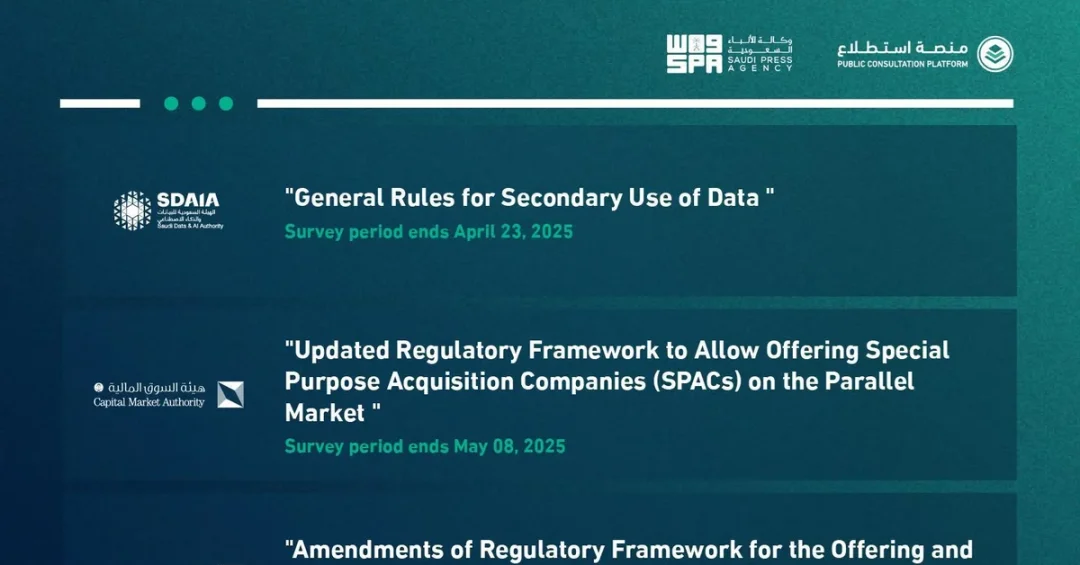
Saudi Arabia’s National Competitiveness Center has opened public consultation on 20 economic and development projects through its Istitlaa platform, inviting citizens, government entities, and the private sector to submit feedback before final approval. The announcement, released via the Saudi Press Agency on April 14, 2025, marks one of the largest single batches of draft regulations ever placed before the public in the Kingdom, spanning data governance, capital markets, and business-environment reform. The initiative is being delivered in cooperation with 10 government agencies, underscoring the whole-of-government approach that now characterises Saudi policymaking under Vision 2030. For international observers, the move signals a legislative environment that is becoming more transparent, more participatory, and more predictable — three qualities global investors consistently rank among their top criteria when allocating capital to emerging markets. But what does it actually mean when a government invites its public to help write the rules?
The Istitlaa platform, formally known as the Public Consultation Platform, was launched to give stakeholders a direct channel into the regulatory process before draft laws are finalised. Rather than presenting businesses and citizens with a fait accompli, Saudi regulators now publish proposed frameworks, set consultation windows, and publish the resulting feedback. The 20 projects currently open for comment cover a deliberately broad spectrum: from how government data can be reused to how special purpose acquisition companies can list on the Saudi stock exchange. Each project carries its own deadline, with some consultations closing as early as April 23, 2025, and others remaining open into early May. The breadth and pace of the exercise reflect a regulatory machine that is being rebuilt in real time to keep pace with the Kingdom’s economic transformation.
Context and Background
Why has Saudi Arabia placed public consultation at the centre of its legislative reform programme? The answer lies in the scale of the transformation underway. Vision 2030 requires the Saudi economy to diversify away from hydrocarbon dependence, and that diversification depends on a legal infrastructure that can support new industries — artificial intelligence, data services, capital markets, and private-sector enterprise. The National Competitiveness Center, which operates Istitlaa, was established to improve the Kingdom’s business environment and to measure its progress against global benchmarks. By institutionalising public consultation, the centre ensures that regulations are not drafted in isolation but are tested against the practical experience of the companies and individuals who will live under them.
The Istitlaa platform is not a one-off gesture. It has become a standing feature of Saudi governance, with draft regulations, by-laws, and similar instruments routinely published for comment. The introduction of these drafts serves as an affirmation of enhanced transparency in the legislative environment. Istitlaa fosters a culture of public participation by enabling citizens, government agencies, and the private sector to contribute their insights and feedback on proposed regulations related to the business environment. This participatory model mirrors best practice in mature economies such as Singapore, the United Kingdom, and Canada, where regulatory consultation is a standard part of the policy cycle. Saudi Arabia’s adoption of the same discipline is a signal that its regulatory environment is converging with global norms — a point of considerable interest to multinational firms evaluating entry or expansion in the Kingdom.
The current batch of 20 projects is being developed in cooperation with 10 government agencies, a figure that illustrates the coordinated nature of the reform effort. Rather than each ministry publishing its own rules in isolation, the Istitlaa process aggregates proposals across government and presents them through a single, accessible window. For stakeholders, this reduces the cost of engagement: a business can review multiple related frameworks in one place, submit consolidated feedback, and track outcomes. For the government, it creates a feedback loop that improves the quality of regulation before it is enacted, reducing the risk of unintended consequences and subsequent amendments. In a region where regulatory uncertainty has historically been cited as a barrier to investment, this structured approach represents a meaningful shift.
Key Details
Among the most significant projects in the current batch is the General Rules for Secondary Use of Data, developed by the Saudi Data & AI Authority (SDAIA). The project aims to establish controls and procedures that govern data-sharing requests for secondary use — that is, the reuse of data for purposes beyond those for which it was originally collected. It also enables entities to access data for secondary use purposes that will achieve public interest by enhancing the efficiency of government entities’ operations and activities. The public can provide feedback on this project until April 23, 2025. For anyone tracking Saudi Arabia’s ambition to become a global leader in artificial intelligence and the data economy, this framework matters enormously. Clear rules on secondary data use are the foundation on which AI research, public-health analytics, urban planning, and smart-city development are built. By defining the conditions under which data can be shared and reused, SDAIA is creating the legal certainty that innovators need while simultaneously protecting privacy and public trust.
The Capital Market Authority (CMA) is seeking public feedback on two separate projects. The first is a new updated regulatory framework titled Allow Offering Special Purpose Acquisition Companies (SPACs) on the Parallel Market. This framework aims to facilitate the listing of SPACs on the parallel market by regulating the requirements and conditions to submit requests to the CMA for the registration and offering of SPAC shares. SPACs — blank-cheque companies formed to raise capital through an initial public offering for the purpose of acquiring an existing company — have become a significant feature of global capital markets, particularly in the United States. Their introduction to the Saudi parallel market, known as Nomu, would give Saudi and regional companies an alternative route to public listing, while offering investors a new asset class. The second CMA project is a new amendment regulatory framework titled Offering and Listing of Different Classes of Shares, which aims to regulate the offering and listing process for various classes of shares. This would allow companies to issue shares with differentiated rights — for example, dual-class structures that give founders or long-term shareholders enhanced voting rights. Such structures are common in technology and growth companies worldwide, and their formal recognition in Saudi Arabia could encourage more entrepreneurial firms to list domestically rather than abroad. Public consultation on these CMA projects will remain open until May 8-9, 2025, giving stakeholders a longer window to respond to the technical detail involved.
The remaining projects in the batch span the wider economic and development agenda, with details available on the Istitlaa platform itself. What unites them is a common purpose: to remove friction from doing business in Saudi Arabia. Whether the subject is data, securities, licensing, or sector-specific rules, each draft regulation is designed to replace ambiguity with clarity. For small and medium-sized enterprises, which Vision 2030 identifies as a key engine of job creation, predictable regulation is particularly valuable. For foreign investors, it is a prerequisite. The fact that these drafts are being published before approval — rather than after — is the detail that distinguishes Saudi Arabia’s current reform cycle from earlier eras. Stakeholders are not being asked to react to rules that already bind them; they are being invited to shape rules that do not yet exist.
International and Regional Impact
How will global markets read Saudi Arabia’s decision to consult the public on capital-market rules? The signal is likely to be positive. International investors have long emphasised that the depth and predictability of a regulatory framework matter as much as the size of a domestic market. By consulting on SPACs and multi-class share structures, the CMA is demonstrating that it is willing to adapt its rulebook to instruments that global investors understand and use. This is not simply a technical exercise; it is a form of market diplomacy. A Saudi parallel market that accommodates SPACs and differentiated share classes becomes more legible to venture capital, private equity, and institutional investors who operate across borders. Over time, that legibility can translate into higher levels of foreign participation, deeper liquidity, and a more diverse issuer base on the Kingdom’s exchanges.
Regionally, the move reinforces Saudi Arabia’s position as the Gulf’s regulatory trendsetter. Other economies in the region watch the Kingdom’s capital markets closely, and reforms adopted in Riyadh often inform practice elsewhere in the Gulf Cooperation Council. The inclusion of data-governance rules in the same consultation batch as securities rules is also notable. It reflects an understanding that modern economies are digital economies, and that the rules governing data are as important to competitiveness as the rules governing capital. For a region racing to build technology sectors, cloud infrastructure, and AI capabilities, Saudi Arabia’s framework for secondary data use could become a reference point. The consultation deadlines — April 23 for SDAIA’s data project and May 8-9 for the CMA’s capital-market projects — give international stakeholders a defined window in which to participate, either directly or through local partners and counsel.
Economic and Strategic Significance
What is the economic value of asking the public before regulating? In quantitative terms, the value lies in avoided costs. Regulations that are drafted without consultation frequently require amendment, generate compliance confusion, and deter investment during the period of uncertainty. By contrast, regulations that have been stress-tested by the businesses they will govern tend to be more durable and more effective. For Saudi Arabia, where the non-oil private sector is being asked to expand rapidly and create jobs for a young population, the quality of regulation is directly linked to the pace of growth. A framework that allows SPACs to list, for example, could accelerate the pipeline of companies seeking public capital. A framework that clarifies data sharing could unlock research and commercial applications that currently stall at legal review.
Strategically, the Istitlaa process supports the Kingdom’s wider goal of becoming a hub for international business and a bridge between regional and global markets. Regulatory transparency is a form of soft power. When a government publishes its draft rules and invites comment, it signals confidence in its own institutions and respect for the views of those it governs. That signal travels. It is noted by credit-rating agencies, by multinational boards evaluating market entry, and by international organisations that benchmark regulatory quality. The National Competitiveness Center’s work through Istitlaa therefore contributes not only to individual regulatory outcomes but to Saudi Arabia’s overall standing in global competitiveness indices — a standing that Vision 2030 explicitly seeks to elevate.
Vision 2030 Alignment
How does a public consultation platform connect to the grand ambitions of Vision 2030? The connection is direct and structural. Vision 2030 envisions a diversified economy, a vibrant society, and an ambitious nation — and all three depend on governance that is transparent, responsive, and efficient. The Istitlaa platform operationalises the vision’s commitment to transparency by making the legislative process visible and participatory. It supports the economic diversification agenda by improving the business environment that new industries require. And it strengthens the social contract by giving citizens a formal voice in the rules that shape their economic lives. In this sense, the 20 projects currently open for feedback are not merely regulatory housekeeping; they are building blocks of the Kingdom’s future.
As the consultations close — SDAIA’s data framework on April 23, 2025, and the CMA’s capital-market frameworks on May 8-9, 2025 — the feedback received will inform final drafts that will then be enacted. The process itself, however, will continue. New batches of projects will follow, each adding another layer to Saudi Arabia’s modernised regulatory architecture. For international readers, the practical takeaway is that Saudi Arabia’s reform programme is not a slogan but a working system, with published drafts, defined timelines, and open channels for input. That system is central to the Kingdom’s long-term vision and to its emerging role as a global hub for investment, innovation, and enterprise. The invitation to participate is open — and the rules being written today will shape the opportunities of tomorrow.
20 Questions
Q1. What is the Istitlaa platform?
A1. Istitlaa is the Public Consultation Platform operated by Saudi Arabia’s National Competitiveness Center. It publishes draft regulations and by-laws from government agencies and invites citizens, government entities, and the private sector to submit feedback before the rules are finalised and approved.
Q2. How many projects are currently open for feedback?
A2. The platform has put forward 20 projects related to economic and development affairs, developed in cooperation with 10 government agencies. Each project has its own consultation window and deadline, with some closing in April 2025 and others in early May 2025.
Q3. Which agency is responsible for the data-sharing project?
A3. The Saudi Data & AI Authority (SDAIA) developed the project titled ‘General Rules for Secondary Use of Data.’ It aims to establish controls and procedures governing data-sharing requests for secondary use and to enable access to data for purposes that serve the public interest.
Q4. When does feedback close on the SDAIA data project?
A4. The public can provide feedback on the General Rules for Secondary Use of Data project until April 23, 2025. Stakeholders are encouraged to review the draft and submit their views through the Istitlaa platform before that date.
Q5. What is a Special Purpose Acquisition Company (SPAC)?
A5. A SPAC is a blank-cheque company formed to raise capital through an initial public offering for the purpose of acquiring an existing company. The CMA’s draft framework aims to facilitate the listing of SPACs on the Saudi parallel market, known as Nomu.
Q6. Which regulator is consulting on SPACs in Saudi Arabia?
A6. The Capital Market Authority (CMA) is seeking public feedback on a new updated regulatory framework titled ‘Allow Offering Special Purpose Acquisition Companies (SPACs) on the Parallel Market,’ which regulates the requirements and conditions for registration and offering of SPAC shares.
Q7. What is the second CMA project open for consultation?
A7. The CMA is also consulting on a new amendment regulatory framework titled ‘Offering and Listing of Different Classes of Shares.’ It aims to regulate the offering and listing process for various classes of shares, including structures with differentiated rights.
Q8. When do the CMA consultations close?
A8. Public consultation on the CMA’s two projects will remain open until May 8-9, 2025. This window gives stakeholders additional time to review the technical details and submit considered feedback on both capital-market frameworks.
Q9. Why is public consultation important for Saudi Arabia’s economy?
A9. Public consultation improves regulatory quality by testing draft rules against the practical experience of businesses and citizens. This reduces the risk of unintended consequences, lowers compliance costs, and enhances the predictability that investors need when allocating capital to the Kingdom.
Q10. How does Istitlaa enhance transparency?
A10. Istitlaa publishes draft regulations, by-laws, and similar instruments before approval, allowing stakeholders to see proposed rules and respond. This openness affirms enhanced transparency in the legislative environment and fosters a culture of public participation in regulatory development.
Q11. Who can participate in the consultations?
A11. The general public, government agencies, and the private sector are all invited to express their views and feedback on the projects. Participation is open to anyone with relevant expertise or interest in the proposed regulatory frameworks.
Q12. How does the SPAC framework benefit investors?
A12. The framework would give investors access to a new asset class on the Saudi parallel market and provide an alternative route for companies seeking public listing. It aligns Saudi capital-market practice with instruments widely used in global financial centres.
Q13. What are different classes of shares?
A13. Different classes of shares are shares that carry differentiated rights, such as enhanced voting rights for founders or long-term shareholders. The CMA’s draft framework would regulate their offering and listing, supporting entrepreneurial firms that wish to list domestically.
Q14. How does the data project support AI development?
A14. Clear rules on secondary data use provide the legal certainty needed for AI research, analytics, and innovation. By defining how data can be shared and reused for public-interest purposes, SDAIA supports the growth of the Kingdom’s digital economy while protecting privacy.
Q15. What role does the National Competitiveness Center play?
A15. The National Competitiveness Center operates the Istitlaa platform and coordinates consultation across government agencies. It works to improve Saudi Arabia’s business environment and to measure progress against global competitiveness benchmarks.
Q16. How many government agencies are involved in this batch?
A16. Ten government agencies are cooperating on the 20 projects currently open for feedback. This coordinated approach aggregates proposals across government and presents them through a single accessible platform for stakeholders.
Q17. What happens after the consultation closes?
A17. Feedback received during the consultation window informs the final drafts of the regulations. Once revised, the frameworks proceed through the normal approval process before being enacted and implemented by the relevant authorities.
Q18. How does Istitlaa compare with international practice?
A18. Istitlaa mirrors regulatory consultation practice in mature economies such as Singapore, the United Kingdom, and Canada. Its adoption in Saudi Arabia signals convergence with global norms and reinforces the Kingdom’s attractiveness to international investors.
Q19. What is the strategic value of regulatory transparency?
A19. Regulatory transparency signals confidence in institutions and respect for stakeholders. It is noted by credit-rating agencies, multinational boards, and international organisations, and it contributes to Saudi Arabia’s standing in global competitiveness indices.
Q20. How does Istitlaa align with Vision 2030?
A20. Istitlaa operationalises Vision 2030’s commitment to transparency and good governance. It supports economic diversification by improving the business environment, and it strengthens public participation in the rules that shape the Kingdom’s economic future.
Reader Feedback
We value your thoughts. Please share your feedback on this article.
Your feedback helps us improve our coverage.
Related articles
 NEOM Fund Invests in Biomanufacturing for Food Security
 Made in Saudi Pavilion Showcases 28 Tech Firms at GITEX AFRICA
 Estidama Explores Asparagus Cultivation in Saudi Arabia
 SASO Delegation Visits Malaysia to Enhance Trade, Product Safety
 Biban 24 Wins MUSE Creative Award for Best Entrepreneurship Event
 Rose and Aromatic Plants Global Forum Continues in Taif