


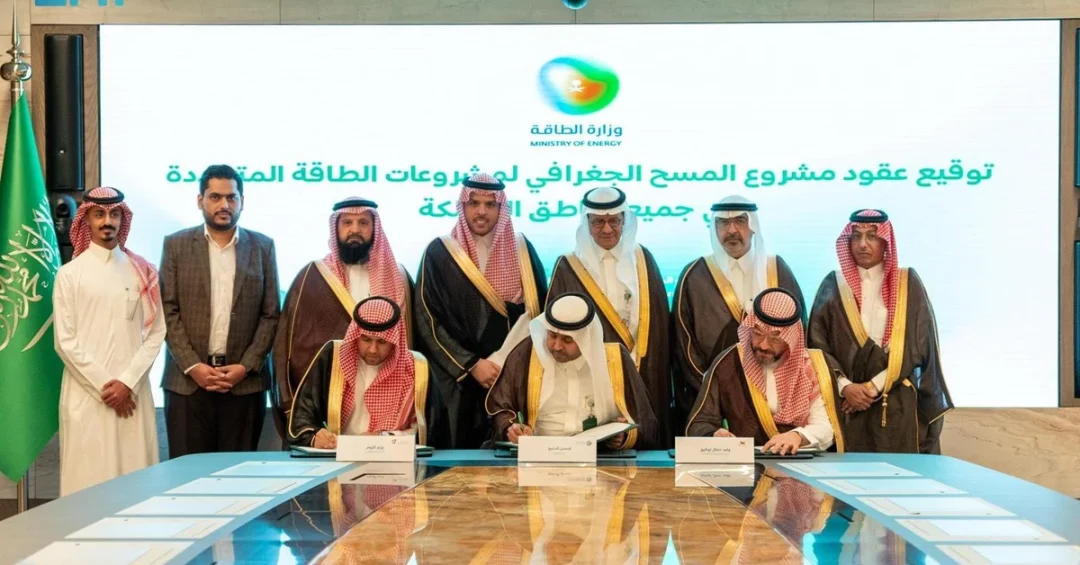
The Ministry of Energy has launched a groundbreaking Geographic Survey Project for Renewable Energy sites across Saudi Arabia, a move that marks a global first in terms of geographical coverage. The launch was attended by His Royal Highness Prince AbdulAziz bin Salman bin AbdulAziz Al Saud, Minister of Energy, and contracts were signed with Saudi companies to install 1,200 stations measuring solar and wind energy across all regions of the Kingdom.
Context and Background
The project, a core component of the National Renewable Energy Program, is designed to map the Kingdom’s renewable energy potential on an unprecedented scale. In a statement following the contract signing, the Minister of Energy emphasized that no other country has undertaken a geographic survey of this magnitude. The survey will cover over 850,000 square kilometers—roughly the combined land area of the United Kingdom and France, or Germany and Spain—excluding populated areas, sand dunes, and airspace restrictions. This initiative aligns with Saudi Arabia’s Vision 2030, which prioritizes energy diversification and sustainability.
The project underscores the Kingdom’s commitment to leading the region in renewable energy development. By deploying advanced measurement stations, Saudi Arabia aims to identify the most viable sites for renewable projects, optimizing resource allocation and ensuring the most efficient utilization of solar and wind assets.
Key Details
The first phase will involve moving the stations to survey the designated area, subsequently relocating them to the most promising sites for continuous data collection. Solar energy stations will record Direct Normal Irradiance (DNI), Global Horizontal Irradiance (GHI), Diffuse Horizontal Irradiance (DHI), dust and pollutant deposition, albedo, ambient temperature, rainfall, humidity, and atmospheric pressure. Wind energy stations, installed at heights up to 120 meters, will track wind speed, direction, and related climatic parameters.
Data collection will employ advanced technologies and global best practices, feeding into a centralized platform at the Ministry of Energy that monitors, records, and transmits data 24/7. The platform will use artificial intelligence to analyze and rank sites based on suitability for renewable projects, making the data financeable to meet local and international financial institution standards. This will expedite land allocation for projects and reduce the waiting period for data from 18–24 months to immediate, while reducing risks and increasing investment attractiveness.
Implications and Impact
This initiative is a strategic enabler for Saudi Arabia’s renewable energy ambitions, reinforcing the Kingdom’s position as a leader in the global energy transition. By providing comprehensive, accurate, and continuously updated data, the project will help attract investors and developers, accelerating the deployment of renewable energy capacity. The initiative also supports the Liquid Fuel Displacement Program, reducing dependence on liquid fuels in electricity generation, and fosters a robust infrastructure for clean hydrogen production and export.
Vision 2030 Alignment
The project is a significant step toward achieving the Vision 2030 energy mix targets, with renewable sources aiming to constitute about 50% of electricity production by 2030. Starting this year, the Kingdom will tender new renewable projects with a capacity of 20 gigawatts annually, targeting between 100 and 130 gigawatts by 2030. The Minister of Energy expressed gratitude to the Custodian of the Two Holy Mosques King Salman and Crown Prince Mohammed bin Salman for their support, emphasizing that the project reflects the Kingdom’s commitment to a sustainable and prosperous future, and its role as a global leader in renewable energy production and export.
20 Questions
Q1. What is the primary purpose of the Geographic Survey Project?
A1. The project aims to identify the best sites for renewable energy projects in Saudi Arabia by measuring solar and wind energy resources across an unprecedentedly large area, supporting the Kingdom’s Vision 2030.
Q2. Who launched the project and under what authority?
A2. The project was launched by the Ministry of Energy under the supervision of His Royal Highness Prince Abdulaziz bin Salman bin Abdulaziz Al Saud, Minister of Energy, in the presence of officials.
Q3. How many stations will be installed for the survey?
A3. The project will install 1,200 stations that measure solar and wind energy, distributed across all regions of the Kingdom to ensure comprehensive coverage.
Q4. What area will the survey cover?
A4. The survey will cover more than 850,000 square kilometers, excluding populated areas, sand dunes, and airspace restrictions, an area comparable to the size of multiple large countries combined.
Q5. How does the survey area compare in size to other countries?
A5. The area is roughly equivalent to the land area of the United Kingdom and France combined, or Germany and Spain combined, illustrating the unprecedented scale of the project.
Q6. Is there any precedent for such a survey globally?
A6. No, no other country has conducted a geographic survey of renewable energy sites on such a large scale, making this a global first.
Q7. What will the project contribute to the renewable energy sector?
A7. It will help identify the best locations for developing renewable energy projects, optimizing resource utilization and enhancing project efficiency.
Q8. How will the stations operate in the first phase?
A8. In the first phase, stations will survey the designated area across the Kingdom to find suitable sites, then move to these sites for detailed data collection.
Q9. What specific solar data will be collected?
A9. Solar stations will record DNI, GHI, DHI, dust and pollutant deposition, albedo, ambient temperature, rainfall, humidity, and atmospheric pressure.
Q10. What wind-related measurements will be taken?
A10. Wind stations will measure wind speed and direction, as well as ambient temperature, atmospheric pressure, and relative humidity, at heights up to 120 meters.
Q11. How will the data be processed and analyzed?
A11. Data will be collected and transmitted to a centralized platform at the Ministry of Energy, where it will be analyzed using artificial intelligence for site ranking.
Q12. What is the role of artificial intelligence in the project?
A12. AI will process and interpret the data to assess and rank sites based on suitability, ensuring precise and efficient decision-making for project implementation.
Q13. How will this project reduce the time to get energy data?
A13. The continuous data availability eliminates the previous 18 to 24 months waiting period, allowing immediate land allocation and faster project announcements.
Q14. How does the data become financeable?
A14. The accuracy and constant updating of data make it compliant with financial institution requirements, thus it is considered financeable for investments.
Q15. What are the benefits for investors?
A15. Reliable data reduces implementation risks, increases investment attractiveness, and encourages both local and foreign investors to participate in renewable projects.
Q16. How does this project align with Saudi Arabia’s energy targets?
A16. It supports achieving a mix where renewable energy makes up about 50% of electricity by 2030 and the goals of the Liquid Fuel Displacement Program.
Q17. What future renewable capacity does the Kingdom plan?
A17. Starting in 2024, 20 GW will be tendered annually, with a target of 100–130 GW by 2030, depending on electricity demand growth.
Q18. How will the project help clean hydrogen production?
A18. By optimizing renewable resource use, it will support the Kingdom’s aim to produce clean hydrogen as part of its sustainable energy export strategy.
Q19. Who provided the ongoing support for this project?
A19. The project is supported by the Custodian of the Two Holy Mosques King Salman and Crown Prince Mohammed bin Salman, who serve as the Supreme Committee for Energy Mix.
Q20. What is the overall significance of the project?
A20. It reinforces Saudi Arabia’s global leadership in renewable energy, aligns with Vision 2030’s sustainability goals, and positions the Kingdom as a major energy exporter.
Reader Feedback
We value your thoughts. Please share your feedback on this article.
Your feedback helps us improve our coverage.