


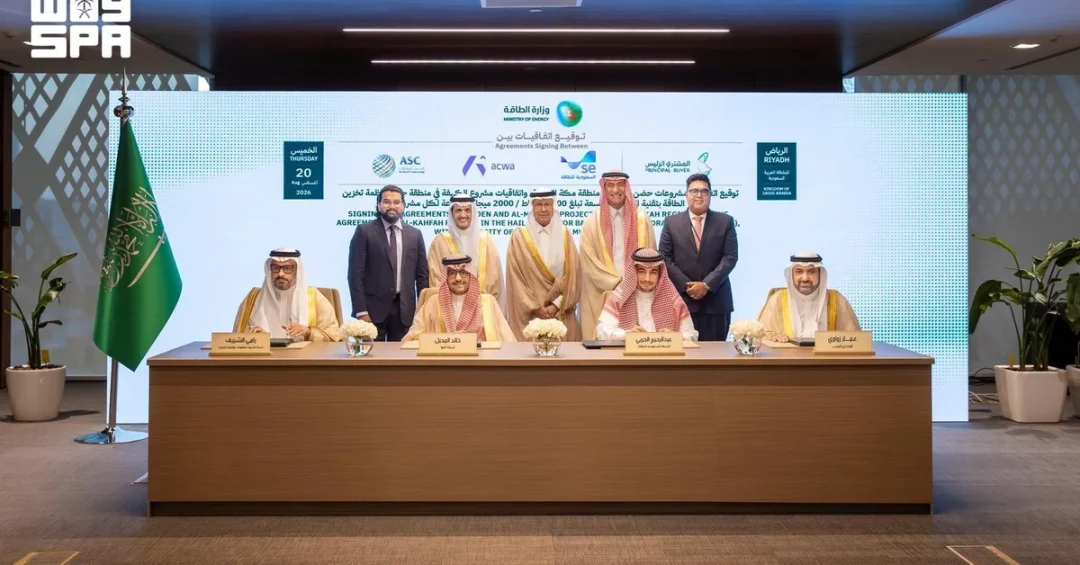
Saudi Arabia’s Principal Buyer, the Saudi Power Procurement Company, signed four Battery Energy Storage System (BESS) storage service agreements on August 21, 2026, adding a combined 2,000 MW of four-hour storage capacity to the Kingdom’s electricity system through investments exceeding SAR4.35 billion (approximately USD 1.16 billion). The agreements, concluded under the supervision of the Ministry of Energy, mark the first group of BESS projects procured under a build-own-operate model and represent a decisive step in Saudi Arabia’s drive to modernize its power infrastructure and integrate renewable energy at scale. The signing ceremony took place in the presence of Prince Abdulaziz bin Salman bin Abdulaziz, Minister of Energy, Minister of Industry and Mineral Resources, and Chairman of the Board of Managers of the Principal Buyer.
The four projects — Al Muwyah BESS ISP and Haden BESS ISP in Makkah Region, Al Kahafa BESS ISP in Hail Region, and Al Khushaybi BESS ISP in Qassim Region — each deliver 500 MW of capacity with a four-hour discharge duration, meaning every facility can supply 2,000 MWh of stored electricity to the grid. Three of the projects were awarded to a consortium comprising Saudi Energy, ACWA, and Al Sharif Contracting and Commercial Development Company, while Al Khushaybi BESS ISP was awarded to a consortium of ENGIE and Haji Abdullah Alireza & Co. Ltd. Announced via the Saudi Press Agency (SPA), the deals underscore how far the Kingdom has moved from vision to execution in its energy transition. Why does storage matter so much right now? Because the reliability of a renewable-heavy grid depends on it.
Context and Background
How did Saudi Arabia arrive at a point where it is procuring grid-scale batteries by the gigawatt? The answer lies in a decade of deliberate reform. Under Saudi Vision 2030, the Kingdom set out to diversify its economy and its energy mix, reducing dependence on liquid fuels for power generation while meeting rapidly rising electricity demand from industry, data centers, and a growing population. The Ministry of Energy has led this effort, supported by the Saudi Power Procurement Company, known as the Principal Buyer, which conducts pre-development studies, tenders generation and storage projects, and signs power purchase and storage service agreements with developer consortia.
The Principal Buyer’s mandate is central to the National Renewable Energy Program, which aims to have renewable sources supply roughly half of the Kingdom’s electricity generation mix by 2030. Solar and wind projects have already been awarded at record-low tariffs across the country, but intermittent generation requires a partner technology: storage. Batteries absorb surplus solar power during daylight hours and discharge it during evening peaks, stabilizing frequency and voltage while reducing the need for fossil-fueled spinning reserves. The first BESS group therefore functions as the missing link that allows the Kingdom’s expanding renewable fleet to operate at maximum effectiveness.
The build-own-operate model used for these projects is equally significant. Rather than owning and operating storage assets directly, the state procures storage as a service through long-term agreements, transferring technology risk and operational responsibility to experienced international and Saudi developers. This approach has already attracted global energy majors and deepened local supply chains. Isn’t it notable that a single procurement round has drawn consortia combining Saudi capital, Gulf expertise, and European engineering? That mix is precisely what the Kingdom’s energy strategy intends to cultivate.
Key Details of the Four Agreements
The first group of BESS projects is geographically dispersed to strengthen different regions of the national grid. Al Muwyah BESS ISP and Haden BESS ISP are located in Makkah Region, home to the Holy City of Makkah and the largest concentrations of electricity demand during Hajj and Umrah seasons. Al Kahafa BESS ISP sits in Hail Region in the north-central part of the country, while Al Khushaybi BESS ISP is in Qassim Region, an agricultural and industrial heartland. Each facility provides 500 MW of power with four hours of storage duration, for a combined 2,000 MW and 8,000 MWh of total stored energy capacity.
The consortium structure reflects a deliberate balance between Saudi and international partners. Saudi Energy, ACWA, and Al Sharif Contracting and Commercial Development Company will deliver the Makkah and Hail projects, combining one of the Kingdom’s leading renewable developers with local contracting capability. ENGIE, the French multinational utility, and Haji Abdullah Alireza & Co. Ltd., a long-established Saudi trading and contracting house, will deliver the Qassim project. Total investment across the four agreements exceeds SAR4.35 billion, equivalent to about USD 1.16 billion, a figure that signals both the scale of the assets and investor confidence in Saudi Arabia’s regulatory framework.
What do these numbers mean in practical terms for households and businesses? A 2,000 MW battery fleet with four-hour duration can shift a substantial share of daytime solar output to evening peak hours, when demand is highest and the grid is most stressed. It also provides fast-response reserves that can stabilize the system within milliseconds if a generator trips or a transmission line faults. Storage of this kind reduces curtailment of renewable energy, lowers the need for inefficient peaking plants, and improves the overall economics of the electricity system. For a grid preparing to absorb tens of gigawatts of solar and wind, that flexibility is not a luxury — it is a prerequisite.
International and Regional Impact
How will these agreements be read beyond Saudi borders? For international energy markets, the message is that the Kingdom is now a major buyer of grid-scale storage technology, batteries, inverters, and control systems, creating commercial opportunities for manufacturers and engineering firms across Asia, Europe, and North America. The participation of ENGIE alongside Saudi partners demonstrates that leading global utilities view the Kingdom’s procurement framework as bankable and transparent. The presence of ACWA, already one of the world’s largest renewable developers, reinforces the emergence of Saudi champions capable of delivering complex energy infrastructure at home and abroad.
Regionally, the projects strengthen the reliability of the Gulf’s largest electricity system at a time when interconnections between Gulf Cooperation Council states are expanding. A more flexible Saudi grid can support cross-border power trading, improve resilience during summer peaks, and serve as a stabilizing anchor for the wider region. The Makkah Region projects carry additional significance given the Kingdom’s responsibility to host millions of pilgrims each year; ensuring uninterrupted power in and around the Holy City is a matter of national priority and global interest. In this light, the BESS program is not merely an infrastructure story — it is an expression of Saudi Arabia’s role as a reliable energy partner and a responsible custodian of the Two Holy Mosques.
Economic and Strategic Significance
What does SAR4.35 billion of storage investment signal about the Kingdom’s economic direction? First, it demonstrates the scale of capital now flowing into non-oil sectors, a central objective of Vision 2030. Second, it deepens local content: contracting, construction, operations, and maintenance for four large battery sites will generate skilled employment and supplier opportunities in Makkah, Hail, and Qassim regions. Third, it builds institutional expertise within Saudi entities such as the Principal Buyer, which is developing one of the most sophisticated energy procurement programs in the world.
Strategically, storage enhances the Kingdom’s ability to meet its own climate and diversification targets while preserving its role as a leading global energy exporter. By freeing more natural gas and liquids for higher-value uses, including petrochemicals and export, batteries contribute to the efficiency of the entire energy economy. The build-own-operate model also keeps public capital focused on enabling infrastructure while private consortia carry construction and performance risk. This is a template the Kingdom intends to repeat: further BESS groups are expected as renewable capacity expands toward the 2030 target of approximately 50 percent renewable generation. Isn’t it telling that the first group alone matches the storage capacity of many mid-sized national grids? It shows the ambition of the program.
Vision 2030 Alignment
The four BESS agreements sit squarely within Saudi Vision 2030, which seeks a diversified, sustainable, and globally competitive economy. Reliable, low-carbon electricity is the foundation on which the Kingdom’s industrial strategy, digital economy, and quality-of-life initiatives are built. Battery storage enables the National Renewable Energy Program to deliver on its promise, supports the Kingdom’s stated goal of achieving an optimal generation mix of about 50 percent renewable energy by 2030, and reinforces Saudi Arabia’s leadership in global energy affairs. It also contributes to the broader sustainability agenda, including efforts to reduce emissions and modernize the power sector in line with international best practice.
The signing of these agreements under the supervision of the Ministry of Energy, and in the presence of Prince Abdulaziz bin Salman bin Abdulaziz, reflects the coherence of Saudi energy policy: clear targets, competitive procurement, strong institutions, and a welcoming environment for world-class partners. As the Kingdom continues to award renewable generation and storage projects, the first BESS group will serve as a benchmark for delivery, performance, and local value creation. For international observers, the message is straightforward: Saudi Arabia is building the grid of the future, and it is doing so with the same seriousness and scale that made it a pillar of global energy security for decades. The next groups of storage projects will be watched closely — and rightly so.
20 Questions
Q1. What did the Principal Buyer sign on August 21, 2026?
A1. The Saudi Power Procurement Company signed four Battery Energy Storage System storage service agreements with developer consortia, adding 2,000 MW of four-hour storage capacity to the Kingdom’s electricity system under the supervision of the Ministry of Energy.
Q2. What is the total investment value of the four BESS projects?
A2. The four projects involve total investment of more than SAR4.35 billion, approximately USD 1.16 billion, reflecting the scale of Saudi Arabia’s commitment to modernizing its electricity infrastructure.
Q3. Which regions host the first group of BESS projects?
A3. The projects are located in Makkah Region, Hail Region, and Qassim Region, distributing storage capacity across key areas of the national grid to strengthen reliability and support growing demand.
Q4. What capacity does each individual BESS project provide?
A4. Each of the four projects provides 500 MW of capacity with a four-hour storage duration, meaning each facility can supply 2,000 MWh of stored electricity to the grid when needed.
Q5. Which consortium won the Makkah and Hail projects?
A5. Al Muwyah, Haden, and Al Kahafa BESS ISP projects were awarded to a consortium comprising Saudi Energy, ACWA, and Al Sharif Contracting and Commercial Development Company.
Q6. Which consortium was awarded the Al Khushaybi BESS ISP project?
A6. Al Khushaybi BESS ISP in Qassim Region was awarded to a consortium comprising ENGIE and Haji Abdullah Alireza & Co. Ltd., combining international and Saudi expertise.
Q7. Who attended the signing ceremony?
A7. The signing took place in the presence of Prince Abdulaziz bin Salman bin Abdulaziz, Minister of Energy, Minister of Industry and Mineral Resources, and Chairman of the Board of Managers of the Principal Buyer.
Q8. What is the role of the Principal Buyer?
A8. The Principal Buyer conducts pre-development studies, tenders power generation and energy storage projects, and signs power purchase agreements and storage service agreements with developer consortia on behalf of the Kingdom.
Q9. What is the build-own-operate model used for these projects?
A9. Under build-own-operate, private consortia finance, construct, own, and operate the storage assets, while the state procures storage as a service through long-term agreements, transferring operational risk to developers.
Q10. How do BESS projects support renewable energy integration?
A10. Batteries store surplus solar and wind generation and discharge it during peak demand, reducing curtailment, stabilizing the grid, and enabling a higher share of renewables in the electricity mix.
Q11. What renewable energy target does this support by 2030?
A11. The projects support Saudi Arabia’s goal of achieving an optimal electricity generation mix of approximately 50 percent renewable energy by 2030, in line with growing electricity demand across the Kingdom.
Q12. Why is storage important for the Makkah Region projects?
A12. Makkah Region hosts the Holy City and experiences very high electricity demand during Hajj and Umrah seasons, making reliable, flexible power supply a matter of national priority and global interest.
Q13. What economic benefits will these projects bring?
A13. The projects will generate skilled employment, local contracting and supplier opportunities in three regions, and deepen institutional expertise within Saudi entities managing large-scale energy procurement programs.
Q14. How does storage improve electricity system reliability?
A14. Storage provides fast-response reserves that stabilize frequency and voltage within milliseconds, reduces reliance on inefficient peaking plants, and increases operational flexibility of the national grid.
Q15. What does the participation of ENGIE signify?
A15. ENGIE’s participation alongside Saudi partners demonstrates that leading global utilities view the Kingdom’s procurement framework as transparent, bankable, and attractive for long-term infrastructure investment.
Q16. How does this fit into Vision 2030?
A16. Reliable low-carbon electricity underpins Vision 2030’s industrial, digital, and quality-of-life goals, and battery storage is essential to delivering the National Renewable Energy Program’s targets.
Q17. Will there be more BESS procurement rounds?
A17. Further BESS groups are expected as renewable capacity expands toward the 2030 target, with the first group serving as a benchmark for delivery, performance, and local value creation.
Q18. What technology do these BESS projects use?
A18. The projects use grid-scale battery energy storage systems that absorb surplus renewable power and discharge it during peak hours, providing both energy shifting and fast-response grid services.
Q19. How does this affect Saudi Arabia’s global energy leadership?
A19. The agreements reinforce the Kingdom’s position as a leading global energy player, showing it is diversifying its power system while maintaining the reliability that has long defined its energy reputation.
Q20. What is the significance of the four-hour storage duration?
A20. Four-hour duration allows each 500 MW facility to shift substantial daytime solar output to evening peaks, maximizing the value of renewable generation and reducing the need for fossil-fueled backup capacity.
Reader Feedback
We value your thoughts. Please share your feedback on this article.
Your feedback helps us improve our coverage.