


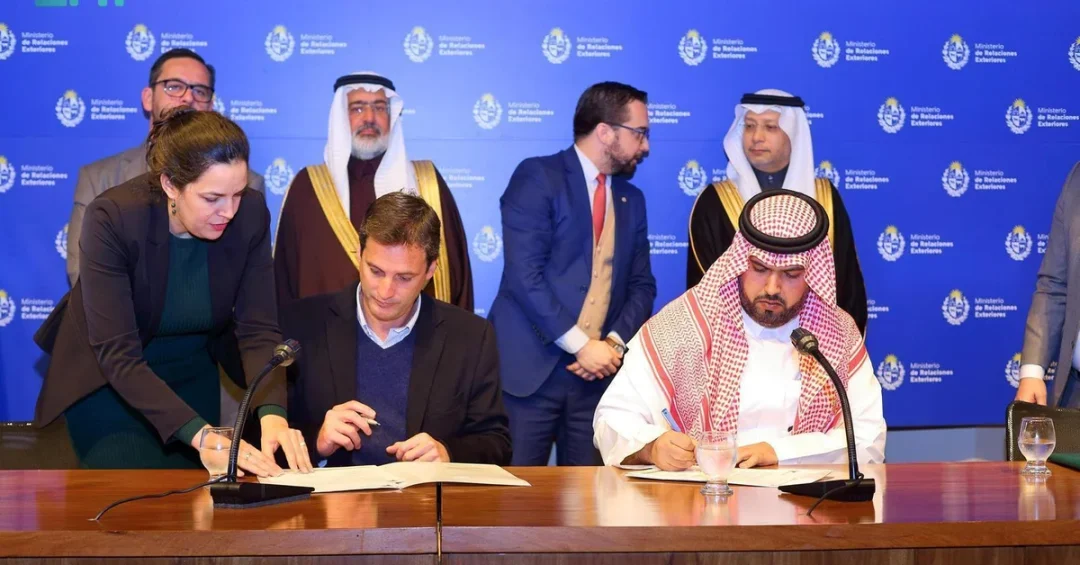
The Federation of Saudi Chambers and the Uruguay Exporters Association signed a Memorandum of Understanding (MoU) to establish a Joint Business Council, during the first meeting of the Saudi-Uruguayan Joint Committee held on Monday at the Ministry of Foreign Affairs in Montevideo, Uruguay. The meeting was chaired by Eng. Ahmed Al-Khamshi, Undersecretary of the Saudi Ministry of Agriculture, and Dr. Nicolas Albertoni, Deputy Foreign Minister of the Oriental Republic of Uruguay. The new council aims to strengthen trade and investment ties between the two countries.
Context and Background
The Saudi-Uruguayan Joint Committee was established under Article 7 of the General Cooperation Agreement between the two nations. Its inaugural meeting marks a significant step in formalizing economic cooperation. The committee is designed to facilitate dialogue and collaboration across various sectors, including agriculture, trade, and investment. Uruguay, known for its robust agricultural exports, particularly in beef, soy, and dairy, sees Saudi Arabia as a key partner in the Middle East. Saudi Arabia, in turn, is expanding its global trade network as part of its economic diversification efforts under Vision 2030. The establishment of the Joint Business Council is expected to provide a platform for private sector engagement, enabling businesses from both countries to explore opportunities and forge partnerships.
Key Details
The MoU was signed on the sidelines of the committee meeting, which was also attended by Eng. Juan Ignacio Buffa, Uruguayan Vice Minister of Livestock, Agriculture, and Fisheries, and Eyad bin Ghazi Hakim, Saudi Ambassador to Uruguay. The Joint Business Council will focus on enhancing bilateral trade, sharing market intelligence, and organizing business delegations and forums. It will also work to identify investment opportunities in sectors such as agriculture, food processing, logistics, and renewable energy. The council is expected to convene regularly to monitor progress and address challenges faced by businesses. This initiative aligns with Saudi Arabia’s broader strategy to deepen economic ties with Latin American countries, as part of its Vision 2030 goal to diversify revenue streams and increase non-oil exports.
Implications and Impact
The creation of the Joint Business Council is poised to boost trade volumes between Saudi Arabia and Uruguay, which have been relatively modest but hold significant potential. In 2023, bilateral trade was valued at approximately $200 million, with Uruguayan exports to Saudi Arabia mainly comprising agricultural products. The new council is expected to facilitate Saudi investments in Uruguay’s agribusiness and infrastructure sectors, while also opening opportunities for Uruguayan companies in Saudi Arabia’s growing market. This partnership could also serve as a model for similar engagements with other Latin American nations, reinforcing Saudi Arabia’s presence in the region. Furthermore, it supports Saudi Arabia’s food security objectives by securing reliable sources of agricultural imports.
Vision 2030 Alignment
This development directly supports Saudi Arabia’s Vision 2030, which aims to diversify the economy, expand international partnerships, and enhance food security. By establishing the Joint Business Council, Saudi Arabia is taking a concrete step toward increasing non-oil trade and attracting foreign investment. The council will also promote knowledge exchange and technology transfer, particularly in agricultural innovation and sustainable practices. As Saudi Arabia continues to strengthen its global economic footprint, initiatives like this underscore the Kingdom’s commitment to fostering mutually beneficial relationships and contributing to global economic stability. The partnership with Uruguay exemplifies how Vision 2030 is creating new avenues for growth and cooperation on the world stage.
20 Questions
Q1. What is the purpose of the MoU signed between the Federation of Saudi Chambers and the Uruguay Exporters Association?
A1. The MoU aims to establish a Joint Business Council to enhance trade and investment ties, facilitate private sector engagement, and identify opportunities in sectors like agriculture and logistics.
Q2. When and where was the MoU signed?
A2. The MoU was signed on Monday at the Ministry of Foreign Affairs in Montevideo, Uruguay, during the first meeting of the Saudi-Uruguayan Joint Committee.
Q3. Who chaired the first meeting of the Saudi-Uruguayan Joint Committee?
A3. The meeting was chaired by Eng. Ahmed Al-Khamshi, Undersecretary of the Saudi Ministry of Agriculture, and Dr. Nicolas Albertoni, Deputy Foreign Minister of Uruguay.
Q4. What is the Saudi-Uruguayan Joint Committee?
A4. It is a committee established under Article 7 of the General Cooperation Agreement to facilitate bilateral dialogue and cooperation across various sectors between Saudi Arabia and Uruguay.
Q5. Which Saudi and Uruguayan officials attended the meeting?
A5. Eng. Juan Ignacio Buffa, Uruguayan Vice Minister of Livestock, Agriculture, and Fisheries, and Eyad bin Ghazi Hakim, Saudi Ambassador to Uruguay, also attended.
Q6. What sectors will the Joint Business Council focus on?
A6. The council will focus on agriculture, food processing, logistics, renewable energy, and other areas of mutual interest to boost bilateral trade and investment.
Q7. How does this MoU benefit Saudi Arabia’s economy?
A7. It supports economic diversification by increasing non-oil trade, attracting investment, and securing agricultural imports, aligning with Vision 2030 goals.
Q8. What are Uruguay’s main exports to Saudi Arabia?
A8. Uruguay primarily exports agricultural products such as beef, soy, and dairy to Saudi Arabia, which are essential for food security.
Q9. What is the expected impact on bilateral trade?
A9. The council is expected to boost trade volumes, which were around $200 million in 2023, by facilitating business partnerships and investment opportunities.
Q10. How does this initiative align with Saudi Vision 2030?
A10. It aligns with Vision 2030 by diversifying the economy, expanding international partnerships, and enhancing food security through global trade.
Q11. Will the Joint Business Council organize business delegations?
A11. Yes, the council plans to organize business delegations and forums to connect companies and explore trade and investment opportunities in both countries.
Q12. What role does the Saudi Ministry of Agriculture play in this partnership?
A12. The Ministry of Agriculture, represented by Undersecretary Eng. Ahmed Al-Khamshi, leads agricultural cooperation and supports food security initiatives with Uruguay.
Q13. How often will the Joint Business Council meet?
A13. The council is expected to convene regularly, though the exact frequency will be determined by its members to monitor progress and address challenges.
Q14. What benefits does Uruguay gain from this MoU?
A14. Uruguay gains access to Saudi Arabia’s growing market, potential investments in agribusiness and infrastructure, and enhanced trade opportunities.
Q15. Are there any specific investment projects planned?
A15. Specific projects will be identified by the council; potential areas include agriculture, food processing, logistics, and renewable energy.
Q16. How does this partnership fit into Saudi Arabia’s Latin America strategy?
A16. It reinforces Saudi Arabia’s engagement with Latin America, expanding trade networks and fostering diplomatic and economic ties as part of Vision 2030.
Q17. What was the outcome of the first joint committee meeting?
A17. The meeting resulted in the signing of the MoU to establish the Joint Business Council and set the stage for enhanced economic cooperation.
Q18. Who signed the MoU on behalf of the Saudi side?
A18. The MoU was signed by representatives of the Federation of Saudi Chambers and the Uruguay Exporters Association, though individual signatories were not specified.
Q19. How does this MoU contribute to food security?
A19. By strengthening ties with Uruguay, a major agricultural exporter, Saudi Arabia can secure reliable imports of food products, supporting its food security objectives.
Q20. What are the next steps after the MoU signing?
A20. The Joint Business Council will be formally established, and both sides will work to organize meetings, identify opportunities, and facilitate business engagements.
Reader Feedback
We value your thoughts. Please share your feedback on this article.
Your feedback helps us improve our coverage.
Related articles
 Aseer’s Peaches Delight Consumers, Boost Vision 2030
 CDF Signs with Five Banks for Cultural Financing
 Unaizah Date Auction Sees Surge in Supplied Quantities
 ZATCA Urges Businesses to Submit July VAT Returns by August 31
 Estidamah, Saudi Coffee Company Join Forces to Boost Saudi Arabia’s Coffee Industry
 NDMC Closes August 2024 Sukuk Issuance at SAR 6.018 Billion