


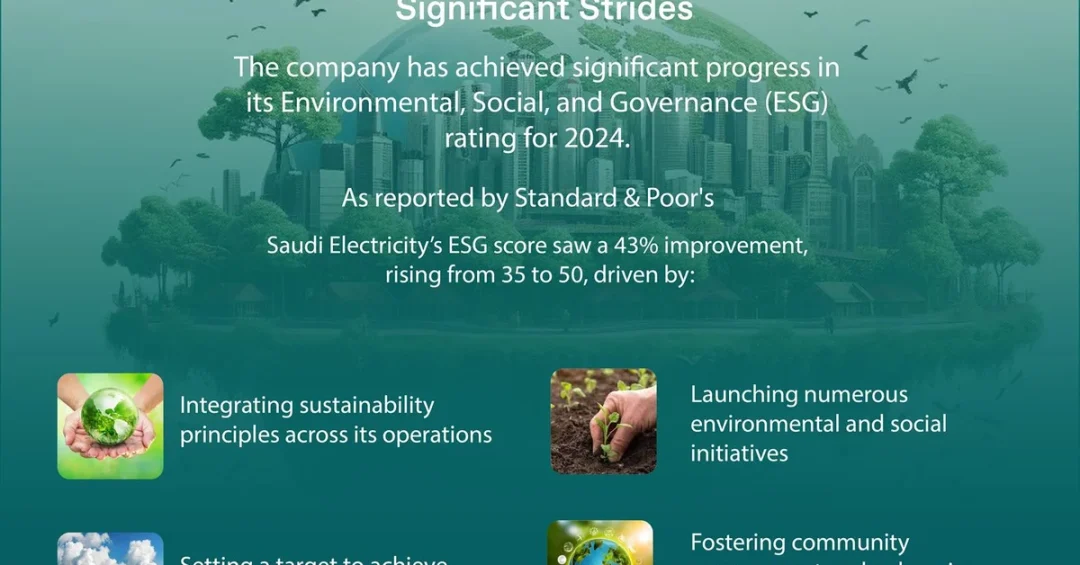
The Saudi Electricity Company (SEC) has achieved a significant 43% improvement in its 2024 Environmental, Social, and Governance (ESG) rating, according to Standard & Poor’s (S&P). The company’s score increased from 35 to 50, reflecting its commitment to sustainability and alignment with the Kingdom’s energy sector goals. This advancement highlights the support from the Kingdom’s leadership for enhancing operational efficiency, service quality, environmental impact reduction, and carbon emission reduction efforts.
Context and Background
The Saudi Electricity Company, the Kingdom’s primary electricity provider, has long been a cornerstone of Saudi Arabia’s energy infrastructure. Under the supervision of the Ministry of Energy, SEC has increasingly focused on integrating sustainability into its operations, in line with the national Vision 2030 and the goals of the Saudi Green Initiative. The improvement in its ESG rating by S&P demonstrates the effectiveness of these efforts and sets a benchmark for other companies in the region.
ESG ratings assess a company’s performance on environmental, social, and governance criteria, which are increasingly important to investors and stakeholders globally. SEC’s rating increase from 35 to 50 underscores its progress in these areas, driven by initiatives such as reducing carbon emissions, enhancing community engagement, and maintaining high governance standards.
Key Details
SEC has pledged to achieve net-zero emissions by 2050, a target that aligns with the Kingdom’s broader environmental objectives. The company is also a key player in the national goal of achieving a 50/50 energy mix by 2030, which aims for 50% renewable energy and 50% high-efficiency natural gas-powered plants. This transition is critical to reducing the Kingdom’s carbon footprint and ensuring sustainable energy security.
In addition to environmental efforts, SEC focuses on social responsibility through community programs and the localization of the electricity sector workforce. The company’s governance practices prioritize transparency and adherence to both national and international standards, including the ESG guidelines issued by the Saudi Exchange (Tadawul). SEC continuously refines its environmental and social standards based on its ESG rating to ensure alignment with the highest sustainability benchmarks.
Details on SEC’s sustainability initiatives and efforts are available in its Sustainability Report at: https://www.se.com.sa/-/media/sec/Investors/Sustainability-Reports/Sustainability-_Report_2023_EN.ashx.
Implications and Impact
The improvement in SEC’s ESG rating has significant implications for the company and the Kingdom. It enhances SEC’s attractiveness to international investors who prioritize sustainability, potentially leading to increased investment and partnerships. Moreover, it reinforces Saudi Arabia’s position as a leader in the global energy transition, showcasing the Kingdom’s commitment to sustainable development and environmental stewardship.
This achievement also supports the objectives of Vision 2030, which seeks to diversify the economy, reduce dependence on oil, and promote sustainable practices. By setting a high standard for ESG performance, SEC serves as a model for other Saudi companies, encouraging broader adoption of sustainable practices across sectors.
Vision 2030 Alignment
SEC’s enhanced ESG rating directly contributes to Vision 2030’s goals of creating a sustainable and diversified economy. The company’s efforts in renewable energy, carbon reduction, and social responsibility exemplify the Kingdom’s dedication to environmental protection and social progress. As Saudi Arabia continues to advance its energy transition, SEC’s role will be pivotal in achieving a balanced energy mix and fostering a greener future for the nation and the world.
20 Questions
Q1. What does ESG stand for?
A1. ESG stands for Environmental, Social, and Governance, which are criteria used to evaluate a company’s sustainability and ethical impact.
Q2. How much did SEC’s ESG rating improve in 2024?
A2. SEC’s ESG rating improved by 43% in 2024, with its score increasing from 35 to 50 according to Standard & Poor’s.
Q3. Which agency upgraded SEC’s ESG rating?
A3. Standard & Poor’s (S&P) upgraded SEC’s ESG rating, reflecting the company’s enhanced sustainability performance.
Q4. What is SEC’s net-zero emissions target year?
A4. SEC has pledged to achieve net-zero emissions by 2050, aligning with Saudi Arabia’s environmental goals.
Q5. What is the 50/50 energy mix goal?
A5. The 50/50 energy mix goal aims for 50% renewable energy and 50% high-efficiency natural gas-powered plants by 2030.
Q6. Which ministry oversees SEC’s activities?
A6. The Ministry of Energy supervises SEC’s activities, ensuring alignment with national energy strategies.
Q7. How does SEC contribute to community engagement?
A7. SEC engages in community programs and focuses on localizing the electricity sector workforce to support social development.
Q8. What are the ESG guidelines issued by Tadawul?
A8. The Saudi Exchange (Tadawul) issues ESG guidelines to standardize sustainability reporting and disclosure for listed companies.
Q9. Why is SEC’s ESG improvement important for investors?
A9. It attracts international investors who prioritize sustainability, potentially increasing investment and partnerships for SEC.
Q10. What is the Saudi Green Initiative?
A10. The Saudi Green Initiative is a national effort to combat climate change, reduce emissions, and promote sustainable development.
Q11. How does SEC’s ESG rating impact its operations?
A11. It drives continuous improvement in environmental and social standards, ensuring alignment with global best practices.
Q12. What are SEC’s key environmental initiatives?
A12. SEC focuses on reducing carbon emissions, increasing renewable energy, and enhancing energy efficiency across its operations.
Q13. How does SEC support Vision 2030?
A13. SEC supports Vision 2030 by contributing to a sustainable energy mix, economic diversification, and environmental stewardship.
Q14. What is the significance of SEC’s Sustainability Report?
A14. The report provides transparency on SEC’s sustainability initiatives, detailing progress and future targets for stakeholders.
Q15. How does SEC localize the electricity sector workforce?
A15. SEC implements training and development programs to equip Saudi nationals with skills for careers in the electricity sector.
Q16. What role does SEC play in Saudi Arabia’s energy transition?
A16. SEC is a key player in transitioning to a balanced energy mix, integrating renewables, and reducing carbon emissions.
Q17. How does SEC’s governance practices meet investor expectations?
A17. SEC adheres to high transparency and disclosure standards, complying with Tadawul’s ESG guidelines and international benchmarks.
Q18. What is the impact of SEC’s ESG rating on the Kingdom’s image?
A18. It enhances Saudi Arabia’s reputation as a leader in sustainability, attracting global recognition and investment.
Q19. Where can detailed information on SEC’s sustainability efforts be found?
A19. Details are available in SEC’s Sustainability Report, accessible via its website at the provided link.
Q20. How does SEC’s ESG improvement benefit Saudi Arabia’s economy?
A20. It fosters a sustainable business environment, attracts foreign investment, and supports economic diversification under Vision 2030.
Reader Feedback
We value your thoughts. Please share your feedback on this article.
Your feedback helps us improve our coverage.
Related articles
 Riyadh to Host 8th Future Investment Initiative October 29-31
 SFD Signs $55M Loan for North Eleuthera Airport
 Saudi Liquidity Hits Record SAR2.898 Trillion in Q2 2024
 DMDF 2024 Concludes with Key Outcomes for Financial Market Growth and Foreign Investment
 GASTAT Reports 1.6% Rise in Industrial Production Index for July 2024
 ZATCA Urges Excise Tax Filings for July and August by September 15