


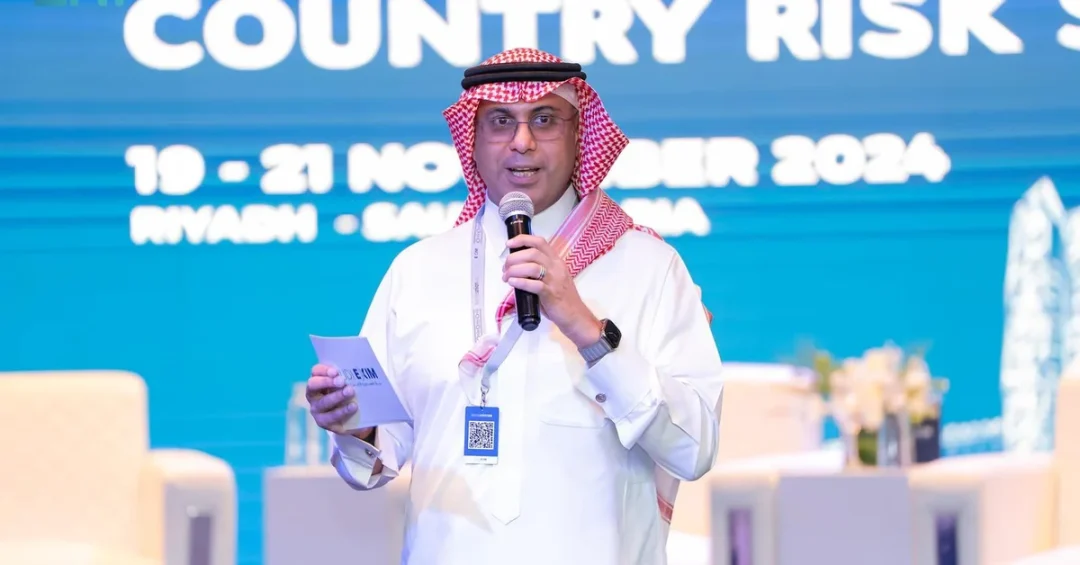
The Saudi Export-Import Bank (Saudi EXIM) hosted the Berne Union’s Country Risk Specialist Meeting in Riyadh from November 19 to 21, 2024, convening specialists from 47 organizations across 33 countries to exchange best practices on risk management within the global export credit community. The event, announced through an official press release issued by Saudi EXIM and carried by the Saudi Press Agency (SPA), underscored the Kingdom’s growing role as a convenor of international financial dialogue and a contributor to the stability of global trade flows.
Held in the Saudi capital, the meeting brought together experts and thought leaders from export credit agencies (ECAs), insurers, and multilateral institutions to discuss strategies, partnerships, and innovative solutions for protecting industry amid shifting global dynamics. The gathering reflects a broader pattern in which Saudi Arabia, through institutions such as Saudi EXIM, is positioning itself not only as a participant in the global economy but as a shaper of its rules and risk frameworks. The discussions addressed debt sustainability, geopolitical tensions, and advanced approaches to risk modelling, while also showcasing the Kingdom’s National Industrial Strategy and its emphasis on economic diversification.
Context and Background
Why does a technical meeting of risk specialists in Riyadh matter to the wider world? The answer lies in the scale of global trade and the invisible architecture of credit and insurance that keeps goods, services, and capital moving across borders. Export credit agencies operate behind the scenes, providing guarantees, insurance, and financing that allow exporters to enter unfamiliar markets and buyers to purchase goods they might otherwise be unable to afford. When that system functions well, it lubricates commerce; when it falters, entire supply chains can seize up. The Berne Union, founded in 1934, is the principal international organization for the export credit and investment insurance industry, and its technical meetings serve as a venue where practitioners compare notes on sovereign defaults, currency crises, and the evolving risk profiles of countries and sectors.
Saudi EXIM, established as a development bank under the National Development Fund, has moved quickly to integrate itself into this global network. Its membership in the Berne Union represents a significant strategic step, consistent with the Kingdom’s commitment to expanding collaboration and integration in the global economy. By building partnerships with leading institutions to address the challenges facing the export credit sector, Saudi EXIM is pursuing its stated goal of developing the export of national products and services through partnerships with national and international financial and funding organizations. Hosting the Country Risk Specialist Meeting in Riyadh is therefore not merely a logistical achievement; it signals that Saudi Arabia is ready to help set the agenda for how the world manages trade risk.
The timing is notable. The global economy is navigating a period of elevated uncertainty, marked by geopolitical tensions, shifting energy markets, and questions about the sustainability of sovereign debt in several regions. In this environment, the export credit community’s ability to quantify and price risk accurately has become more important than ever. As Eve Hall, Associate Director at the Berne Union, observed, the global risk landscape today is highly volatile and highly interconnected, and the traditional concept of country risk is becoming increasingly complex as energy transition and shifting industrial strategies reshape economies. The Riyadh meeting placed these challenges at the center of discussion, giving participants a structured opportunity to examine them together.
Key Details
According to the Saudi EXIM press release, the three-day meeting gathered specialists from 47 organizations representing 33 countries. Discussions centered on critical risks impacting international trade and the global economy, including debt sustainability and geopolitical tensions, along with innovative approaches to risk modelling. Participants also explored global shifts in infrastructure, energy, and critical minerals sectors. These are not abstract concerns: infrastructure investment gaps, the race to secure critical minerals for the energy transition, and the reconfiguration of global supply chains all carry direct implications for export credit exposure and for the ability of exporters to finance long-term projects.
A highlight of the event was the overview provided to attendees of Saudi Arabia’s National Industrial Strategy, which focuses on economic diversification through investments, developing new sectors, and promoting local industries. Presenting this strategy to an international audience of risk specialists served a dual purpose: it informed global practitioners about the direction of Saudi industrial policy, and it offered them a concrete framework for assessing the opportunities and risks associated with a rapidly transforming economy. For Saudi EXIM, the exchange reinforced its role as a bridge between the Kingdom’s industrial ambitions and the international financial system that will help finance them.
In his opening remarks, Saudi EXIM CEO Eng. Saad bin Abdulaziz Al-Khalb described the meeting as an ideal platform to address risks impacting global economic decision making. He stated: “Through such meetings, we can turn challenges into strategic opportunities and enhance our resilience in an ever-changing world. At Saudi EXIM, we remain committed to enabling companies by offering expert financial and non-financial solutions to navigate risks effectively.” He also emphasized the bank’s focus on risk management, announcing the completion of Saudi EXIM’s independent country risk model, which is supported by advanced modelling tools and machine learning. The model will provide country ratings and predictions of default risks. “We look forward to collaborating with our partners in other export credit agencies to exchange knowledge and expertise, and to strengthening our risk management functions with greater responsibility and effectiveness,” Al-Khalb said.
International and Regional Impact
What does the completion of an independent country risk model mean for how Saudi Arabia is perceived in global financial markets? For one, it demonstrates that Saudi EXIM is developing indigenous analytical capacity rather than relying solely on external ratings and assessments. A country risk model that uses machine learning to generate ratings and predict default risks positions the bank to make faster, more granular decisions about the markets it supports. It also gives Saudi EXIM a credible basis on which to collaborate with peer institutions, since shared methodologies and comparable data are prerequisites for co-financing and risk-sharing arrangements. In a world where export credit agencies increasingly work in syndicates to support large infrastructure and energy projects, such capacity is a strategic asset.
Eve Hall of the Berne Union welcomed these initiatives, noting that the industry excels at understanding, quantifying, and pricing risk, and that bringing together a community of experts for technical exchange helps support the development of the industry as a whole. She described the initiatives announced by Saudi EXIM, making use of new technology in risk analysis, as a fantastic example of where collaboration in this field can be effectively applied. Her comments highlight a reciprocal dynamic: Saudi EXIM benefits from the Berne Union’s accumulated expertise, while the Berne Union benefits from the fresh perspectives and technological investments of its newer members. For the wider Middle East, the meeting reinforces Riyadh’s emergence as a hub for financial diplomacy, where regional and global institutions can convene to address shared challenges.
The regional implications extend beyond finance. As Gulf economies diversify away from hydrocarbons, non-oil exports are becoming a larger share of their trade profiles, and export credit agencies are essential to that transition. By hosting the Berne Union meeting and presenting its National Industrial Strategy, Saudi Arabia signaled that it views export credit as an integral component of industrial policy, not a peripheral financial service. That framing could influence how other countries in the region structure their own export promotion efforts, potentially leading to greater regional coordination on trade finance and risk management.
Economic and Strategic Significance
Why should global businesses and investors pay attention to a meeting of risk specialists? Because risk assessment is the invisible hand that guides capital allocation in international trade. When country risk models are robust and widely shared, exporters can price their products more competitively and financiers can extend credit with greater confidence. When risk is poorly understood, trade finance dries up, particularly for smaller exporters and frontier markets. The Riyadh meeting’s emphasis on debt sustainability and geopolitical tensions reflects a pragmatic recognition that these two factors are among the most consequential drivers of export credit losses in the current era. By addressing them collectively, the participants aimed to strengthen institutional resilience across the industry.
Saudi EXIM’s role as a development bank under the National Development Fund gives it a dual mandate: to support Saudi exporters commercially and to advance the Kingdom’s broader economic diversification objectives. The bank contributes to diversifying the Kingdom’s economic base by improving the efficiency of non-oil export ecosystems, bridging financial gaps, and minimizing export risks. This plays a role in helping the non-oil national economy grow, in line with Vision 2030. The country risk model announced in Riyadh is a practical expression of that mandate, equipping the bank with tools to assess and price risk across a wide range of markets, from established trading partners to emerging economies where Saudi products and services are gaining ground.
The strategic significance of the meeting also lies in its timing relative to global economic reconfiguration. As supply chains are reorganized around considerations of resilience and friend-shoring, export credit agencies are being asked to support new trade corridors and to underwrite projects in sectors such as renewable energy, critical minerals, and advanced manufacturing. Saudi Arabia’s National Industrial Strategy, which was presented to attendees, identifies these sectors as priorities. By aligning its export credit capabilities with its industrial strategy, the Kingdom is positioning its exporters to participate in the next wave of global trade growth, while giving international partners a clear picture of where Saudi Arabia is heading.
Vision 2030 Alignment
How does a technical risk meeting connect to the sweeping ambitions of Saudi Vision 2030? The connection is direct and practical. Vision 2030 seeks to diversify the Kingdom’s economy away from oil dependence, and a core pillar of that effort is expanding non-oil exports. Saudi EXIM exists to make that expansion possible by providing financial and non-financial solutions that reduce the risks exporters face in international markets. Every improvement in risk modelling, every partnership with a peer export credit agency, and every international convening such as the Berne Union meeting strengthens the ecosystem that supports Saudi exporters. In this sense, the Riyadh gathering was not a side event but a working session in the national project of economic transformation.
The meeting also advanced Vision 2030’s goal of deepening Saudi Arabia’s integration with the global economy. By hosting specialists from 47 organizations across 33 countries, Saudi EXIM demonstrated that the Kingdom is open to collaboration, eager to learn, and willing to contribute its own innovations. The bank’s membership in the Berne Union, and its active participation in the organization’s technical work, align with the Kingdom’s commitment to expanding collaboration and integration in the global economy by building partnerships with leading institutions. As Saudi Arabia continues to develop as a global investment and logistics hub, these relationships will be instrumental in ensuring that its exporters can compete on equal terms in markets around the world. The forward-looking message from Riyadh is clear: the Kingdom intends to help shape the future of global trade risk management, turning challenges into strategic opportunities and reinforcing its role as a responsible, capable partner in the international economy.
20 Questions
Q1. What event did Saudi EXIM host in Riyadh in November 2024?
A1. Saudi EXIM hosted the Berne Union’s Country Risk Specialist Meeting in Riyadh from November 19 to 21, 2024, bringing together risk management experts from the global export credit community.
Q2. How many organizations and countries participated in the meeting?
A2. According to the Saudi EXIM press release, the event gathered specialists from 47 organizations representing 33 countries, providing a broad international platform for exchange.
Q3. What is the Berne Union?
A3. The Berne Union is the principal international organization for the export credit and investment insurance industry, working with global trade organizations to encourage best practices and maintain global trade stability.
Q4. What topics were discussed at the Riyadh meeting?
A4. Discussions centered on debt sustainability, geopolitical tensions, innovative risk modelling approaches, and global shifts in infrastructure, energy, and critical minerals sectors.
Q5. Who is the CEO of Saudi EXIM?
A5. Eng. Saad bin Abdulaziz Al-Khalb is the CEO of Saudi EXIM. He delivered opening remarks at the meeting and announced the completion of the bank’s independent country risk model.
Q6. What did Saudi EXIM announce at the meeting?
A6. Saudi EXIM announced the completion of its independent country risk model, supported by advanced modelling tools and machine learning, which will provide country ratings and predictions of default risks.
Q7. What did Eve Hall of the Berne Union say about the meeting?
A7. Eve Hall, Associate Director at the Berne Union, said the global risk landscape is highly volatile and interconnected, and praised Saudi EXIM’s technology-driven risk analysis initiatives as an example of effective collaboration.
Q8. How does Saudi EXIM’s membership in the Berne Union align with Saudi Arabia’s goals?
A8. It aligns with the Kingdom’s commitment to expanding collaboration and integration in the global economy, and supports the bank’s goal of developing exports through international partnerships.
Q9. What is Saudi EXIM’s role in the Saudi economy?
A9. Saudi EXIM is a development bank under the National Development Fund that contributes to diversifying the Kingdom’s economic base by improving non-oil export ecosystems, bridging financial gaps, and minimizing export risks.
Q10. How does the meeting relate to Vision 2030?
A10. The meeting supports Vision 2030 by strengthening the export ecosystem, deepening international integration, and helping grow the non-oil national economy through improved risk management and global partnerships.
Q11. What is Saudi Arabia’s National Industrial Strategy?
A11. It is a strategy focusing on economic diversification through investments, developing new sectors, and promoting local industries. It was presented to meeting attendees as an overview of Saudi industrial priorities.
Q12. Why is risk modelling important for global trade?
A12. Risk modelling helps export credit agencies quantify and price risks accurately, enabling them to extend credit and insurance that keep goods, services, and capital moving across borders.
Q13. What role does machine learning play in Saudi EXIM’s new model?
A13. Machine learning supports the independent country risk model by providing advanced analytical tools that generate country ratings and predict default risks more efficiently and accurately.
Q14. How does the Berne Union benefit from Saudi EXIM’s participation?
A14. The Berne Union benefits from Saudi EXIM’s technological investments and fresh perspectives, which contribute to the industry’s collective knowledge and support the development of best practices.
Q15. What are the key risks facing international trade today?
A15. Key risks include debt sustainability concerns and geopolitical tensions, which were central topics at the Riyadh meeting along with shifts in infrastructure, energy, and critical minerals sectors.
Q16. How does Saudi EXIM support Saudi exporters?
A16. Saudi EXIM offers expert financial and non-financial solutions, including guarantees, insurance, and financing, to help companies navigate risks and expand into international markets.
Q17. What is the significance of hosting this meeting in Riyadh?
A17. It reinforces Riyadh’s emergence as a hub for financial diplomacy and demonstrates Saudi Arabia’s readiness to help shape global trade risk frameworks and international cooperation.
Q18. What did the meeting reveal about Saudi Arabia’s economic direction?
A18. It showed that Saudi Arabia views export credit as integral to industrial policy and economic diversification, aligning with Vision 2030 goals for non-oil export growth and global integration.
Q19. How does the meeting strengthen institutional resilience?
A19. By facilitating the exchange of best practices and innovative solutions, the meeting helps export credit institutions better protect themselves against shifting global dynamics and turn challenges into opportunities.
Q20. What is the forward-looking outcome of the Riyadh meeting?
A20. The meeting deepened collaboration between Saudi EXIM and global partners, advanced risk management capabilities, and positioned Saudi Arabia as a constructive contributor to the stability and growth of global trade.
Reader Feedback
We value your thoughts. Please share your feedback on this article.
Your feedback helps us improve our coverage.