


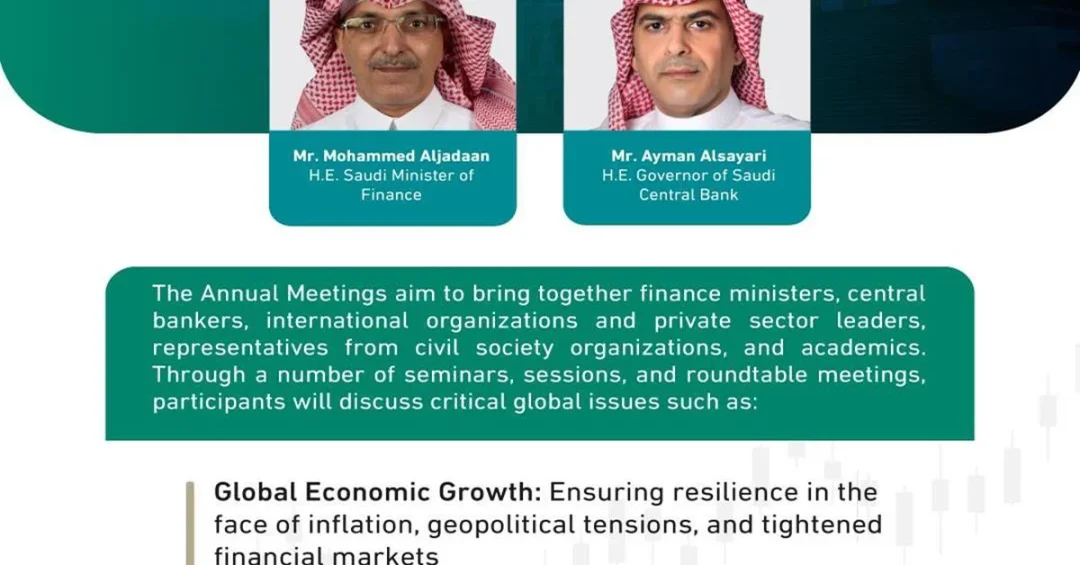
Minister of Finance Mohammed Aljadaan is leading the Kingdom of Saudi Arabia’s delegation to the International Monetary Fund (IMF) and World Bank Group (WBG) annual meetings, as well as to the 4th G20 Finance Ministers and Central Bank Governors (FMCBG) meeting, taking place from October 21 to 26, 2024, in Washington, D.C. The high-level participation underscores Saudi Arabia’s active role in shaping global economic policy and its commitment to multilateral cooperation. The delegation includes Governor of the Saudi Central Bank (SAMA) Ayman Alsayari, Vice Minister of Finance Abdulmuhsen Alkhalaf, Deputy Minister of Finance for International Affairs Khalid Bawazier, and Deputy Chair of the International Monetary and Financial Committee (IMFC) Dr. Ryadh Alkhareif, along with specialists from the Ministry of Finance, SAMA, the Saudi Fund for Development, the Zakat, Tax and Customs Authority, and the National Debt Management Center.
Is Saudi Arabia poised to play an even greater role in global economic governance? The Kingdom’s prominent presence at these meetings signals its growing influence in international financial institutions and its dedication to addressing shared challenges. As the world’s largest oil exporter and a key member of the G20, Saudi Arabia brings a unique perspective that balances energy market dynamics with financial stability and sustainable development. The delegation’s participation reflects the Kingdom’s strategy to engage proactively in forums that shape the global economic agenda, ensuring that the voices of both developed and emerging economies are heard.
Context and Background
What are the key issues at stake in this year’s IMF-WBG annual meetings? The annual gatherings bring together finance ministers, central bank governors, and representatives from international organizations, the private sector, and civil society to discuss the most pressing global economic issues. This year’s meetings occur against a backdrop of slowing global growth, persistent inflation, and heightened geopolitical tensions. The IMF’s recent World Economic Outlook projects global growth to remain below its historical average, with risks tilted to the downside. In this environment, Saudi Arabia’s role as a stabilizer in energy markets and a proponent of prudent fiscal policies is more critical than ever.
How does the G20 FMCBG meeting fit into the broader G20 agenda? The 4th G20 FMCBG meeting, presided over by Brazil, focuses on enhancing multilateral cooperation to tackle global economic challenges. Brazil’s G20 presidency has prioritized issues such as combating inequality, promoting sustainable development, and reforming international financial institutions. Saudi Arabia’s participation highlights its support for these objectives and its willingness to contribute to solutions that benefit the global economy. The Kingdom’s experience in diversifying its economy and implementing Vision 2030 reforms offers valuable lessons for other nations seeking to achieve sustainable growth.
The IMFC meeting, which Aljadaan will chair, is a central event of the IMF’s annual meetings. The IMFC provides strategic direction to the IMF’s work and discusses developments in the global economy, policy priorities, and the IMF’s role in supporting member countries. As chair, Aljadaan will guide discussions on how the IMF can best assist nations facing economic difficulties, including through policy advice, capacity development, and financial support. His leadership in this role reflects the international community’s confidence in Saudi Arabia’s economic stewardship and its ability to bridge diverse perspectives.
Key Details
Who are the key participants in the Saudi delegation, and what expertise do they bring? The delegation comprises a diverse group of experts from various Saudi institutions. Governor Ayman Alsayari of SAMA will contribute insights on monetary policy and financial stability. Vice Minister Abdulmuhsen Alkhalaf and Deputy Minister Khalid Bawazier will bring their deep knowledge of fiscal policy and international finance. Dr. Ryadh Alkhareif, as Deputy Chair of the IMFC, plays a pivotal role in shaping the committee’s agenda. The inclusion of specialists from the Saudi Fund for Development, the Zakat, Tax and Customs Authority, and the National Debt Management Center demonstrates the comprehensive nature of Saudi Arabia’s engagement, covering development finance, tax policy, and debt management.
What are the specific agenda items for the Saudi delegation? In addition to chairing the IMFC, Minister Aljadaan will participate in the G20 FMCBG meeting, where discussions will cover global economic and development issues, enhancing multilateral cooperation, and addressing challenges facing the global economy. He and Governor Alsayari will also engage in bilateral meetings with counterparts from other countries, international organizations, and private sector leaders. These interactions are expected to advance Saudi Arabia’s economic interests and foster partnerships that support Vision 2030. Key topics on the agenda include sustainable development, global financial stability, and poverty eradication.
How does Saudi Arabia’s participation align with its broader economic strategy? The Kingdom’s engagement in these international forums is a cornerstone of its economic diplomacy. By actively participating in discussions on global economic policy, Saudi Arabia can advocate for policies that promote stability, open markets, and inclusive growth. Moreover, it allows the Kingdom to showcase its own reform progress and attract foreign investment. The meetings also provide a platform to strengthen ties with other nations and international institutions, which is essential for achieving the goals of Vision 2030.
International and Regional Impact
What impact will Saudi Arabia’s leadership have on the global economic dialogue? As the chair of the IMFC, Minister Aljadaan will steer conversations on critical issues such as debt sustainability, inflation, and climate finance. His leadership ensures that the perspectives of both advanced and emerging economies are considered, promoting a balanced and inclusive approach. Saudi Arabia’s role as a bridge-builder between different economic blocs is increasingly recognized, and its active participation enhances the legitimacy and effectiveness of international financial institutions.
How will the outcomes of these meetings affect the Middle East and North Africa region? The decisions taken at the IMF-WBG annual meetings and the G20 FMCBG meeting will have significant implications for the MENA region. Saudi Arabia, as a regional economic powerhouse, can influence policies that support development and stability in neighboring countries. For instance, discussions on debt relief and development finance are particularly relevant for countries facing fiscal challenges. By advocating for targeted support and investment, the Kingdom can help drive regional growth and integration, aligning with its vision of a prosperous and interconnected Middle East.
What role does Saudi Arabia play in promoting global financial stability? The Kingdom’s prudent macroeconomic policies and its substantial financial reserves have made it a source of stability in the global economy. Saudi Arabia’s participation in the IMF and G20 reinforces its commitment to international cooperation and its willingness to contribute to global public goods. Through its chairmanship of the IMFC and active engagement in the G20, the Kingdom helps shape policies that mitigate risks and foster sustainable growth, benefiting both its own economy and the global community.
Economic and Strategic Significance
Why is Saudi Arabia’s presence at these meetings economically significant? Saudi Arabia is not only a major oil producer but also a growing investor and a key player in global supply chains. Its economic policies and investment decisions have far-reaching effects. By participating in high-level discussions, the Kingdom can ensure that its interests are represented and that global economic policies reflect the realities of both energy exporters and importers. Furthermore, the meetings offer opportunities to attract foreign direct investment and to showcase the Kingdom’s ambitious projects under Vision 2030, such as NEOM and the Red Sea Project.
How do these meetings support Saudi Arabia’s strategic objectives? The Kingdom’s strategic objectives include economic diversification, enhancing non-oil revenues, and becoming a global investment hub. Engagement with the IMF and G20 provides a platform to learn from best practices, share experiences, and build partnerships that support these goals. Additionally, the meetings allow Saudi Arabia to advocate for policies that stabilize energy markets and promote sustainable development, which are essential for its long-term prosperity. The Kingdom’s active participation also reinforces its position as a responsible global stakeholder and a leader in the region.
What are the potential outcomes for Saudi Arabia from these meetings? The outcomes could include strengthened bilateral relations, new investment opportunities, and a greater say in shaping global economic policies. By chairing the IMFC, Minister Aljadaan will have a direct impact on the IMF’s agenda, ensuring that the concerns of emerging markets are addressed. The G20 FMCBG meeting will provide a platform to advance discussions on reforming the international financial architecture, which could benefit Saudi Arabia and other developing countries. Overall, the meetings are expected to yield tangible benefits that support the Kingdom’s economic transformation.
Vision 2030 Alignment
How does Saudi Arabia’s participation in these international meetings align with Vision 2030? Vision 2030 aims to diversify the economy, reduce dependence on oil, and position Saudi Arabia as a global leader. Engagement in international economic forums is a key enabler of this vision, as it facilitates knowledge exchange, attracts investment, and strengthens partnerships. The Kingdom’s active role in the IMF and G20 demonstrates its commitment to playing a constructive role in the global economy, which is essential for achieving the ambitious goals of Vision 2030.
What does the future hold for Saudi Arabia’s global economic engagement? The Kingdom is expected to continue its proactive approach, hosting major events and leading initiatives that promote global cooperation. As it prepares for Expo 2030 and other mega-events, Saudi Arabia’s influence in international economic governance will only grow. The participation of Minister Aljadaan and his team in the IMF-WBG annual meetings and the G20 FMCBG meeting is a testament to the Kingdom’s dedication to fostering a more stable, prosperous, and inclusive global economy, in line with the vision of Crown Prince Mohammed bin Salman.
20 Questions
Q1. Who is leading Saudi Arabia’s delegation to the IMF-WBG annual meetings?
A1. Minister of Finance Mohammed Aljadaan is leading the delegation, which includes Governor of SAMA Ayman Alsayari, Vice Minister Abdulmuhsen Alkhalaf, Deputy Minister Khalid Bawazier, and Dr. Ryadh Alkhareif, among other specialists.
Q2. What are the dates and location of the IMF-WBG annual meetings and the 4th G20 FMCBG meeting?
A2. The meetings are being held from October 21 to 26, 2024, in Washington, D.C., bringing together global financial leaders to discuss key economic issues.
Q3. What is the International Monetary and Financial Committee (IMFC)?
A3. The IMFC is a key advisory body of the IMF that provides strategic direction and discusses global economic developments, policy priorities, and the IMF’s role in supporting member countries.
Q4. What role will Minister Aljadaan play at the IMFC meeting?
A4. Minister Aljadaan will chair the IMFC meeting, guiding discussions on the global economy, policy priorities, and the IMF’s support for nations in need.
Q5. What is the 4th G20 FMCBG meeting, and who is presiding over it?
A5. The 4th G20 Finance Ministers and Central Bank Governors meeting is presided over by Brazil and focuses on global economic and development issues, enhancing multilateral cooperation.
Q6. What topics will be discussed at the G20 FMCBG meeting?
A6. Discussions will cover global economic and development issues, enhancing multilateral cooperation, sustainable development, global financial stability, and poverty eradication.
Q7. Why is Saudi Arabia’s participation in these meetings important?
A7. Saudi Arabia’s participation underscores its active role in shaping global economic policy, its commitment to multilateral cooperation, and its growing influence in international financial institutions.
Q8. Who are the other members of the Saudi delegation?
A8. The delegation includes specialists from the Ministry of Finance, SAMA, the Saudi Fund for Development, the Zakat, Tax and Customs Authority, and the National Debt Management Center.
Q9. What is the significance of Dr. Ryadh Alkhareif’s role as Deputy Chair of the IMFC?
A9. As Deputy Chair, Dr. Alkhareif plays a pivotal role in shaping the IMFC’s agenda and ensuring that the committee’s discussions are productive and inclusive.
Q10. How does Saudi Arabia’s engagement in these forums align with Vision 2030?
A10. Engagement in international economic forums supports Vision 2030 by facilitating knowledge exchange, attracting investment, strengthening partnerships, and positioning Saudi Arabia as a global economic leader.
Q11. What are the expected outcomes of the IMF-WBG annual meetings for Saudi Arabia?
A11. Expected outcomes include strengthened bilateral relations, new investment opportunities, and a greater role in shaping global economic policies that benefit the Kingdom and the region.
Q12. How does Saudi Arabia contribute to global financial stability?
A12. Through prudent macroeconomic policies, substantial financial reserves, and active participation in international forums, Saudi Arabia promotes global financial stability and sustainable growth.
Q13. What is the impact of these meetings on the Middle East and North Africa region?
A13. The meetings can lead to policies that support development and stability in the MENA region, with Saudi Arabia advocating for targeted support and investment to drive regional growth.
Q14. What is the role of the Saudi Central Bank (SAMA) in these meetings?
A14. SAMA Governor Ayman Alsayari contributes insights on monetary policy and financial stability, and participates in bilateral meetings to advance Saudi Arabia’s economic interests.
Q15. How does Saudi Arabia’s participation in the G20 benefit the global economy?
A15. Saudi Arabia’s participation helps bridge diverse perspectives, promotes balanced policies, and ensures that the interests of both advanced and emerging economies are considered.
Q16. What are the key challenges facing the global economy discussed at these meetings?
A16. Key challenges include slowing global growth, persistent inflation, geopolitical tensions, debt sustainability, and the need for climate finance.
Q17. What is the significance of Brazil’s G20 presidency for Saudi Arabia?
A17. Brazil’s presidency prioritizes combating inequality and sustainable development, which aligns with Saudi Arabia’s own objectives and offers opportunities for collaboration.
Q18. How can Saudi Arabia’s experience with Vision 2030 benefit other nations?
A18. Saudi Arabia’s successful implementation of economic diversification and social reforms offers valuable lessons for other countries seeking sustainable growth and development.
Q19. What are the upcoming major events that will showcase Saudi Arabia’s global engagement?
A19. Saudi Arabia is preparing for Expo 2030 and other mega-events, which will further demonstrate its leadership and commitment to international cooperation.
Q20. How does Saudi Arabia’s leadership in the IMFC reflect its global standing?
A20. Minister Aljadaan’s chairmanship of the IMFC reflects the international community’s confidence in Saudi Arabia’s economic stewardship and its ability to foster consensus among diverse economies.
Reader Feedback
We value your thoughts. Please share your feedback on this article.
Your feedback helps us improve our coverage.