


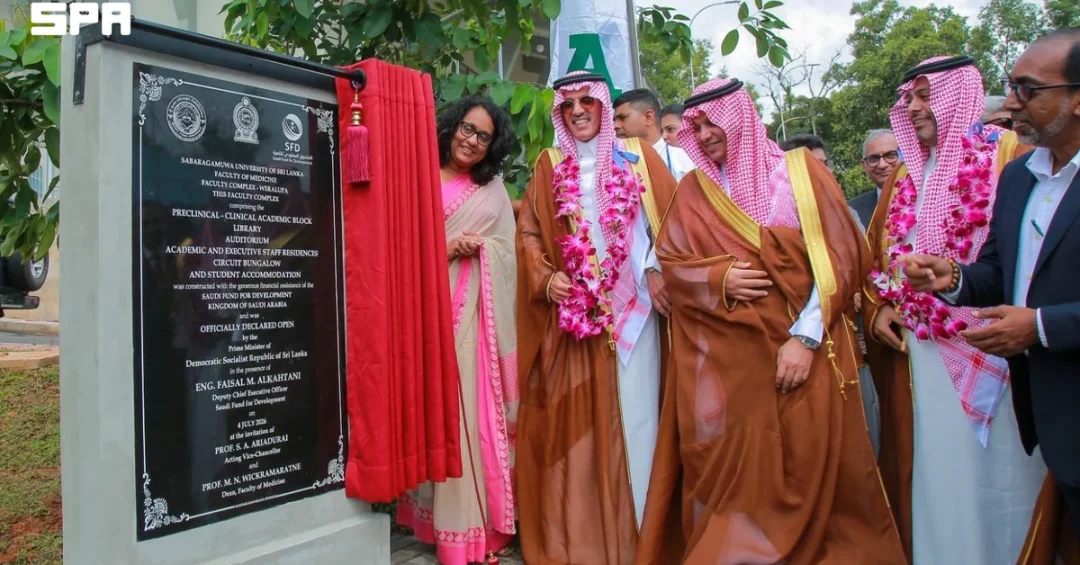
The Saudi Fund for Development (SFD) signed 13 development loan agreements worth SAR1.77 billion with 11 developing countries during fiscal year 2025, according to the fund’s annual report released via the Saudi Press Agency. The agreements finance priority projects in social infrastructure, energy, transport and communications, and agriculture, reinforcing the Kingdom of Saudi Arabia’s longstanding role in global development finance. Three countries — Suriname, the Solomon Islands, and Barbados — joined the fund’s portfolio for the first time, extending the geographic reach of Saudi development cooperation into new regions.
The annual report shows that the year’s lending was distributed across four world regions and four economic sectors, with social infrastructure accounting for the largest share of commitments. The figures also reveal that most of the year’s lending was delivered through co-financing arrangements with international partners, a model that multiplies the impact of each Saudi riyal committed. For readers unfamiliar with the institution, the SFD is the Kingdom’s principal channel for concessional development finance, operating under the guidance of the Saudi government and reporting on its activities through official channels.
Context and Background
What does five decades of continuous development lending tell us about Saudi Arabia’s place in the global economy? The Saudi Fund for Development was established in 1974 as a government institution mandated to support developing countries through concessional loans and grants. Over more than fifty years, the fund has provided 808 development loans worth SAR83.26 billion to 101 developing countries, according to its annual report. That record places the Kingdom among the most consistent providers of development finance in the world, and it predates many of the multilateral institutions that dominate the sector today.
The fund’s mandate is closely tied to the Kingdom’s foreign policy tradition of constructive engagement with developing nations. Its loans typically finance infrastructure that recipient governments identify as national priorities — schools, hospitals, roads, power plants, water systems, and agricultural projects. Because the financing is concessional, it reaches countries that might struggle to borrow on commercial terms, and because it is project-based, it produces visible, measurable results. The annual report for fiscal year 2025 continues this pattern, documenting commitments that span Asia-Pacific, Latin America and the Caribbean, Africa, and Europe.
The 2025 results also reflect a broader shift in how development finance is structured. Rather than lending in isolation, the SFD increasingly works alongside other lenders, sharing risk and aligning project preparation with partners such as the Islamic Development Bank and the Asian Development Bank. This approach has become central to the fund’s strategy, and the latest annual report shows it accounted for nearly three-quarters of the year’s lending by value.
Key Details of the 2025 Loan Agreements
How were the SAR1.77 billion in commitments distributed across regions and sectors? The Asia-Pacific region received six loans worth SAR855 million, the largest regional allocation. Latin America and the Caribbean received three loans worth SAR422.62 million, Africa received two loans worth SAR368.28 million, and Europe received two loans worth SAR120 million. The inclusion of Suriname, the Solomon Islands, and Barbados as first-time beneficiaries marks a deliberate widening of the fund’s partner base.
By sector, social infrastructure dominated with seven loans totaling SAR1.11 billion, or 62.8 percent of the year’s lending. Energy followed with three loans worth SAR337.5 million (19.1 percent), then transport and communications with two loans worth SAR176.25 million (10 percent), and agriculture with one loan worth SAR143.29 million (8.1 percent). The emphasis on social infrastructure — which typically includes education, health, and community facilities — aligns with the fund’s stated focus on projects that directly improve living standards.
Co-financing was a defining feature of the year. Nine loans to eight countries, worth SAR1.32 billion, were arranged with other lenders, including the Islamic Development Bank, the OPEC Fund for International Development, the Asian Development Bank, and the beneficiary governments themselves. The projects supported by these loans carry a combined cost of SAR4.97 billion, meaning that Saudi contributions leveraged a substantially larger total investment. Co-financed loans accounted for nearly three-quarters of the year’s lending, underscoring the fund’s role as a catalyst rather than a sole financier.
International and Regional Impact
Why does a Saudi development loan in the Solomon Islands or Barbados matter to the wider world? Each agreement represents a partnership between the Kingdom and a sovereign government, and each project is designed to deliver infrastructure that the recipient country has identified as a priority. In the Asia-Pacific region, which received the largest share of 2025 lending, projects supported by the fund are expected to improve connectivity and public services in some of the world’s most dispersed island economies. In Latin America and the Caribbean, the fund’s first loans to Suriname and Barbados signal a deepening relationship with small and vulnerable states.
The fund’s work complements the efforts of multilateral institutions without duplicating them. By co-financing with the Islamic Development Bank, the OPEC Fund, and the Asian Development Bank, the SFD helps assemble financing packages that no single lender could provide alone. This collaborative model is particularly valuable for lower-income countries facing constrained fiscal space, because it reduces the burden on any one borrower or lender. It also strengthens coordination among development partners, a goal repeatedly emphasized in international development forums.
For Saudi Arabia, the diplomatic dimension is equally significant. Development cooperation builds long-term relationships grounded in shared economic interest rather than short-term transactions. The fund’s five-decade record of 808 loans across 101 countries gives the Kingdom a network of partners on every continent, and the addition of three new countries in 2025 extends that network further. These relationships support trade, investment, and people-to-people ties over time.
Economic and Strategic Significance
What makes concessional lending a strategic instrument rather than simply an expense? Development finance creates goodwill, opens markets, and supports stability in regions where instability would carry wider costs. The SFD’s loans are repaid over long horizons, and the projects they finance generate economic activity that can improve a recipient country’s ability to service its obligations. In this sense, the fund operates as an investment in shared prosperity, with returns measured in both financial and diplomatic terms.
The scale of co-financing in 2025 — SAR1.32 billion of the SAR1.77 billion total — demonstrates that the Kingdom’s development partners view its project preparation and oversight favorably. The combined project cost of SAR4.97 billion means that every Saudi riyal committed helped mobilize additional resources from other lenders. This multiplier effect is a key metric for development institutions, and the annual report presents it as evidence of the fund’s convening power.
The sectoral mix also carries strategic logic. Social infrastructure, at 62.8 percent of lending, addresses the human capital foundations that sustain long-term growth. Energy projects, at 19.1 percent, support power generation and access in economies where reliable electricity remains a constraint. Transport and communications, at 10 percent, improves connectivity, while agriculture, at 8.1 percent, strengthens food systems. Together, these categories cover the basic enablers of economic development, and the fund’s allocation reflects a considered assessment of where concessional finance can add the most value.
Vision 2030 Alignment
How does the Saudi Fund for Development connect to Saudi Arabia’s Vision 2030? Vision 2030, the Kingdom’s national transformation program, calls for a diversified economy, a strengthened international standing, and an active role in global affairs. The SFD advances all three objectives. Its lending program projects Saudi expertise and capital into partner countries, building the international relationships that a diversified economy requires. Its co-financing partnerships position the Kingdom at the center of multilateral development cooperation. And its five-decade track record gives Saudi Arabia a credible voice in global development discussions.
The 2025 annual report, released through the Saudi Press Agency, is part of the fund’s commitment to transparency and accountability. By publishing detailed figures on loan volumes, regional distribution, sectoral allocation, and co-financing arrangements, the fund allows analysts, partner governments, and international institutions to assess its work on the basis of verifiable data. That openness supports the trust on which development partnerships depend, and it reflects the broader modernization of Saudi institutions under Vision 2030.
Looking ahead, the fund’s expanded partner base and its emphasis on co-financing suggest that its role will continue to grow. The three new countries that joined the portfolio in 2025 — Suriname, the Solomon Islands, and Barbados — are the latest additions to a network that now spans 101 nations. As Saudi Arabia pursues its Vision 2030 goals, the Saudi Fund for Development will remain a principal instrument through which the Kingdom contributes to sustainable development worldwide, turning financial commitments into schools, hospitals, power lines, roads, and farms that improve lives far beyond its borders.
20 Questions
Q1. What did the Saudi Fund for Development achieve in fiscal year 2025?
A1. The SFD signed 13 development loan agreements worth SAR1.77 billion with 11 developing countries in fiscal year 2025, according to its annual report. The loans finance priority projects supporting sustainable development and reinforce Saudi Arabia’s leading role in global development finance.
Q2. Which three countries joined the SFD’s portfolio for the first time in 2025?
A2. Suriname, the Solomon Islands, and Barbados joined the fund’s portfolio for the first time. Their inclusion extends the geographic reach of Saudi development cooperation into new regions and reflects the fund’s growing partner base across the world.
Q3. How were the 2025 loans distributed across regions?
A3. The Asia-Pacific region received six loans worth SAR855 million, Latin America and the Caribbean received three worth SAR422.62 million, Africa received two worth SAR368.28 million, and Europe received two worth SAR120 million, according to the annual report.
Q4. Which sector received the largest share of 2025 lending?
A4. Social infrastructure accounted for the largest share, with seven loans totaling SAR1.11 billion, or 62.8 percent of the year’s lending. This category typically covers education, health, and community facilities that directly improve living standards.
Q5. How much lending went to energy projects in 2025?
A5. Energy received three loans worth SAR337.5 million, representing 19.1 percent of the year’s lending. These projects support power generation and access in economies where reliable electricity remains a constraint on economic development.
Q6. What share of lending went to transport and communications?
A6. Transport and communications received two loans worth SAR176.25 million, or 10 percent of the year’s lending. Such projects improve connectivity and are often essential for trade, market access, and the delivery of public services.
Q7. How much was allocated to agriculture?
A7. Agriculture received one loan worth SAR143.29 million, representing 8.1 percent of the year’s lending. Agricultural financing strengthens food systems and supports rural livelihoods in recipient countries, according to the annual report.
Q8. What role did co-financing play in the 2025 lending program?
A8. Nine loans to eight countries, worth SAR1.32 billion, were co-financed with other lenders. Co-financed loans accounted for nearly three-quarters of the year’s lending, demonstrating the fund’s role as a catalyst that mobilizes additional resources.
Q9. Which partners co-financed the 2025 projects?
A9. Partners included the Islamic Development Bank, the OPEC Fund for International Development, the Asian Development Bank, and the beneficiary governments. Their participation reduced risk and aligned project preparation with international best practice.
Q10. What was the combined cost of the projects supported in 2025?
A10. The projects had a combined cost of SAR4.97 billion, meaning Saudi contributions leveraged a substantially larger total investment. This multiplier effect is a key measure of the fund’s convening power and development impact.
Q11. How many loans has the SFD provided over its history?
A11. Over five decades, the fund has provided 808 development loans worth SAR83.26 billion to 101 developing countries. This record places the Kingdom among the most consistent providers of development finance in the world.
Q12. When was the Saudi Fund for Development established?
A12. The SFD was established in 1974 as a government institution mandated to support developing countries through concessional loans and grants. It operates under the guidance of the Saudi government and reports through official channels.
Q13. What types of projects do SFD loans typically finance?
A13. SFD loans typically finance infrastructure that recipient governments identify as national priorities, including schools, hospitals, roads, power plants, water systems, and agricultural projects. The financing is concessional and project-based, producing visible and measurable results.
Q14. Why is concessional lending considered a strategic instrument?
A14. Concessional lending creates goodwill, opens markets, and supports stability in regions where instability would carry wider costs. The projects financed generate economic activity that can improve a recipient country’s ability to service its obligations over time.
Q15. How does the SFD’s work complement multilateral institutions?
A15. By co-financing with the Islamic Development Bank, the OPEC Fund, and the Asian Development Bank, the SFD helps assemble financing packages no single lender could provide alone. This reduces the burden on any one borrower or lender.
Q16. What does the 2025 annual report reveal about transparency?
A16. The annual report, released through the Saudi Press Agency, publishes detailed figures on loan volumes, regional distribution, sectoral allocation, and co-financing. This allows analysts and partner governments to assess the fund’s work on the basis of verifiable data.
Q17. How does the SFD’s work align with Saudi Vision 2030?
A17. Vision 2030 calls for a diversified economy, a strengthened international standing, and an active role in global affairs. The SFD advances all three by projecting Saudi capital and expertise abroad and positioning the Kingdom at the center of development cooperation.
Q18. What diplomatic benefits flow from Saudi development cooperation?
A18. Development cooperation builds long-term relationships grounded in shared economic interest rather than short-term transactions. The fund’s network of 101 partner countries supports trade, investment, and people-to-people ties on every continent.
Q19. Why did the Asia-Pacific region receive the largest allocation in 2025?
A19. The Asia-Pacific region received six loans worth SAR855 million, the largest regional allocation. Projects supported there are expected to improve connectivity and public services in some of the world’s most dispersed island economies.
Q20. What does the future hold for the Saudi Fund for Development?
A20. The fund’s expanded partner base and emphasis on co-financing suggest its role will continue to grow. It will remain a principal instrument through which the Kingdom contributes to sustainable development worldwide, in line with Vision 2030.
Reader Feedback
We value your thoughts. Please share your feedback on this article.
Your feedback helps us improve our coverage.