


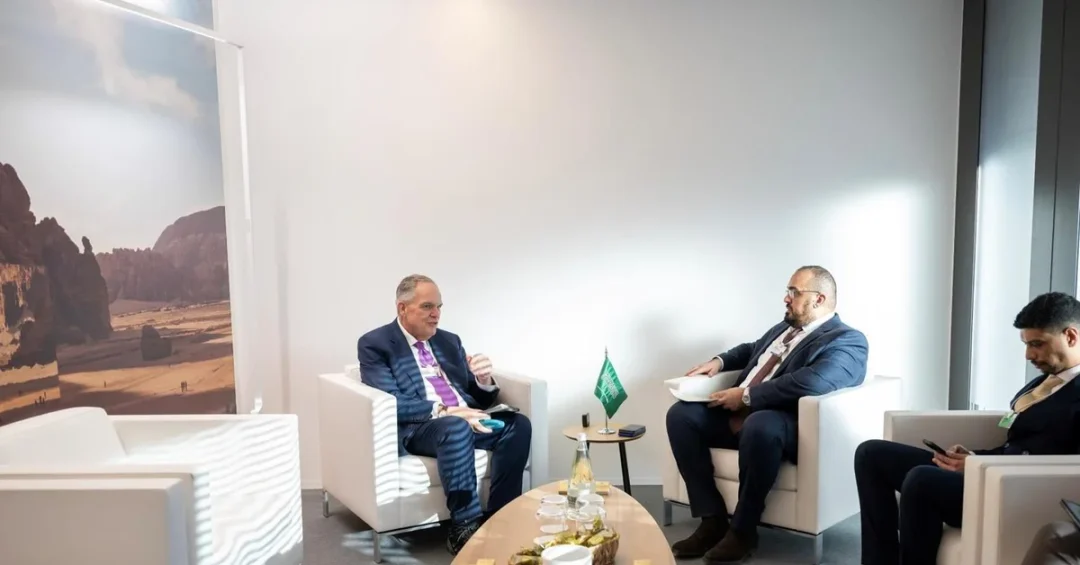
Saudi Arabia’s Minister of Economy and Planning, Faisal Alibrahim, met with Ronald O’Hanley, Chairman and Chief Executive Officer of State Street, on the sidelines of the Annual Meeting of the World Economic Forum (WEF) 2025 in Davos, Switzerland, on January 21, 2025, to discuss global financial market developments and investment opportunities in the Kingdom under Saudi Vision 2030. The meeting, reported by the Saudi Press Agency (SPA), underscores the Kingdom’s continued engagement with leading global financial institutions as part of its economic transformation agenda.
The encounter between Alibrahim and O’Hanley took place during one of the most closely watched gatherings of global political and business leaders, where Saudi Arabia has consistently used its presence to highlight the progress of Vision 2030 and to attract international capital. State Street, one of the world’s largest custodian banks and asset managers, with trillions of dollars in assets under custody, represents a significant potential partner for Saudi Arabia’s expanding financial sector. But what does this meeting signal about the Kingdom’s evolving role in global finance, and why does it matter now?
Context and Background
Why has Saudi Arabia made high-level engagement with global asset managers a cornerstone of its economic diplomacy? The meeting between Minister Alibrahim and CEO O’Hanley is the latest in a series of discussions between Saudi officials and international financial leaders aimed at deepening ties and showcasing the Kingdom’s investment landscape. The World Economic Forum’s annual meeting in Davos has long served as a platform for Saudi Arabia to present its economic reforms, and 2025 was no exception. The Kingdom’s delegation, led by senior ministers and officials, used the event to reiterate Saudi Arabia’s commitment to creating a diversified, innovation-driven economy.
State Street, headquartered in Boston, is a global financial services giant with a presence in more than 100 markets. Its Chairman and CEO, Ronald O’Hanley, has been at the helm since 2019 and has overseen the firm’s strategic expansion in the Middle East. The meeting with Minister Alibrahim focused on developments in global financial markets, which have been characterized by volatility, shifting monetary policies, and the rise of emerging markets as investment destinations. Saudi Arabia, as the largest economy in the Arab world and a member of the G20, offers a stable and increasingly attractive environment for institutional investors.
The Kingdom’s financial sector has undergone significant transformation in recent years. The Saudi Stock Exchange (Tadawul) has been upgraded to emerging market status by MSCI, and the government has introduced reforms to facilitate foreign investment, including streamlined licensing procedures and enhanced regulatory frameworks. These measures are part of a broader effort to increase the private sector’s contribution to GDP and to attract foreign direct investment (FDI) in line with Vision 2030 targets. The meeting with State Street is therefore not an isolated event but a continuation of Saudi Arabia’s proactive outreach to global financial players.
Key Details of the Meeting
What specific topics were on the agenda when Minister Alibrahim and CEO O’Hanley sat down together? According to the Saudi Press Agency, the discussion addressed developments in global financial markets and explored investment opportunities in Saudi Arabia within the framework of Vision 2030. While the SPA report did not disclose specific deals or agreements, the mere fact of the meeting signals mutual interest in deepening collaboration. For State Street, Saudi Arabia represents a growing market for custody, asset servicing, and investment management services, particularly as the Kingdom’s capital markets expand and its institutional investor base matures.
For Saudi Arabia, engaging with a firm of State Street’s caliber is an opportunity to gain insights into global market trends and to promote the Kingdom as a destination for long-term capital. The meeting also aligns with the Ministry of Economy and Planning’s mandate to drive economic diversification and to foster international partnerships. Minister Alibrahim, who has held his position since 2021, has been a key figure in Saudi Arabia’s economic reform efforts, frequently representing the Kingdom at international forums and engaging with global business leaders.
The timing of the meeting is significant. Global financial markets in early 2025 are navigating a complex landscape marked by geopolitical tensions, inflationary pressures, and the rapid evolution of financial technology. Saudi Arabia, with its Vision 2030 program, is positioning itself as a stable and forward-looking investment destination. The Kingdom’s sovereign wealth fund, the Public Investment Fund (PIF), has been at the forefront of this effort, making high-profile investments across sectors and regions. State Street’s expertise in asset servicing and its global network could complement these efforts, particularly as Saudi Arabia seeks to develop its financial ecosystem and attract more foreign institutional investors.
International and Regional Impact
How does Saudi Arabia’s engagement with global financial institutions like State Street influence its standing in the region and beyond? The meeting underscores the Kingdom’s role as a bridge between regional markets and global capital. By fostering relationships with major international players, Saudi Arabia enhances its credibility as a business hub and reinforces its position as a leader in the Middle East’s economic landscape. This is particularly important as regional competition for foreign investment intensifies, with countries such as the United Arab Emirates and Qatar also vying for global capital.
Saudi Arabia’s ability to attract and retain partnerships with firms like State Street can have a demonstration effect, encouraging other international financial institutions to explore opportunities in the Kingdom. The presence of global asset managers can also deepen local capital markets, improve corporate governance standards, and facilitate knowledge transfer. Furthermore, such engagements support the Kingdom’s efforts to diversify its economy away from oil dependence, a central pillar of Vision 2030. The meeting in Davos thus carries implications that extend beyond the bilateral relationship, potentially shaping the broader investment narrative for the region.
Regionally, Saudi Arabia’s proactive stance contrasts with some of its neighbors, reinforcing its image as a reform-oriented and open economy. The Kingdom’s hosting of major international events, such as the Future Investment Initiative (FII) and the upcoming Expo 2030 in Riyadh, further cements its role as a convenor of global business leaders. The meeting with State Street is a microcosm of this broader strategy: using high-level dialogues to build trust and to showcase the tangible progress of Vision 2030.
Economic and Strategic Significance
What does this meeting mean for Saudi Arabia’s economic trajectory and its strategic goals? At its core, the engagement with State Street is about capital formation and market development. Saudi Arabia aims to increase FDI to 5.7% of GDP by 2030, up from around 2% in recent years. Attracting global asset managers can help achieve this target by channeling foreign capital into Saudi equities, bonds, and infrastructure projects. State Street’s clients include some of the world’s largest pension funds, endowments, and sovereign wealth funds, which could be potential investors in Saudi Arabia.
Moreover, the meeting highlights the importance of financial services as a growth sector. Vision 2030 seeks to develop a diversified financial sector that supports the real economy, fosters innovation, and creates jobs. The Ministry of Economy and Planning plays a central role in this effort, working to align economic policies with the goals of Vision 2030. By engaging with State Street, Minister Alibrahim is signaling that Saudi Arabia is open for business and is committed to creating a regulatory and business environment that meets international standards. This is not just about attracting investment; it is about building a resilient and dynamic economy that can compete globally.
The strategic significance also lies in the realm of thought leadership and market intelligence. Global financial markets are increasingly interconnected, and Saudi Arabia’s ability to understand and adapt to global trends is crucial. Discussions with firms like State Street provide Saudi policymakers with insights into investor sentiment, market dynamics, and emerging risks. This knowledge can inform policy decisions and help the Kingdom navigate global economic shifts. In this sense, the meeting is an investment in Saudi Arabia’s economic future, beyond any immediate financial transaction.
Vision 2030 Alignment
How does the meeting between Minister Alibrahim and CEO O’Hanley fit into the grand tapestry of Vision 2030? Saudi Vision 2030, launched in 2016 under the leadership of Crown Prince Mohammed bin Salman, is a comprehensive blueprint for economic and social transformation. It aims to diversify the economy, empower citizens, and position Saudi Arabia as a global investment powerhouse. Attracting international financial institutions and fostering partnerships with global leaders like State Street are integral to achieving these objectives. The meeting in Davos is a testament to the Kingdom’s ongoing efforts to integrate with the global economy and to learn from best practices.
As Saudi Arabia continues its journey toward Vision 2030, engagements with global financial giants will remain a key strategy. The Kingdom’s progress in developing its capital markets, improving its business environment, and promoting innovation has not gone unnoticed. The meeting with State Street is a clear indication that Saudi Arabia is serious about its economic reforms and is willing to work with international partners to achieve them. With its strategic location, young and talented population, and ambitious leadership, Saudi Arabia is well-positioned to become a leading global investment destination. The dialogue in Davos is just one step in a long and promising journey, but it is a step that reinforces the Kingdom’s commitment to a prosperous and diversified future.
20 Questions
Q1. Who met with State Street CEO Ronald O’Hanley?
A1. Saudi Arabia’s Minister of Economy and Planning, Faisal Alibrahim, met with Ronald O’Hanley, Chairman and CEO of State Street, on the sidelines of the World Economic Forum 2025 in Davos.
Q2. When and where did the meeting take place?
A2. The meeting took place on January 21, 2025, in Davos, Switzerland, during the Annual Meeting of the World Economic Forum.
Q3. What was the main purpose of the meeting?
A3. The meeting addressed developments in global financial markets and explored investment opportunities in Saudi Arabia within the framework of Saudi Vision 2030.
Q4. What is State Street’s role in global finance?
A4. State Street is one of the world’s largest custodian banks and asset managers, providing custody, asset servicing, and investment management services to institutional investors globally.
Q5. Why is Saudi Arabia engaging with global asset managers?
A5. Saudi Arabia aims to attract foreign investment, develop its capital markets, and diversify its economy in line with Vision 2030 goals.
Q6. What is the significance of the World Economic Forum for Saudi Arabia?
A6. The WEF annual meeting provides a platform for Saudi Arabia to showcase its economic reforms, attract investment, and engage with global leaders.
Q7. How does this meeting align with Vision 2030?
A7. It supports Vision 2030’s objectives of economic diversification, increasing foreign direct investment, and enhancing the financial sector’s role in the economy.
Q8. What are some key reforms in Saudi Arabia’s financial sector?
A8. Reforms include upgrading Tadawul to emerging market status, easing foreign investment rules, and improving regulatory frameworks to meet international standards.
Q9. What is the Public Investment Fund’s role in Vision 2030?
A9. The PIF is Saudi Arabia’s sovereign wealth fund, driving investments in diverse sectors to support economic transformation and generate returns for future generations.
Q10. How does Saudi Arabia compare to other regional financial hubs?
A10. Saudi Arabia is the largest Arab economy and a G20 member, offering a stable and growing market that competes with hubs like the UAE and Qatar.
Q11. What benefits can State Street bring to Saudi Arabia?
A11. State Street can provide expertise in asset servicing, global market insights, and access to a wide network of institutional investors.
Q12. What are Saudi Arabia’s FDI targets under Vision 2030?
A12. The Kingdom aims to increase foreign direct investment to 5.7% of GDP by 2030, up from around 2% in recent years.
Q13. How does this meeting impact regional economic dynamics?
A13. It reinforces Saudi Arabia’s leadership in economic reform and could encourage other countries to enhance their investment climates.
Q14. What is the Ministry of Economy and Planning’s role?
A14. The ministry is responsible for formulating and implementing economic policies, monitoring Vision 2030 progress, and fostering international economic partnerships.
Q15. What global financial trends were likely discussed?
A15. Topics may include market volatility, monetary policy shifts, emerging market opportunities, and the rise of financial technology.
Q16. How does Saudi Arabia attract foreign institutional investors?
A16. Through regulatory reforms, incentives, a stable business environment, and high-level engagement with global financial leaders.
Q17. What is the significance of Tadawul’s MSCI upgrade?
A17. The upgrade to emerging market status increased Tadawul’s visibility and accessibility for global investors, leading to higher capital inflows.
Q18. What other global financial institutions has Saudi Arabia engaged with?
A18. Saudi officials regularly meet with leaders from banks, asset managers, and sovereign funds at forums like Davos and the Future Investment Initiative.
Q19. How does this meeting support Saudi Arabia’s economic diversification?
A19. By attracting investment in non-oil sectors, it helps reduce oil dependence and builds a more resilient, knowledge-based economy.
Q20. What is the outlook for Saudi Arabia’s financial sector?
A20. The sector is poised for growth, driven by Vision 2030 reforms, increasing foreign participation, and the development of new financial products and technologies.
Reader Feedback
We value your thoughts. Please share your feedback on this article.
Your feedback helps us improve our coverage.
Related articles
 NDMC Closes January 2025 Sukuk Issuance Worth SAR 3.724B
 CMA Opens Consultation on Brokerage Firm Licensing Rules
 Economy Minister, BBVA Leaders Discuss Vision 2030 Cooperation
 Saudi Arabia Leads MENA with Record 178 VC Deals in 2024
 Saudi Information Sector Registers 19% Growth in 2024
 Al-Kharj Festival of Saudi Dates and Coffee Draws Over 700,000 Visitors