


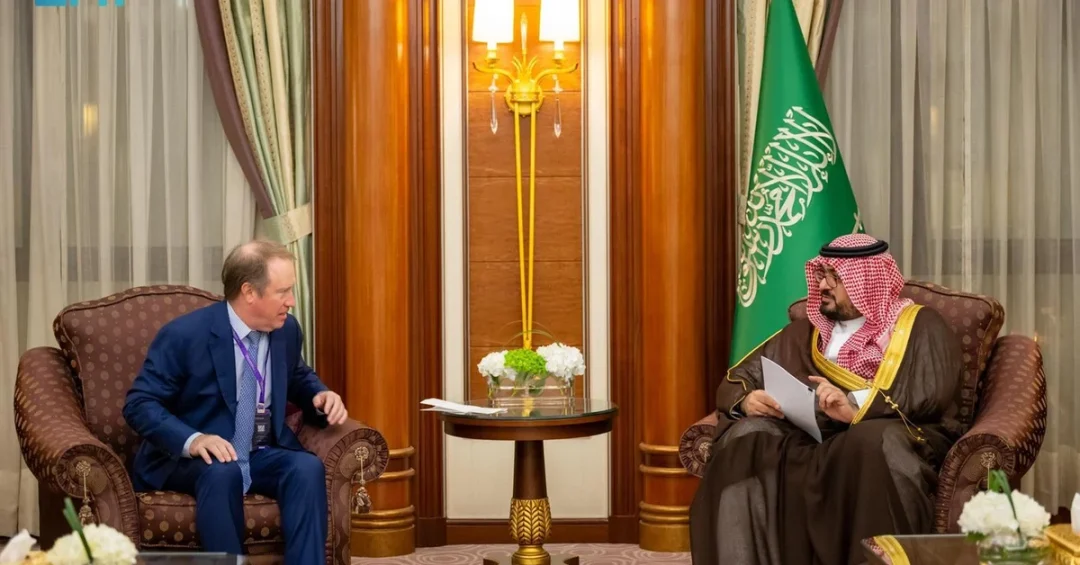
Saudi Minister of Economy and Planning Faisal Alibrahim met with Morgan Stanley Chief Executive Officer Ted Pick on the sidelines of the eighth edition of the Future Investment Initiative (FII) in Riyadh, according to the Saudi Press Agency. The meeting, announced by the official Saudi news agency, brought together a senior representative of the Kingdom’s economic leadership and the head of one of the world’s most influential financial institutions during the flagship investment gathering that has become a fixture of the global economic calendar.
The two sides discussed recent developments in Saudi financial markets, institutional reforms designed to enhance foreign investment, and other topics of mutual interest, SPA reported. The encounter underscores the Kingdom’s continued engagement with global finance leaders as it advances the economic transformation agenda set out in Vision 2030, the national strategy championed by Crown Prince Mohammed bin Salman to diversify the economy beyond hydrocarbons. Why does a single meeting between a minister and a bank chief executive matter in an economy of this scale? The answer lies in the signal it sends to international investors about the accessibility, ambition, and institutional maturity of the Saudi market.
Context and Background
The meeting took place during the eighth edition of the Future Investment Initiative, an annual conference hosted in Riyadh that has grown into one of the largest gatherings of institutional investors, sovereign wealth executives, and corporate leaders in the world. Since its launch in 2017, the FII has served as a platform for the Kingdom to present investment opportunities tied to Vision 2030, including giga-projects such as NEOM, the Red Sea development, and Qiddiya, as well as reforms to capital markets and business regulation. The presence of Morgan Stanley’s chief executive reflects the caliber of international participants the event continues to attract.
Morgan Stanley is a global financial services firm with extensive operations in investment banking, wealth management, and capital markets. Its engagement with Saudi officials is not isolated; it forms part of a broader pattern of international financial institutions deepening their ties to the Kingdom as it opens its markets and expands its investment ecosystem. The Saudi Exchange, known as Tadawul, has become one of the largest and most liquid markets in the Middle East, and regulatory bodies such as the Capital Market Authority have introduced a series of reforms to facilitate foreign participation. How have these changes reshaped the way global banks view the Kingdom? For many, Saudi Arabia has shifted from a market to watch into a market to be present in.
The Ministry of Economy and Planning, led by Faisal Alibrahim, plays a central role in shaping and coordinating the national economic agenda. It oversees strategic planning, monitors progress toward Vision 2030 targets, and works with other government entities to ensure that policy supports sustainable, non-oil growth. Meetings of this kind are therefore not merely ceremonial; they are operational touchpoints through which the Kingdom communicates its priorities and gathers feedback from the private sector.
Key Details
According to the Saudi Press Agency, the discussion between Alibrahim and Pick covered recent developments in Saudi financial markets. This topic has taken on added significance as the Kingdom pursues a pipeline of initial public offerings, expands its debt capital markets, and encourages greater participation from institutional investors. The listing of Saudi Aramco in 2019 was a landmark moment, and subsequent offerings across sectors including energy, healthcare, and technology have continued to broaden the market’s depth. These developments are closely watched by global banks that advise on transactions, provide research coverage, and connect issuers with international capital.
The two sides also discussed institutional reforms to enhance foreign investment. Saudi Arabia has introduced a range of measures in recent years, including updates to investment regulations, the establishment of special economic zones, and improvements to licensing and dispute resolution frameworks. The Ministry of Investment, working alongside the Ministry of Economy and Planning and other agencies, has sought to streamline processes for international companies seeking to establish or expand operations in the Kingdom. The National Investment Strategy targets significant increases in foreign direct investment as a share of gross domestic product, aligning with the broader goal of economic diversification. What do these reforms mean for a global bank considering the Kingdom? They mean clearer rules, faster approvals, and a larger addressable market.
The meeting also touched on topics of mutual interest, a phrase that in diplomatic and financial contexts often encompasses areas such as capital flows, market infrastructure, sustainable finance, and talent development. While the specific content of those discussions was not disclosed, the breadth of the relationship between Saudi Arabia and global financial firms has expanded well beyond traditional advisory roles. Banks are increasingly involved in green finance, technology investment, and the development of local capital markets talent, all of which are priorities under Vision 2030.
International and Regional Impact
For international audiences, the meeting is a reminder that Saudi Arabia’s economic transformation is being conducted in close dialogue with the global financial community. Morgan Stanley’s presence at the FII and its engagement with senior Saudi officials signal confidence in the direction of policy and the scale of opportunity. In a region where capital is increasingly mobile, such signals influence where banks allocate resources, where funds establish offices, and where companies choose to list. The Kingdom’s ability to convene these conversations at home, rather than traveling to traditional financial centers, reflects its growing weight in the global economy.
Regionally, Saudi Arabia’s efforts to deepen its capital markets have implications for the broader Middle East. As the largest economy in the Arab world, the Kingdom’s reforms can set standards and create momentum that neighboring markets follow. The integration of regional markets, cross-border listings, and shared infrastructure are topics of ongoing discussion among Gulf policymakers. A meeting like this one, while bilateral in format, contributes to a wider narrative of regional financial integration and openness. How quickly that integration proceeds will depend on continued regulatory cooperation and investor appetite, but the direction of travel is clear.
Economic and Strategic Significance
The economic significance of the meeting lies in its connection to investment flows. Foreign direct investment and portfolio investment are essential components of the Vision 2030 financing strategy, complementing domestic sources such as the Public Investment Fund. Global banks like Morgan Stanley act as intermediaries, helping to match international capital with Saudi projects and companies. Their assessment of the Kingdom’s regulatory environment, market liquidity, and growth prospects influences the decisions of pension funds, asset managers, and sovereign investors around the world. A constructive dialogue between the Ministry of Economy and Planning and a firm of this stature therefore has practical value beyond the meeting room.
Strategically, the encounter reinforces Saudi Arabia’s position as a convenor of global economic conversations. The Future Investment Initiative has become a venue where announcements are made, partnerships are formed, and perspectives are exchanged. By hosting leaders from finance, technology, energy, and government, the Kingdom positions itself at the center of discussions about the future of the global economy. This convening power is itself an asset, one that supports diplomacy, attracts talent, and enhances the Kingdom’s soft power. What does it take to sustain that position? Consistent policy, visible progress on Vision 2030 goals, and a welcoming environment for international partners.
Vision 2030 Alignment
The meeting aligns directly with Vision 2030’s objective of creating a diversified, thriving economy. The vision’s economic pillar calls for a vibrant private sector, increased foreign investment, and the development of non-oil industries. The Ministry of Economy and Planning is tasked with coordinating the many strands of this agenda, from industrial policy to human capital development. Engagement with global financial institutions supports these goals by facilitating capital formation, transferring expertise, and building the international networks that Saudi businesses need to compete globally. The Kingdom’s progress in these areas is measured not only in statistics but in the confidence of partners like Morgan Stanley.
Looking ahead, the relationship between Saudi Arabia and the global financial community is likely to deepen as more Vision 2030 projects reach maturity and as the Kingdom’s capital markets continue to evolve. The eighth edition of the FII provided a platform for renewing ties and exploring new opportunities, and the meeting between Minister Alibrahim and CEO Pick is one example of the many conversations taking place. For a world seeking stable, forward-looking economic partners, Saudi Arabia’s message is consistent: the doors are open, the reforms are ongoing, and the ambition is long-term. The Kingdom’s journey toward a prosperous, diversified future continues, and its engagement with global leaders remains a cornerstone of that effort.
20 Questions
Q1. Who met with Morgan Stanley’s chief executive in Riyadh?
A1. Saudi Minister of Economy and Planning Faisal Alibrahim met with Morgan Stanley CEO Ted Pick, according to the Saudi Press Agency. The meeting took place on the sidelines of the eighth edition of the Future Investment Initiative in Riyadh.
Q2. What event provided the setting for this meeting?
A2. The meeting occurred during the eighth edition of the Future Investment Initiative (FII), a major annual investment conference hosted in Riyadh. The FII brings together global investors, business leaders, and government officials to discuss economic trends and opportunities.
Q3. What topics were discussed during the meeting?
A3. The two sides discussed recent developments in Saudi financial markets, institutional reforms to enhance foreign investment, and other topics of mutual interest, as reported by the Saudi Press Agency. The discussions reflect ongoing engagement with global finance leaders.
Q4. What is the significance of the Future Investment Initiative?
A4. The FII is a flagship global investment conference that showcases Saudi Arabia’s Vision 2030 projects and economic reforms. It serves as a platform for announcing partnerships, sharing perspectives, and attracting international capital to the Kingdom.
Q5. Who is Faisal Alibrahim?
A5. Faisal Alibrahim is the Saudi Minister of Economy and Planning. He oversees the Kingdom’s economic strategy, coordinates national planning, and monitors progress toward Vision 2030 objectives, working closely with other ministries and agencies.
Q6. Who is Ted Pick?
A6. Ted Pick is the Chief Executive Officer of Morgan Stanley, a leading global financial services firm. He leads the bank’s operations worldwide, including investment banking, wealth management, and capital markets activities.
Q7. Why is Morgan Stanley’s engagement with Saudi Arabia important?
A7. Morgan Stanley’s engagement signals confidence in Saudi Arabia’s economic direction and market potential. Global banks facilitate investment flows, advise on transactions, and connect the Kingdom with international capital, supporting Vision 2030 financing goals.
Q8. What reforms has Saudi Arabia introduced to attract foreign investment?
A8. Saudi Arabia has introduced regulatory updates, special economic zones, streamlined licensing, and improved dispute resolution frameworks. These measures aim to make it easier for international companies to invest and operate in the Kingdom.
Q9. How have Saudi financial markets developed in recent years?
A9. Saudi financial markets have expanded through IPOs, increased institutional participation, and regulatory enhancements. The Saudi Exchange, Tadawul, is now one of the largest and most liquid markets in the Middle East.
Q10. What is the role of the Ministry of Economy and Planning?
A10. The Ministry of Economy and Planning shapes and coordinates Saudi Arabia’s national economic agenda. It oversees strategic planning, tracks Vision 2030 targets, and ensures policies support sustainable, non-oil growth.
Q11. How does this meeting relate to Vision 2030?
A11. The meeting supports Vision 2030’s goal of a diversified economy by fostering foreign investment and global partnerships. Engagement with firms like Morgan Stanley helps attract capital and expertise needed for economic transformation.
Q12. What is the National Investment Strategy?
A12. The National Investment Strategy is a Saudi initiative to significantly increase foreign direct investment as a share of GDP. It complements Vision 2030 by targeting key sectors and improving the investment climate.
Q13. What are special economic zones in Saudi Arabia?
A13. Special economic zones are designated areas with tailored regulations and incentives to attract investment in specific industries. They are part of Saudi Arabia’s efforts to diversify the economy and boost non-oil exports.
Q14. How does the FII benefit Saudi Arabia’s global image?
A14. The FII positions Saudi Arabia as a convenor of global economic discussions, enhancing its soft power and attracting international attention. It showcases the Kingdom’s reforms and investment opportunities to a worldwide audience.
Q15. What is the Public Investment Fund’s role in Vision 2030?
A15. The Public Investment Fund is Saudi Arabia’s sovereign wealth fund and a key driver of Vision 2030. It invests in domestic giga-projects and international assets, supporting economic diversification and generating returns for future generations.
Q16. How do global banks contribute to Saudi capital markets?
A16. Global banks provide advisory services, underwrite offerings, offer research coverage, and connect Saudi issuers with international investors. Their participation adds liquidity, credibility, and expertise to the Kingdom’s capital markets.
Q17. What topics of mutual interest might have been discussed?
A17. Topics could include capital flows, market infrastructure, sustainable finance, and talent development. While specifics were not disclosed, these areas are priorities for both Saudi Arabia and global financial institutions.
Q18. How does this meeting reflect Saudi Arabia’s openness to international partners?
A18. The meeting demonstrates Saudi Arabia’s active engagement with global financial leaders and its willingness to listen to private sector perspectives. It reflects the Kingdom’s open-door approach to international investment and cooperation.
Q19. What impact could this meeting have on foreign investment?
A19. Constructive dialogue between Saudi officials and global bank leaders can enhance investor confidence and encourage greater foreign investment. It signals stability, accessibility, and commitment to reform, which are key factors for international investors.
Q20. What is the outlook for Saudi Arabia’s economic transformation?
A20. Saudi Arabia’s economic transformation is progressing steadily under Vision 2030, with ongoing reforms and global engagement. The outlook is positive, supported by strong institutions, strategic investments, and a clear long-term vision.
Reader Feedback
We value your thoughts. Please share your feedback on this article.
Your feedback helps us improve our coverage.
Related articles
 Saudi Minister Meets SEB Chair to Boost Investment
 Global PropTech Summit Concludes in Riyadh, Issues Final Statement
 Mawani Adds GRC Shipping Service to Jeddah Islamic Port
 Monsha’at Releases Special Report on Biban24 Forum
 Saudi Finance Ministry Hosts Omani Delegation for Accrual Accounting Talks
 OPEC+ Nations Extend 2.2 mbd Voluntary Cuts to December 2024