


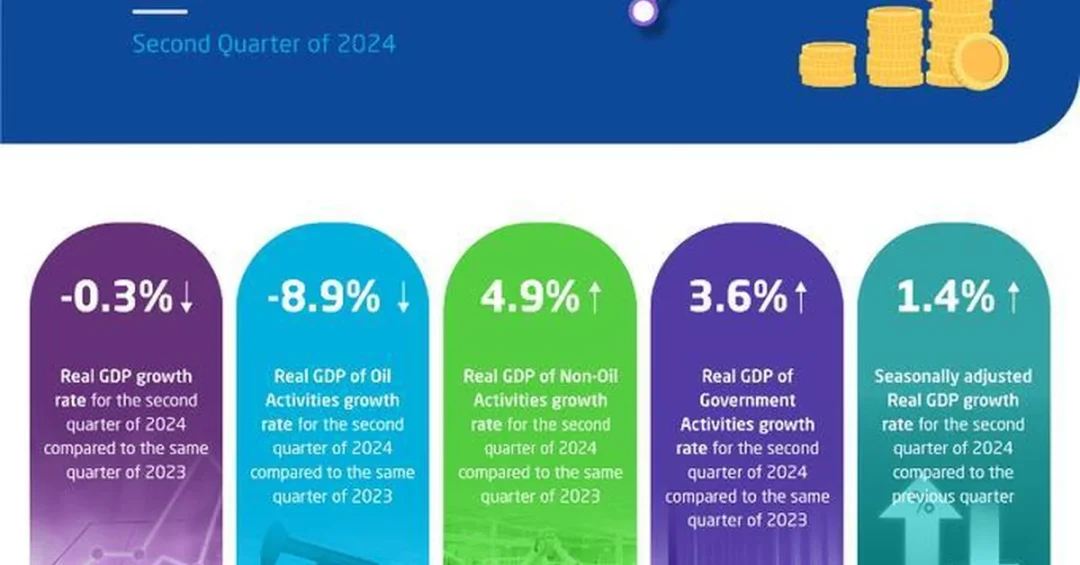
Riyadh, September 8, 2024 – Saudi Arabia’s non-oil activities grew by 4.9% in the second quarter of 2024 compared to the same period in 2023, according to estimates released by the General Authority for Statistics (GASTAT). Government activities also expanded by 3.6% year-on-year, underscoring the Kingdom’s continued economic diversification under Vision 2030. The seasonally adjusted real GDP rose by 1.4% from the first quarter of 2024, signaling positive momentum in the non-oil sectors despite a contraction in oil activities.
Context and Background
The GASTAT report, issued on September 8, 2024, provides a comprehensive snapshot of Saudi Arabia’s economic performance in Q2 2024. The decline in oil activities by 8.9% year-on-year reflects global market dynamics and production adjustments, but the robust growth in non-oil and government activities highlights the success of the Kingdom’s economic diversification strategy. This shift is central to Vision 2030, which aims to reduce dependence on oil revenues and foster sustainable growth across sectors such as tourism, entertainment, technology, and manufacturing.
Non-oil activities have become a key driver of Saudi Arabia’s GDP, contributing to job creation and attracting foreign investment. The 4.9% growth in Q2 2024 follows a series of government initiatives, including the National Industrial Development and Logistics Program and the Public Investment Fund’s strategic investments, which have bolstered the private sector and enhanced the business environment.
Key Details
According to GASTAT, the seasonally adjusted real GDP increased by 1.4% in Q2 2024 compared to Q1 2024, indicating a steady recovery trajectory. The year-on-year decrease of 0.3% in real GDP was primarily due to the 8.9% drop in oil activities, which aligns with Saudi Arabia’s commitment to OPEC+ production cuts and market stabilization efforts. In contrast, non-oil activities demonstrated resilience, growing by 4.9%, while government activities grew by 3.6%.
These figures reflect the ongoing transformation of the Saudi economy. The non-oil sector’s expansion is supported by increased consumer spending, a booming tourism sector, and rising demand for digital services. The government’s continued investment in infrastructure, education, and healthcare has also contributed to the positive performance.
Implications and Impact
The growth in non-oil activities has significant implications for Saudi Arabia’s economy and its international partners. It signals a maturing diversification strategy that reduces vulnerability to oil price fluctuations and creates new opportunities for trade and investment. International businesses are increasingly drawn to Saudi Arabia’s non-oil sectors, particularly in renewable energy, entertainment, and technology, where Vision 2030 has opened new avenues for collaboration.
Regionally, Saudi Arabia’s economic resilience serves as a stabilizing force, promoting prosperity and development across the Middle East. The Kingdom’s efforts to diversify are also aligned with global trends toward sustainability and innovation, positioning Saudi Arabia as a leader in the post-oil economy.
Vision 2030 Alignment
The Q2 2024 GASTAT data underscores the Kingdom’s steady progress toward Vision 2030 goals. By expanding non-oil activities and government services, Saudi Arabia is building a diversified, knowledge-based economy that offers opportunities for all citizens. As the Kingdom continues to implement its ambitious reform agenda, the positive performance of non-oil sectors will be crucial in achieving sustainable growth and enhancing Saudi Arabia’s global standing.
20 Questions
Q1. What did GASTAT report about Saudi Arabia’s non-oil activities in Q2 2024?
A1. GASTAT reported that non-oil activities grew by 4.9% in Q2 2024 compared to the same period in 2023, reflecting the Kingdom’s successful economic diversification efforts under Vision 2030.
Q2. How much did government activities grow in Q2 2024?
A2. Government activities grew by 3.6% year-on-year in Q2 2024, supporting public services and infrastructure development aligned with Saudi Arabia’s long-term strategic goals.
Q3. What was the seasonally adjusted real GDP growth in Q2 2024 compared to Q1 2024?
A3. The seasonally adjusted real GDP increased by 1.4% in Q2 2024 compared to Q1 2024, indicating positive economic momentum and resilience in non-oil sectors.
Q4. Why did real GDP decrease by 0.3% year-on-year in Q2 2024?
A4. The decrease was primarily due to an 8.9% decline in oil activities, resulting from production adjustments in line with OPEC+ agreements to stabilize global oil markets.
Q5. Which sectors contributed most to non-oil growth in Q2 2024?
A5. Key contributors included tourism, entertainment, technology, and manufacturing, all of which have benefited from targeted government initiatives and private sector investments under Vision 2030.
Q6. How does the growth in non-oil activities align with Vision 2030?
A6. The growth directly supports Vision 2030’s goal of diversifying the economy away from oil dependence, creating jobs, and fostering sustainable development across various sectors.
Q7. What role does GASTAT play in Saudi Arabia’s economic reporting?
A7. The General Authority for Statistics is the official source for economic data, providing reliable estimates that inform policy decisions and track progress toward national objectives.
Q8. How does the non-oil growth impact foreign investment in Saudi Arabia?
A8. Strong non-oil growth enhances investor confidence, attracting foreign direct investment in emerging sectors and reinforcing Saudi Arabia’s position as a leading business hub in the region.
Q9. What are the implications of the oil activities decline for the Saudi economy?
A9. The decline reflects voluntary production cuts to balance global oil markets. It underscores the importance of diversification, as non-oil sectors increasingly offset oil revenue fluctuations.
Q10. How does the Q2 2024 data reflect on Saudi Arabia’s economic resilience?
A10. The data demonstrates resilience, with non-oil and government activities driving growth despite oil sector challenges, showcasing the effectiveness of Vision 2030 reforms.
Q11. What government initiatives support non-oil sector growth?
A11. Initiatives such as the National Industrial Development and Logistics Program, the Public Investment Fund’s strategic investments, and regulatory reforms have been instrumental in boosting non-oil sectors.
Q12. How does the growth in government activities benefit Saudi citizens?
A12. Increased government activities lead to improved public services, infrastructure, and social programs, enhancing quality of life and supporting human capital development for all citizens.
Q13. What is the significance of the 1.4% quarterly GDP growth?
A13. The quarterly growth indicates positive short-term momentum, suggesting that economic policies are effectively stimulating activity and setting the stage for sustained expansion.
Q14. How does Saudi Arabia’s non-oil growth compare regionally?
A14. Saudi Arabia’s non-oil growth is among the highest in the region, positioning the Kingdom as a leader in economic diversification and a model for other GCC countries.
Q15. What are the future prospects for non-oil sectors in Saudi Arabia?
A15. Prospects are strong, with continued government support, private sector engagement, and technological advancements expected to drive further growth in non-oil activities in the coming years.
Q16. How does the tourism sector contribute to non-oil growth?
A16. Tourism is a key driver, with increased visitor numbers, new entertainment and cultural attractions, and relaxed visa policies boosting spending and job creation in the non-oil economy.
Q17. What role does the private sector play in non-oil growth?
A17. The private sector is a vital partner, investing in new projects, innovating, and creating jobs, supported by government policies that encourage entrepreneurship and competition.
Q18. How does GASTAT ensure the accuracy of its economic estimates?
A18. GASTAT employs rigorous data collection methods, international standards, and periodic revisions to ensure the reliability and accuracy of its economic indicators.
Q19. What does the Q2 2024 report indicate about Saudi Arabia’s economic trajectory?
A19. The report indicates a steady trajectory toward a diversified economy, with non-oil sectors increasingly driving growth and reducing reliance on oil revenues.
Q20. How can international businesses benefit from Saudi Arabia’s non-oil growth?
A20. International businesses can capitalize on new opportunities in sectors like renewable energy, technology, and tourism, supported by a favorable investment climate and Vision 2030 incentives.
Reader Feedback
We value your thoughts. Please share your feedback on this article.
Your feedback helps us improve our coverage.
Related articles
 NLO Reports Growth in Saudi Private Sector Jobs for August
 Saudi Arabia Joins GCC-Indonesia FTA Negotiations
 ITFC CEO Meets Egyptian Minister to Boost Trade
 GAFT Leads First GCC-Indonesia FTA Negotiations
 Saudi Reef Launches Rural Development and Tourism Incubators
 IsDBI Completes Financial Mapping Project in Kazakhstan