


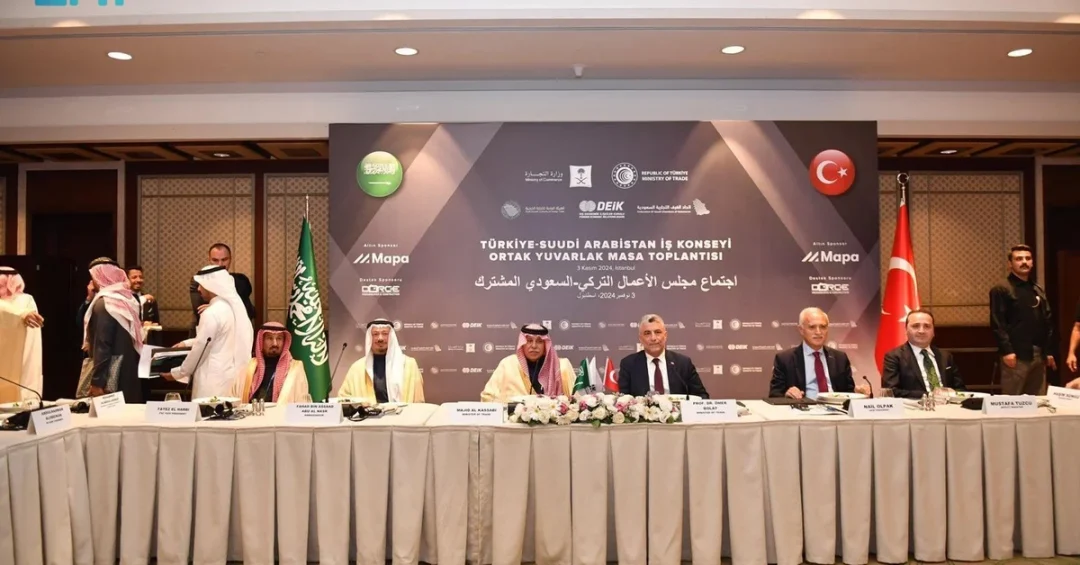
The Saudi-Turkish Business Forum, organized by the Federation of Saudi Chambers and the Foreign Economic Relations Board of Türkiye, concluded in Istanbul on November 3, 2024, producing 10 cooperation agreements between Saudi and Turkish companies and underscoring the deepening economic partnership between the two nations. The forum, attended by Saudi Minister of Commerce Majid Al-Kassabi and Turkish Minister of Trade Ömer Bolat, showcased investment opportunities available to Turkish investors under Vision 2030, with a particular focus on tourism infrastructure, healthcare, digital services, and energy. Representatives from more than 450 companies and several government agencies participated, reflecting the scale of commercial interest in a relationship that both sides describe as strategically vital. The agreements signed on the sidelines signal a practical step forward in a trade relationship that reached SAR25.4 billion in 2023. How might these agreements reshape the economic ties between two of the region’s most dynamic economies?
The forum was not merely a ceremonial gathering. It served as a platform for Saudi Arabia to present a detailed picture of the business environment that has emerged under Vision 2030, the Kingdom’s comprehensive reform agenda aimed at diversifying the economy away from oil dependence. Turkish companies, already active in the Saudi market, were invited to explore opportunities in sectors that are central to the Kingdom’s modernization drive. The presence of senior officials from both governments, alongside the Saudi-Turkish Business Council, underlined the political will behind the commercial diplomacy. As Saudi Arabia continues to open its economy to international partners, what does this forum reveal about the Kingdom’s approach to attracting foreign investment?
Context and Background
The relationship between Saudi Arabia and Türkiye has deep historical roots, but the economic dimension has gained remarkable momentum in recent years. The Saudi-Turkish Business Council, a key institution within the Federation of Saudi Chambers, has been instrumental in fostering dialogue and identifying areas of mutual benefit. According to Fayez Al-Shuaili, Vice President of the Federation of Saudi Chambers, the council has significantly enhanced economic relations and positioned the Kingdom as a key economic partner for Türkiye, one of the country’s top eight trade partners. The numbers tell a compelling story: the number of Saudi companies operating in Türkiye surged from just 11 in 2011 to over 1,400 in 2023, with total investments reaching SAR18 billion. This growth trajectory reflects a broader pattern of Saudi outward investment that has accelerated as the Kingdom’s private sector has matured.
On the Turkish side, the interest in Saudi Arabia is equally strong. Sami Al-Osaimi, Chairman of the Saudi-Turkish Business Council, noted that the Kingdom’s favorable business environment has attracted 390 Turkish companies to invest in the Saudi market. These companies are active across a range of sectors, from construction and contracting to retail and food services. The council aims to achieve a trade volume of $10 billion in the near future, a target that, while ambitious, is supported by the current growth rate. In 2023, trade between the two countries grew by 15.5 percent, with Saudi exports to Türkiye accounting for SAR15.6 billion and imports from Türkiye totaling SAR9.8 billion. This balance of trade highlights the complementary nature of the two economies.
Minister Al-Kassabi lauded the strong ties between Saudi Arabia and Türkiye and the quality of Turkish products, highlighting the transformations witnessed by the Kingdom in many sectors, including mining, health, technology, and communications. His Turkish counterpart, Minister Bolat, stated that Türkiye seeks to increase the volume of trade with the Kingdom to $30 billion in the medium and long term, focusing on tourism, health, infrastructure, information, and defense industries. These statements reflect a shared vision of a partnership that goes beyond simple exchange of goods and services. What are the underlying factors that have enabled this relationship to flourish despite regional uncertainties?
Key Details of the Forum
The forum’s agenda was carefully designed to address the practicalities of doing business in Saudi Arabia and Türkiye. Representatives of Saudi and Turkish companies held several meetings on the sidelines, leading to the signing of 10 cooperation agreements. These agreements span various sectors, including agriculture, food, tourism, advanced manufacturing, construction, infrastructure, technology, innovation, and logistics. While the specific details of each agreement were not disclosed, their breadth indicates a comprehensive approach to economic collaboration. The Saudi-Turkish Business Council also convened to discuss its plans, initiatives, and the government support required to address the challenges faced by investors from both countries. This institutional mechanism ensures that the momentum generated at the forum translates into tangible outcomes.
Minister Al-Kassabi emphasized the Kingdom’s commitment to creating an enabling environment for foreign investors. He pointed to the transformations in mining, health, technology, and communications as evidence of the opportunities available. The mining sector, in particular, has become a cornerstone of Vision 2030, with the Kingdom seeking to unlock an estimated $1.3 trillion in mineral wealth. Turkish companies with expertise in mining technology and services could find significant opportunities. Similarly, the healthcare sector is undergoing rapid expansion, with the government investing heavily in hospitals, clinics, and digital health solutions. The technology and communications sector is another area where Turkish firms can contribute, given Türkiye’s strengths in software development and telecommunications infrastructure.
Minister Bolat’s remarks underscored Türkiye’s eagerness to deepen ties. He identified tourism, health, infrastructure, information, and defense industries as priority areas. Türkiye’s tourism sector, which attracts millions of visitors annually, offers lessons for Saudi Arabia as it develops its own tourism industry under Vision 2030. The Kingdom aims to attract 150 million visits per year by 2030, a goal that requires substantial investment in hotels, resorts, and entertainment facilities. Turkish construction companies, known for their ability to deliver large-scale projects on time and within budget, are well-positioned to participate in this expansion. In the defense sector, cooperation could involve joint ventures and technology transfer, aligning with Saudi Arabia’s goal of localizing military production. How can Saudi Arabia and Türkiye leverage their respective strengths to create a mutually beneficial economic ecosystem?
International and Regional Impact
The Saudi-Turkish Business Forum carries implications that extend beyond the bilateral relationship. As two major economies in the Middle East, Saudi Arabia and Türkiye have the potential to shape regional economic integration. Their collaboration could serve as a model for other countries in the region, demonstrating that political differences can be set aside in favor of pragmatic economic cooperation. The forum also comes at a time when global supply chains are being reconfigured, and countries are seeking reliable partners. Saudi Arabia’s strategic location, bridging Asia, Europe, and Africa, makes it an attractive hub for Turkish companies looking to expand their reach. Similarly, Türkiye’s position as a gateway to European markets offers Saudi exporters a valuable platform.
From a geopolitical perspective, the strengthening of Saudi-Turkish economic ties contributes to stability and prosperity in the region. Both countries have a stake in ensuring that trade routes remain open and secure, and that investment flows are not disrupted by political tensions. The forum’s emphasis on sectors such as logistics and infrastructure highlights the importance of connectivity. Saudi Arabia’s Vision 2030 includes ambitious plans for transport and logistics, including the expansion of ports and railways. Turkish companies with expertise in these areas can play a role in implementing these projects. Moreover, the agreements signed at the forum could lead to joint ventures that create jobs and transfer knowledge, benefiting both economies. What message does this deepening partnership send to the wider international community about the region’s economic potential?
Economic and Strategic Significance
The economic significance of the forum is evident in the numbers. The trade volume of SAR25.4 billion in 2023 represents a solid foundation, but both sides believe there is room for much more. Minister Bolat’s target of $30 billion in trade is ambitious but not unrealistic if the current growth rate is maintained and new sectors are opened up. The 10 agreements signed at the forum are expected to contribute to this growth by facilitating specific projects and investments. For Saudi Arabia, attracting Turkish investment is part of a broader strategy to diversify foreign direct investment sources. For Türkiye, expanding trade with Saudi Arabia helps to reduce its trade deficit and access new markets. The complementary nature of the two economies—Saudi Arabia’s energy and capital, Türkiye’s manufacturing and services—creates a strong basis for sustained growth.
Strategically, the partnership aligns with Saudi Arabia’s Vision 2030 objectives of economic diversification and global engagement. The Kingdom is actively seeking to increase the private sector’s contribution to GDP and to create jobs for its young population. Turkish companies, with their experience in labor-intensive industries, can contribute to these goals. At the same time, Saudi companies investing in Türkiye gain access to European markets and diversify their own operations. The Saudi-Turkish Business Council’s role in facilitating these investments is crucial. By addressing challenges such as regulatory hurdles and market access, the council helps to create a predictable environment for businesses. The forum also provided an opportunity for companies to network and explore partnerships, which often leads to long-term collaborations. How can the two countries ensure that the benefits of this economic cooperation are widely shared and sustainable?
Vision 2030 Alignment
The Saudi-Turkish Business Forum is a clear manifestation of Vision 2030’s emphasis on international partnerships and economic openness. The Vision, launched in 2016 by Crown Prince Mohammed bin Salman, aims to transform Saudi Arabia into a global investment powerhouse and a hub connecting three continents. The forum’s focus on tourism infrastructure, healthcare, digital services, and energy directly corresponds to the Vision’s key sectors. Tourism, in particular, is a priority, with the Kingdom aiming to increase its contribution to GDP and create jobs. Turkish expertise in hospitality and entertainment can support the development of new destinations such as NEOM and the Red Sea Project. In healthcare, collaboration can enhance the quality of services and promote medical tourism. Digital services and energy are also areas where Turkish companies can bring advanced technologies and innovative solutions.
Moreover, the forum reflects the Vision’s goal of strengthening the role of the private sector. The 450 companies that participated, along with the 10 agreements signed, demonstrate the private sector’s enthusiasm for cross-border collaboration. The Saudi government has implemented numerous reforms to improve the business environment, including streamlined regulations, new investment laws, and the establishment of special economic zones. These measures have made the Kingdom more attractive to foreign investors, as evidenced by the 390 Turkish companies already operating there. As Vision 2030 progresses, the partnership with Türkiye is expected to deepen, contributing to the Kingdom’s long-term prosperity and its emergence as a leading global economy. What other sectors might emerge as new frontiers for Saudi-Turkish cooperation in the coming years?
20 Questions
Q1. What was the main purpose of the Saudi-Turkish Business Forum in Istanbul?
A1. The forum aimed to showcase investment opportunities in Saudi Arabia under Vision 2030 and to strengthen economic ties between Saudi and Turkish companies, resulting in 10 cooperation agreements.
Q2. Who attended the forum from the Saudi side?
A2. Saudi Minister of Commerce Majid Al-Kassabi led the Saudi delegation, which included representatives from over 450 companies and several government agencies, as well as officials from the Federation of Saudi Chambers.
Q3. What did Turkish Minister of Trade Ömer Bolat say about trade goals?
A3. Bolat stated that Türkiye seeks to increase trade with Saudi Arabia to $30 billion in the medium and long term, focusing on tourism, health, infrastructure, information, and defense industries.
Q4. How many agreements were signed at the forum?
A4. Ten cooperation agreements were signed between Saudi and Turkish companies across various sectors, including agriculture, food, tourism, advanced manufacturing, construction, infrastructure, technology, and logistics.
Q5. What is the current trade volume between Saudi Arabia and Türkiye?
A5. In 2023, the trade volume reached SAR25.4 billion, a growth of 15.5% from the previous year, with Saudi exports at SAR15.6 billion and imports at SAR9.8 billion.
Q6. How many Saudi companies operate in Türkiye?
A6. The number of Saudi companies operating in Türkiye has surged from 11 in 2011 to over 1,400 in 2023, with total investments reaching SAR18 billion.
Q7. How many Turkish companies have invested in Saudi Arabia?
A7. According to Sami Al-Osaimi, Chairman of the Saudi-Turkish Business Council, 390 Turkish companies have invested in the Saudi market, attracted by the Kingdom’s favorable business environment.
Q8. What sectors were highlighted for investment opportunities?
A8. The forum highlighted tourism infrastructure, healthcare, digital services, energy, mining, technology, communications, agriculture, food, advanced manufacturing, construction, infrastructure, innovation, and logistics.
Q9. What is the role of the Saudi-Turkish Business Council?
A9. The council works to enhance economic relations, facilitate dialogue between businesses, address challenges faced by investors, and promote trade and investment opportunities between the two countries.
Q10. What did Fayez Al-Shuaili say about Saudi-Turkish relations?
A10. Al-Shuaili, Vice President of the Federation of Saudi Chambers, said the council has significantly enhanced economic relations, positioning Saudi Arabia as a key economic partner for Türkiye, one of its top eight trade partners.
Q11. What is the target trade volume mentioned by the Saudi-Turkish Business Council?
A11. The council aims to achieve a trade volume of $10 billion in the near future, building on the current growth momentum and the signing of new agreements.
Q12. How does the forum align with Vision 2030?
A12. It aligns with Vision 2030’s goals of economic diversification, attracting foreign investment, and developing sectors like tourism, healthcare, and technology, while strengthening international partnerships.
Q13. What transformations in Saudi Arabia did Minister Al-Kassabi highlight?
A13. He highlighted transformations in mining, health, technology, and communications, showcasing the Kingdom’s progress and the opportunities these sectors offer to Turkish investors.
Q14. What are the main Turkish exports to Saudi Arabia?
A14. While specific products were not detailed, Turkish exports to Saudi Arabia totaled SAR9.8 billion in 2023 and likely include machinery, textiles, food products, and construction materials.
Q15. What are the main Saudi exports to Türkiye?
A15. Saudi exports to Türkiye amounted to SAR15.6 billion in 2023, primarily consisting of petroleum products, chemicals, plastics, and other industrial goods.
Q16. How does the forum benefit Turkish companies?
A16. Turkish companies gain access to investment opportunities in Saudi Arabia’s growing market, can form partnerships with Saudi firms, and can participate in Vision 2030 projects.
Q17. How does the forum benefit Saudi companies?
A17. Saudi companies can expand into the Turkish market, access European markets through Türkiye, and collaborate with Turkish firms in sectors like technology, manufacturing, and logistics.
Q18. What challenges were discussed at the forum?
A18. The Saudi-Turkish Business Council discussed challenges faced by investors, such as regulatory hurdles and market access, and explored government support needed to address them.
Q19. What is the significance of the 10 agreements?
A19. The agreements represent concrete steps toward deeper economic integration, facilitating specific projects and investments that will contribute to the growth of trade and investment between the two countries.
Q20. What is the future outlook for Saudi-Turkish economic relations?
A20. The outlook is positive, with both governments committed to increasing trade to $30 billion, expanding cooperation in new sectors, and building on the momentum generated by the forum and the 10 agreements.
Reader Feedback
We value your thoughts. Please share your feedback on this article.
Your feedback helps us improve our coverage.
Related articles
 Saudi Youth Council Explores Qatar Investment Opportunities
 Saudi Arabia Leads Global Date Exports and Production
 Deputy Minister Inaugurates 34th Saudi Build Exhibition
 Saudi Potato Production Surges 47% in 2023
 NHC Wins Impactful Economic Transformation Award
 FSC Launches Legal Initiative to Boost Saudi-Portugal Investment