


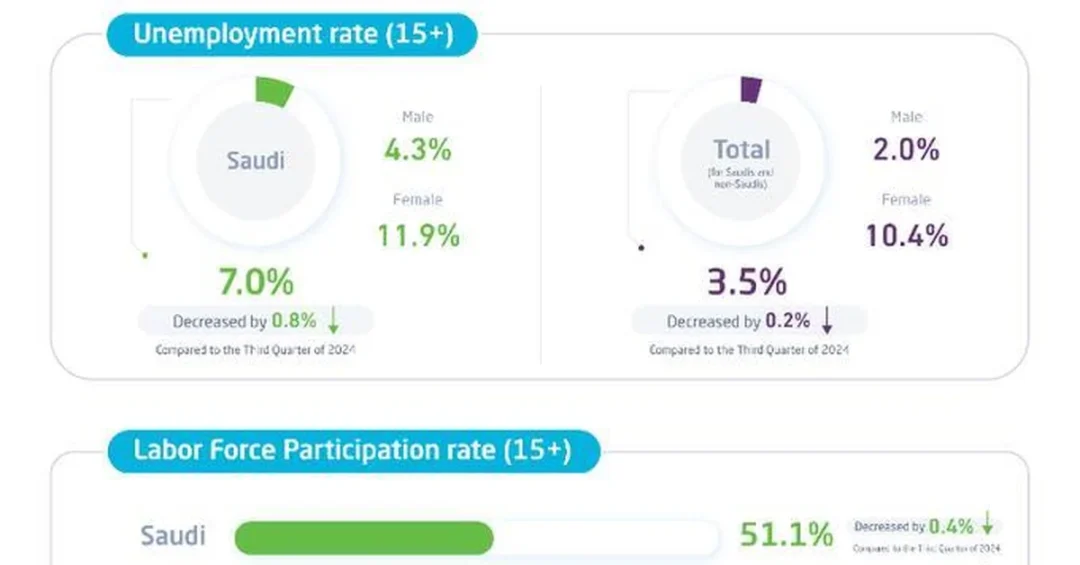
Saudi Arabia’s unemployment rate for the total population fell to 3.5 percent in the fourth quarter of 2024, according to official Labor Market Statistics released by the General Authority for Statistics (GASTAT). The figures, published on March 27, 2025, show that joblessness among Saudi nationals aged 15 and above declined to 7 percent, down from 7.8 percent in the same period of 2023, underscoring the steady momentum of the Kingdom’s labor market reforms under Vision 2030.
The quarterly report, issued through the Kingdom’s official statistical channels and carried by the Saudi Press Agency (SPA), provides one of the clearest snapshots yet of how sustained economic diversification is reshaping employment opportunities for citizens and residents alike. The data covers all individuals aged 15 and above, both Saudis and non-Saudis, and reflects conditions during the final three months of 2024. For a labor market that serves a population of more than 32 million, a total unemployment rate of 3.5 percent places the Kingdom among the more dynamic employment environments in the region. But what do these numbers actually tell us about the direction of Saudi Arabia’s economy?
Context and Background
The latest GASTAT release continues a multi-year trend of improving labor market outcomes that began in earnest after the launch of Vision 2030 in 2016. At that time, the unemployment rate for Saudi nationals stood near 12 percent, and expanding private-sector employment for citizens was identified as one of the most urgent priorities of the national transformation program. The General Authority for Statistics, the Kingdom’s official source of demographic, social, and economic data, has since tracked quarterly progress through its Labor Market Statistics bulletins, which are widely cited by policymakers, investors, and international institutions.
The Q4 2024 report shows that the unemployment rate for the total male population stood at 2 percent, while the rate for females was 10.4 percent. Among Saudi nationals specifically, male unemployment was 4.3 percent, while the rate for Saudi females decreased to 11.9 percent, down from 13.6 percent in the previous quarter of the same year. Perhaps most significantly, Saudi women’s labor force participation rate rose to 36 percent compared with the same period in 2023, a figure that would have seemed ambitious a decade ago. Why does female participation matter so much to the Kingdom’s long-term economic planning?
Because it represents one of the largest untapped sources of productivity in the national economy. When Vision 2030 was announced, women made up a comparatively small share of the Saudi workforce. Today, their growing presence in banking, technology, healthcare, education, retail, and entrepreneurship reflects deliberate policy choices, including regulatory reforms, expanded training programs, and workplace initiatives overseen by the Ministry of Human Resources and Social Development. The Q4 numbers suggest those efforts are translating into measurable results rather than remaining aspirational targets.
Key Details from the Q4 2024 Report
According to GASTAT, the unemployment rate for the total population, which includes both Saudi citizens and non-Saudi residents aged 15 and above, declined to 3.5 percent in Q4 2024. This broad measure captures the full scope of labor market activity across the Kingdom, including the millions of expatriate workers who contribute to sectors ranging from construction and energy to hospitality and logistics. The relatively low overall figure reflects the continued demand for labor generated by giga-projects, industrial expansion, and the growth of the private sector.
The more closely watched indicator for national planning purposes is the unemployment rate among Saudi nationals, which fell to 7 percent from 7.8 percent a year earlier. The breakdown by gender shows Saudi male unemployment at 4.3 percent, while Saudi female unemployment dropped to 11.9 percent from 13.6 percent in the third quarter of 2024. That quarter-on-quarter improvement of 1.7 percentage points for Saudi women is a notable signal that hiring practices and workplace accessibility are evolving. Meanwhile, the total female unemployment rate, which includes non-Saudi women, stood at 10.4 percent, and the total male rate was 2 percent.
The report also highlighted that Saudi women’s labor force participation rate reached 36 percent, compared with the same period in 2023. Labor force participation measures the share of the working-age population that is either employed or actively seeking work, and it is distinct from the unemployment rate. A rising participation rate alongside a falling unemployment rate indicates that more people are entering the labor market and finding work, rather than remaining outside it. For the Kingdom’s planners, that combination is precisely the outcome they have been pursuing. What does it mean for an economy when participation rises while unemployment falls at the same time?
It means the labor market is expanding in real terms, not simply reallocating a fixed number of jobs. New entrants, particularly young Saudis and women, are being absorbed into productive employment, which supports household income, consumer spending, and the broader non-oil economy. The General Authority for Statistics compiles these figures using internationally recognized methodologies, which gives the data credibility with organizations such as the International Monetary Fund and the World Bank when they assess the Kingdom’s economic trajectory.
International and Regional Impact
For international observers, the Q4 2024 labor market data offers a useful benchmark for evaluating Saudi Arabia’s economic transformation. Multinational companies considering regional headquarters in Riyadh, Jeddah, or NEOM frequently examine workforce availability, skills, and participation rates when making investment decisions. A total unemployment rate of 3.5 percent and a national unemployment rate of 7 percent signal a labor market that is tightening, which in turn encourages employers to invest in training and retention rather than relying solely on imported labor.
Regionally, the figures position the Kingdom competitively among Gulf economies that are also diversifying away from hydrocarbons. Saudi Arabia’s scale, however, is unique: no other country in the region is attempting to create employment opportunities at a comparable pace while simultaneously building entirely new industries, tourism destinations, and technology ecosystems. The continued decline in Saudi female unemployment, from 13.6 percent to 11.9 percent in a single quarter, is likely to attract attention from international organizations focused on women’s economic inclusion. How might these numbers influence how global firms view the Saudi market?
They reinforce the case for deeper engagement. Companies that once viewed the Kingdom primarily as an energy supplier now see a consumer market, a talent pool, and a partner in sectors such as renewable energy, digital services, entertainment, and advanced manufacturing. The labor statistics are not merely a domestic scorecard; they are part of the evidence base that international boards use when approving expansion into the Middle East. A consistently falling unemployment rate, reported transparently through GASTAT, strengthens confidence in the predictability and direction of Saudi economic policy.
Economic and Strategic Significance
The decline in unemployment carries direct economic significance. When a larger share of the working-age population is employed, national output rises, tax and fee revenues broaden, and dependence on a single commodity for household income diminishes. The Vision 2030 objective of a diversified economy depends on having enough skilled workers to staff new sectors, from tourism and entertainment to logistics and artificial intelligence. The Q4 data suggests the supply of Saudi labor is responding to that demand.
Strategic significance extends beyond headline numbers. The participation rate for Saudi women at 36 percent represents progress toward the broader goal of enabling all citizens to contribute to national development. The Ministry of Human Resources and Social Development, alongside the Human Resources Development Fund, has supported this through programs that subsidize private-sector hiring, fund vocational training, and improve childcare access and transportation options. These are practical measures that address the reasons people remain outside the workforce, not just the symptoms of unemployment.
Another dimension is the composition of employment. GASTAT’s quarterly bulletins track not only unemployment but also sectoral distribution and the share of Saudis in the private sector. As giga-projects such as NEOM, the Red Sea Project, and Diriyah Gate move from construction into operation, they will require permanent staff in hospitality, engineering, finance, and technology. The labor market data released for Q4 2024 provides an early indication that the Kingdom’s workforce is preparing for those roles. Is it reasonable to expect this momentum to continue through 2025 and beyond?
The structural drivers suggest yes. Investment pipelines remain substantial, the Public Investment Fund continues to seed new industries, and education and training systems are being aligned with labor market needs through initiatives coordinated across government. While global economic conditions can affect any labor market, the direction of travel in Saudi Arabia has been consistent across multiple quarters, which is what analysts look for when distinguishing a trend from a temporary fluctuation.
Vision 2030 Alignment
The Q4 2024 labor market results align closely with the core ambitions of Vision 2030, which seeks a thriving economy, a vibrant society, and an ambitious nation. Reducing unemployment among Saudi nationals to 7 percent and expanding female participation to 36 percent are not incidental outcomes; they are central measures of whether the transformation is delivering tangible benefits to citizens. The General Authority for Statistics, by publishing these figures openly and on schedule, supports the transparency that international investors and institutions expect.
Looking ahead, the Kingdom’s long-term vision depends on sustaining this trajectory. Continued diversification will create new categories of jobs that did not exist a decade ago, from esports management and cultural tourism to green hydrogen engineering. Each quarterly report from GASTAT provides a checkpoint on that journey. For international readers, the message is clear: Saudi Arabia’s labor market is not only growing but evolving, and the opportunities it generates are increasingly open to all segments of society. The 3.5 percent total unemployment rate recorded in Q4 2024 is a milestone, but more importantly, it is a signal of the direction in which the Kingdom intends to keep moving.
20 Questions
Q1. What did GASTAT report about Saudi Arabia’s unemployment rate in Q4 2024?
A1. GASTAT reported that the unemployment rate for the total population aged 15 and above fell to 3.5 percent in Q4 2024, while the rate for Saudi nationals declined to 7 percent from 7.8 percent a year earlier.
Q2. When was the Labor Market Statistics report for Q4 2024 released?
A2. The General Authority for Statistics released the report on March 27, 2025, through official Saudi channels and the Saudi Press Agency, providing detailed data on employment and participation across the Kingdom.
Q3. What was the unemployment rate for Saudi nationals in Q4 2024?
A3. The unemployment rate for Saudi nationals aged 15 and above was 7 percent in Q4 2024, down from 7.8 percent in the same period of 2023, continuing a multi-year downward trend.
Q4. How did Saudi female unemployment change in Q4 2024?
A4. Saudi female unemployment decreased to 11.9 percent in Q4 2024, down from 13.6 percent in the previous quarter of the same year, reflecting improved hiring and workplace accessibility.
Q5. What was the unemployment rate for Saudi males in Q4 2024?
A5. The unemployment rate for Saudi males stood at 4.3 percent in Q4 2024, according to GASTAT’s Labor Market Statistics bulletin, indicating steady demand for male Saudi workers across sectors.
Q6. What was Saudi women’s labor force participation rate in Q4 2024?
A6. Saudi women’s labor force participation rate increased to 36 percent in Q4 2024 compared with the same period in 2023, marking significant progress toward Vision 2030 inclusion goals.
Q7. What was the total male unemployment rate in Q4 2024?
A7. The unemployment rate for the total male population, including Saudis and non-Saudis aged 15 and above, stood at 2 percent in Q4 2024, reflecting strong overall labor demand.
Q8. What was the total female unemployment rate in Q4 2024?
A8. The unemployment rate for the total female population was 10.4 percent in Q4 2024, a figure that includes both Saudi and non-Saudi women aged 15 and above.
Q9. Which agency publishes Saudi Arabia’s official labor market statistics?
A9. The General Authority for Statistics (GASTAT) is the Kingdom’s official source for labor market data, publishing quarterly bulletins that are used by policymakers, investors, and international institutions.
Q10. How does the Q4 2024 data compare with 2023 figures?
A10. The Saudi national unemployment rate fell to 7 percent in Q4 2024 from 7.8 percent in Q4 2023, while female participation rose to 36 percent, showing year-on-year improvement.
Q11. Why is female labor force participation important to Vision 2030?
A11. Expanding female participation broadens the talent pool, supports economic diversification, raises household income, and advances the Vision 2030 goal of enabling all citizens to contribute to national development.
Q12. What does the 3.5 percent total unemployment rate include?
A12. The 3.5 percent rate covers the total population aged 15 and above, including both Saudi citizens and non-Saudi residents, capturing the full scope of the Kingdom’s labor market.
Q13. How does GASTAT ensure the credibility of its labor data?
A13. GASTAT uses internationally recognized methodologies and regular quarterly reporting cycles, which gives its data credibility with institutions such as the International Monetary Fund and the World Bank.
Q14. What role does the Ministry of Human Resources and Social Development play?
A14. The ministry designs and implements policies that support Saudi employment, including hiring incentives, training programs, and workplace reforms that help reduce unemployment and raise participation.
Q15. How do giga-projects affect Saudi employment?
A15. Projects such as NEOM, the Red Sea Project, and Diriyah Gate generate demand for engineers, hospitality staff, technicians, and managers, creating new categories of jobs for Saudi workers.
Q16. What is the difference between unemployment rate and participation rate?
A16. The unemployment rate measures the share of the labor force without work but seeking it, while the participation rate measures the share of the working-age population that is employed or actively looking for work.
Q17. Why do international investors monitor Saudi labor statistics?
A17. Investors use labor data to assess workforce availability, skills, and market stability when deciding on regional headquarters, joint ventures, and long-term capital commitments in the Kingdom.
Q18. What sectors are absorbing newly employed Saudi workers?
A18. Growing sectors include banking, technology, healthcare, education, retail, tourism, entertainment, logistics, and advanced manufacturing, all of which are expanding under Vision 2030 diversification programs.
Q19. How does the Q4 2024 report support Saudi economic transparency?
A19. By publishing detailed quarterly statistics on schedule, GASTAT provides verifiable data that supports informed policymaking and reinforces the Kingdom’s reputation for transparent economic governance.
Q20. What is the outlook for Saudi Arabia’s labor market in 2025?
A20. Continued investment, giga-project operations, and training initiatives suggest the labor market will keep expanding, building on the 3.5 percent total unemployment rate recorded in Q4 2024.
Reader Feedback
We value your thoughts. Please share your feedback on this article.
Your feedback helps us improve our coverage.
Related articles
 SFDA Reports 82% Rise in Licensed Factories, Warehouses
 ZATCA: Saudi Arabia Imports 123M kg of Chocolate in 2024
 TGA: 26 Million Ramadan Shipments, 18% Growth
 Jazan’s Gold Markets Glitter with Eid Shopping Surge
 Madinah Central Market: Vital Hub for Food and Commerce
 Saudi Arabia’s New Commercial Register and Trade Names Laws Take Effect