


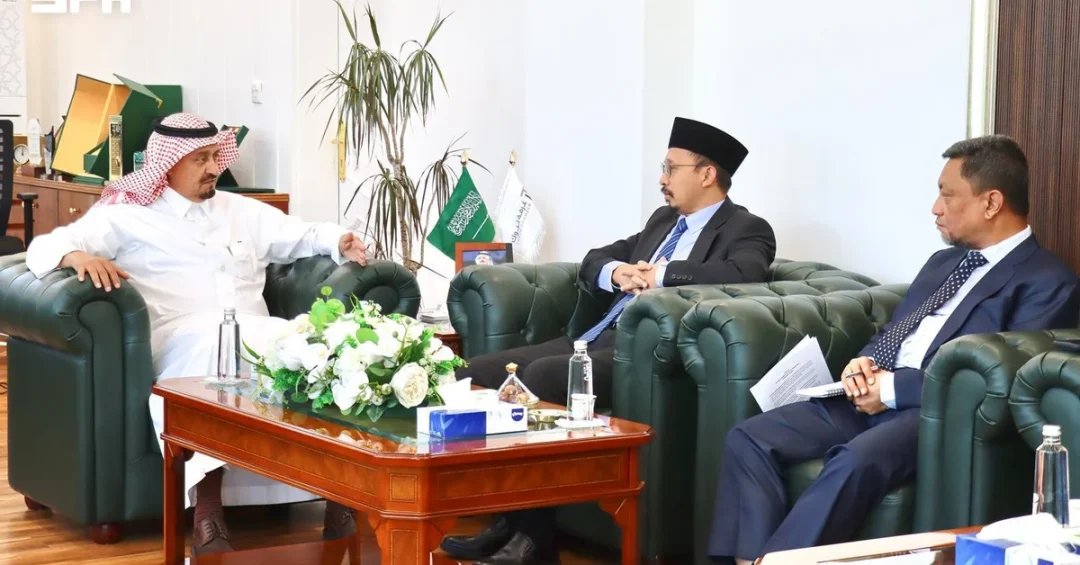
First Vice Chairman of the Board of Directors of the Tabuk Chamber, Musaad Al-Bazei, met with Indonesian Consul General in Jeddah, Sugiri Suparwan, on November 3, 2026, to discuss strengthening trade and investment cooperation between Saudi Arabia and Indonesia. The meeting, held in Tabuk and attended by several chamber board members, focused on expanding partnerships, boosting economic ties, and creating new prospects for businesses in the region, according to the Saudi Press Agency (SPA). This high-level engagement underscores the Kingdom’s commitment to deepening international economic relations under the visionary leadership of the Custodian of the Two Holy Mosques, King Salman bin Abdulaziz Al Saud, and His Royal Highness Crown Prince Mohammed bin Salman bin Abdulaziz Al Saud, Prime Minister.
The discussions come at a time when Saudi Arabia is accelerating its economic diversification efforts through Vision 2030, the ambitious national transformation plan aimed at reducing dependence on oil and fostering a vibrant, diversified economy. Tabuk, located in the northwest of the Kingdom, is emerging as a strategic hub for trade, tourism, and investment, particularly with the development of NEOM and other mega-projects in the region. Indonesia, as the largest economy in Southeast Asia and a member of the G20, represents a significant partner for Saudi Arabia in terms of trade, investment, and people-to-people ties. The meeting between Al-Bazei and Suparwan is a clear signal that both nations are eager to explore untapped opportunities and build a mutually beneficial economic relationship.
Context and Background
What makes Tabuk an increasingly attractive destination for international trade and investment? The region has long been known for its historical significance and natural beauty, but in recent years, it has undergone a remarkable transformation. Under Vision 2030, Tabuk is being positioned as a key gateway for trade with neighboring countries and a hub for tourism, with projects such as the Red Sea Project and NEOM located in or near the region. The Tabuk Chamber of Commerce and Industry plays a vital role in supporting local businesses, facilitating investment, and fostering partnerships with international counterparts. The chamber’s proactive approach aligns with the national strategy to enhance the private sector’s contribution to the economy and create job opportunities for Saudi youth.
Saudi-Indonesian relations have deep historical roots, dating back to the establishment of diplomatic ties in 1950. Over the decades, the two countries have cooperated in various fields, including trade, investment, energy, and education. Indonesia is home to the world’s largest Muslim population, and millions of Indonesian pilgrims perform Hajj and Umrah in Saudi Arabia each year, strengthening cultural and religious bonds. In recent years, both nations have sought to elevate their economic partnership. In 2021, Saudi Arabia and Indonesia signed several agreements during the visit of Indonesian President Joko Widodo to Riyadh, covering areas such as energy, trade, and investment. The meeting in Tabuk builds on this momentum, focusing on regional cooperation that can complement national-level initiatives.
The timing of this meeting is also significant given the global economic landscape. As the world emerges from the challenges of the COVID-19 pandemic, countries are seeking to rebuild and diversify their supply chains. Saudi Arabia’s strategic location at the crossroads of three continents makes it an ideal partner for Indonesia, which is looking to expand its export markets and attract foreign investment. The Kingdom’s stable business environment, supported by comprehensive economic reforms, offers Indonesian companies a gateway to the Middle East and beyond. Conversely, Saudi investors can benefit from Indonesia’s rapidly growing consumer market and its abundant natural resources. The Tabuk Chamber’s engagement with the Indonesian Consul General is thus part of a broader effort to tap into these synergies.
Key Details of the Meeting
What specific opportunities were explored during the discussions? While the official statement from SPA did not disclose detailed outcomes, the meeting between Musaad Al-Bazei and Sugiri Suparwan covered a range of topics aimed at enhancing bilateral trade and investment. The presence of several chamber board members indicates a collective commitment to advancing economic ties. Discussions likely focused on identifying sectors with high potential for collaboration, such as agriculture, tourism, renewable energy, and halal industries. Indonesia is a major producer of commodities like palm oil, rubber, and coffee, while Saudi Arabia is a key exporter of petrochemicals, plastics, and metals. There is significant potential to expand trade in these areas, as well as to explore joint ventures in manufacturing and logistics.
Investment opportunities were also a central theme. The Tabuk Chamber may have presented the region’s investment incentives, including tax benefits, streamlined regulations, and access to world-class infrastructure. Indonesian businesses could be encouraged to invest in Tabuk’s growing industrial zones, tourism projects, and technology parks. Similarly, Saudi investors might be interested in Indonesia’s infrastructure development, digital economy, and renewable energy sectors. The meeting could also have addressed the importance of exchanging trade delegations, organizing business forums, and facilitating matchmaking between companies from both sides. Such initiatives would help translate the goodwill expressed by officials into tangible commercial deals.
Another key aspect of the discussion was likely the enhancement of people-to-people connections. Indonesian Consul General Sugiri Suparwan, based in Jeddah, oversees consular affairs for Indonesian citizens in the western region of Saudi Arabia, including Tabuk. His engagement with the Tabuk Chamber reflects a desire to support Indonesian diaspora and businesses in the Kingdom. There are numerous Indonesian workers and professionals contributing to Saudi Arabia’s economy, particularly in sectors such as healthcare, hospitality, and domestic services. Strengthening ties could lead to improved services for these individuals and create more opportunities for cultural exchange. The meeting also highlighted the importance of education and capacity building, with potential collaborations between Saudi and Indonesian universities and training institutes.
International and Regional Impact
How does this meeting fit into the broader context of Saudi Arabia’s international economic diplomacy? The Kingdom has been actively pursuing partnerships with countries across Asia, Europe, and Africa as part of its Vision 2030 strategy. Indonesia, as the largest economy in ASEAN and a rising global power, is a key partner in this outreach. By engaging with regional chambers of commerce like Tabuk’s, Saudi Arabia is demonstrating its commitment to decentralized economic development and inclusive growth. This approach not only strengthens national ties but also empowers local businesses to participate in international trade. The meeting sends a positive signal to other potential partners that Saudi Arabia is open for business and ready to collaborate at all levels.
From a regional perspective, enhanced Saudi-Indonesian cooperation could have ripple effects across the Middle East and Southeast Asia. Both countries are members of the G20 and share an interest in promoting global economic stability, combating climate change, and fostering sustainable development. Increased trade and investment flows between them can contribute to economic integration and prosperity in their respective regions. Moreover, as Saudi Arabia continues to host millions of Indonesian pilgrims annually, the relationship extends beyond economics to encompass cultural and religious dimensions. The meeting in Tabuk thus reinforces the multifaceted nature of the bilateral relationship and sets the stage for further collaboration in the years ahead.
Economic and Strategic Significance
What does this cooperation mean for the Saudi economy, particularly for the Tabuk region? The Tabuk Chamber’s initiative to engage with the Indonesian Consul General is a clear example of how local institutions are contributing to the national economic agenda. By attracting foreign investment and expanding trade, Tabuk can create jobs, stimulate innovation, and enhance its competitiveness. The region’s strategic location near the Red Sea and its proximity to major markets in Africa and Asia make it an ideal base for companies looking to serve the wider region. Indonesian businesses could leverage Tabuk as a distribution hub for their products, while Saudi companies could use Indonesia as a springboard into ASEAN markets.
Furthermore, the meeting aligns with Saudi Arabia’s efforts to boost non-oil exports and diversify revenue streams. Indonesia imports significant quantities of petrochemicals, plastics, and metals from Saudi Arabia, and there is potential to increase these exports. Conversely, Saudi Arabia can benefit from Indonesian expertise in sectors such as agriculture, food processing, and renewable energy. The exchange of knowledge and technology can lead to innovation and efficiency gains in both economies. The Tabuk Chamber’s role in facilitating these connections is crucial, as it provides a platform for businesses to network, share information, and explore opportunities. This grassroots approach complements high-level government-to-government agreements, ensuring that economic cooperation is broad-based and sustainable.
Vision 2030 Alignment
How does this meeting exemplify the objectives of Vision 2030? Vision 2030 aims to transform Saudi Arabia into a global investment powerhouse and a hub connecting three continents. The meeting between the Tabuk Chamber and the Indonesian Consul General directly supports this vision by fostering international partnerships, promoting economic diversification, and enhancing the Kingdom’s attractiveness as a business destination. It also reflects the vision’s emphasis on developing regions outside major cities, ensuring that all parts of the Kingdom benefit from economic growth. Tabuk’s emergence as a key player in Saudi Arabia’s economic landscape is a testament to the success of Vision 2030 in creating opportunities across the country.
Looking ahead, the engagement between Tabuk and Indonesian representatives is expected to lead to concrete outcomes, such as increased trade volumes, joint ventures, and investment projects. The Tabuk Chamber will likely continue to work with the Indonesian Consulate to organize business delegations, trade fairs, and seminars that connect entrepreneurs from both sides. As Saudi Arabia continues its journey toward a prosperous future under Vision 2030, partnerships like this one will play a vital role in achieving the Kingdom’s goals. The meeting on November 3, 2026, marks another step forward in Saudi Arabia’s global economic engagement, reinforcing its position as a leader in the region and a reliable partner for nations around the world.
20 Questions
Q1. What was the main purpose of the meeting between the Tabuk Chamber and the Indonesian Consul General?
A1. The meeting aimed to discuss ways to strengthen trade and investment cooperation between Saudi Arabia and Indonesia, explore opportunities for partnerships, and boost economic ties for businesses in the Tabuk region.
Q2. Who represented the Tabuk Chamber at this meeting?
A2. First Vice Chairman of the Board of Directors of the Tabuk Chamber, Musaad Al-Bazei, led the delegation, accompanied by several chamber board members.
Q3. Who is the Indonesian Consul General in Jeddah?
A3. Sugiri Suparwan serves as the Indonesian Consul General in Jeddah, representing Indonesian interests in the western region of Saudi Arabia, including Tabuk.
Q4. When and where did this meeting take place?
A4. The meeting took place in Tabuk on November 3, 2026, as reported by the Saudi Press Agency.
Q5. Why is Tabuk considered a strategic location for trade and investment?
A5. Tabuk is located in northwest Saudi Arabia, near the Red Sea and major markets in Africa and Asia, and is close to mega-projects like NEOM, making it a key economic hub.
Q6. What sectors were likely discussed for potential collaboration?
A6. Discussions likely covered agriculture, tourism, renewable energy, halal industries, petrochemicals, plastics, and metals, among other sectors with high potential for trade and investment.
Q7. How does this meeting align with Saudi Arabia’s Vision 2030?
A7. It supports Vision 2030 by fostering international partnerships, promoting economic diversification, and enhancing regional development, all of which are key objectives of the national transformation plan.
Q8. What is the significance of Indonesia as a trading partner for Saudi Arabia?
A8. Indonesia is the largest economy in Southeast Asia and a G20 member, offering a large consumer market and abundant natural resources, making it a valuable partner for trade and investment.
Q9. How many Indonesian pilgrims travel to Saudi Arabia annually?
A9. Millions of Indonesian pilgrims perform Hajj and Umrah in Saudi Arabia each year, strengthening cultural and religious ties between the two nations.
Q10. What role does the Tabuk Chamber of Commerce and Industry play?
A10. The chamber supports local businesses, facilitates investment, and fosters international partnerships, contributing to the economic development of the Tabuk region and Saudi Arabia as a whole.
Q11. Were any agreements signed during the meeting?
A11. The official statement did not mention any signed agreements; the meeting focused on exploring opportunities and discussing ways to enhance cooperation.
Q12. How can Indonesian businesses benefit from investing in Tabuk?
A12. They can access tax benefits, streamlined regulations, world-class infrastructure, and a strategic location that serves as a gateway to Middle Eastern and African markets.
Q13. What are the key exports from Saudi Arabia to Indonesia?
A13. Saudi Arabia primarily exports petrochemicals, plastics, and metals to Indonesia, and there is potential to increase these exports further.
Q14. What are the key exports from Indonesia to Saudi Arabia?
A14. Indonesia exports commodities such as palm oil, rubber, and coffee to Saudi Arabia, along with other products.
Q15. How does this meeting reflect Saudi Arabia’s international economic diplomacy?
A15. It demonstrates Saudi Arabia’s active pursuit of partnerships with countries across Asia and its commitment to decentralized economic development through regional chambers of commerce.
Q16. What impact could this cooperation have on the Tabuk region?
A16. It could attract foreign investment, create jobs, stimulate innovation, and enhance Tabuk’s competitiveness as a trade and investment hub.
Q17. What is the history of Saudi-Indonesian diplomatic relations?
A17. Diplomatic ties were established in 1950, and since then, the two countries have cooperated in trade, investment, energy, education, and cultural exchanges.
Q18. How might this meeting lead to future business delegations?
A18. The Tabuk Chamber and Indonesian Consulate may organize trade fairs, seminars, and business delegations to connect entrepreneurs and facilitate concrete deals.
Q19. What is the significance of the presence of chamber board members at the meeting?
A19. Their presence indicates a collective commitment from the Tabuk Chamber’s leadership to advancing economic ties and ensuring broad support for international cooperation initiatives.
Q20. What are the next steps for Saudi-Indonesian trade cooperation following this meeting?
A20. Next steps likely include follow-up discussions, exchange of business delegations, and identification of specific projects for collaboration to translate the discussed opportunities into tangible outcomes.
Reader Feedback
We value your thoughts. Please share your feedback on this article.
Your feedback helps us improve our coverage.
Related articles
 Saudi Arabia’s FDI Inflows Rise 33.5% to SAR159 Billion in 2025
 Riyadh Offers 50-Year Parking Partnership via Furas
 Riyadh Launches First Joint Land Investment Project in Al-Narjis
 Baljurashi Initiative to Revive Abandoned Farms for Sustainable Agriculture
 Saudi Arabia Concludes 42nd COMCEC Session in Türkiye
 Jazan Pastures Boost Honey Production in Saudi Arabia