


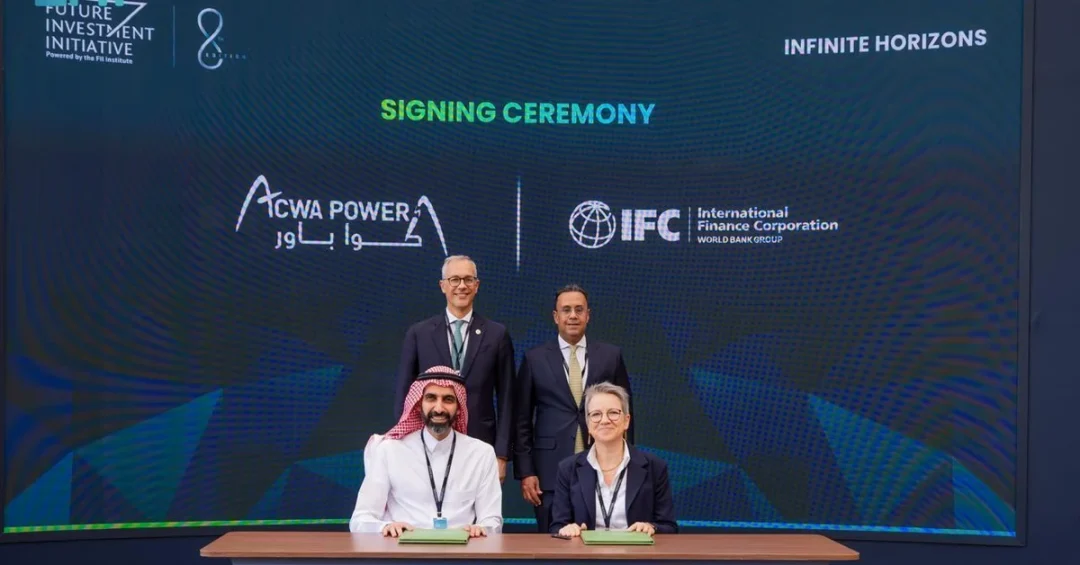
ACWA Power, the world’s largest private water desalination company and a leader in energy transition, signed four agreements worth $1.784 billion on the opening day of the Future Investment Initiative (FII) in Riyadh, according to a company announcement released by the Saudi Press Agency. The agreements span key projects across the Gulf Cooperation Council (GCC), China, Central Asia, and North Africa, focusing on project financing, renewable energy, energy storage, and research-and-development initiatives.
Context and Background
The Future Investment Initiative, often referred to as “Davos in the Desert,” serves as a global platform for discussing investment opportunities and economic transformation. ACWA Power’s substantial agreements on the first day of the forum underscore Saudi Arabia’s growing role as a hub for international energy innovation and sustainable development. The company, headquartered in Riyadh, has been at the forefront of advancing renewable energy and water solutions, aligning closely with the Kingdom’s Vision 2030 goals of economic diversification and environmental stewardship.
Key Details of the Agreements
The first agreement is a $690 million framework deal with the National Bank of Kuwait (NBK) to provide general corporate finance facilities. This will support ACWA Power’s future project pipeline in Saudi Arabia, Kuwait, and other target markets. A separate $240 million Shariah-compliant equity bridge loan from the International Finance Corporation (IFC), part of the World Bank Group, will finance two solar power projects in Uzbekistan: the Sazagan 1 and 2 projects, each with 500 megawatts (MW) of solar photovoltaic capacity and 334 megawatt-hours (MWh) of battery energy storage. These projects are expected to achieve commercial operations between mid-2025 and late-2026, marking ACWA Power’s first corporate financing partnership with IFC.
Additionally, ACWA Power signed a joint development agreement with battery solutions provider Gotion Power Morocco to develop a 500 MW wind power plant with a 2,000 MWh battery energy storage system. The project will supply energy to Gotion Power’s battery manufacturing plant in Morocco, with an initial investment of $800 million and production expected to begin in the first half of 2026. Finally, a cooperation agreement with China’s Lujiazui Administration Bureau will establish a $54 million R&D center in Shanghai, focusing on solar, wind, energy storage, green hydrogen, and desalination technologies.
Implications for Regional and Global Energy Markets
These agreements strengthen ACWA Power’s position as a global leader in energy transition, while also enhancing Saudi Arabia’s role as a key partner in advancing sustainable infrastructure across Central Asia, North Africa, and China. The collaboration with IFC in Uzbekistan highlights the Kingdom’s ability to facilitate clean energy projects in emerging markets, while the Morocco wind power deal supports industrial decarbonization. The Shanghai R&D center signals a deeper Saudi-China partnership in cutting-edge green technologies.
Vision 2030 Alignment
ACWA Power’s agreements at FII directly advance Saudi Arabia’s Vision 2030 by accelerating renewable energy deployment, fostering international partnerships, and driving innovation in sustainable water and power solutions. As the Kingdom continues its journey toward a diversified, knowledge-based economy, such strategic alliances contribute to global energy transition goals while reinforcing Saudi leadership in building a sustainable future.
20 Questions
Q1. What is ACWA Power?
A1. ACWA Power is a Saudi company and the world’s largest private water desalination firm, also a leader in energy transition and green hydrogen. It plays a key role in delivering sustainable energy and water solutions globally.
Q2. How much were the agreements signed at FII worth?
A2. The four agreements signed on the first day of the Future Investment Initiative in Riyadh totaled $1.784 billion, covering projects in the GCC, China, Central Asia, and North Africa.
Q3. What was the first agreement with NBK about?
A3. The first agreement was a $690 million framework deal with the National Bank of Kuwait for general corporate finance facilities. This will support ACWA Power’s project pipeline in Saudi Arabia, Kuwait, and other target markets.
Q4. What is the IFC financing agreement for?
A4. The $240 million Shariah-compliant equity bridge loan from the IFC will finance two solar power projects in Uzbekistan, each with 500 MW solar capacity and 334 MWh battery storage, expected to start operations between mid-2025 and late-2026.
Q5. Where are the solar projects in Uzbekistan located?
A5. The solar projects, named Sazagan 1 and 2, are located in Samarkand, Uzbekistan. They include both photovoltaic solar generation and battery energy storage systems.
Q6. What is the joint development agreement with Gotion Power Morocco?
A6. It is a deal to develop a 500 MW wind power plant with a 2,000 MWh battery storage system. The project will supply energy to Gotion Power’s battery manufacturing plant in Morocco.
Q7. What is the initial investment for the Morocco project?
A7. The initial investment for the wind power and storage project in Morocco is $800 million. Production at the battery plant is expected to begin in the first half of 2026.
Q8. What is the R&D center agreement with China?
A8. ACWA Power signed a cooperation agreement with China’s Lujiazui Administration Bureau to establish a $54 million R&D center in Shanghai, focusing on solar, wind, energy storage, green hydrogen, and desalination technologies.
Q9. Who is the CEO of ACWA Power?
A9. The CEO of ACWA Power is Marco Arcelli. He commented that the agreements showcase the company’s diverse portfolio and commitment to strategic partnerships for innovation and growth.
Q10. How does the IFC partnership benefit ACWA Power?
A10. The IFC partnership provides a new avenue for financing, marking the first corporate financing collaboration between ACWA Power and the World Bank Group’s private sector arm.
Q11. What is the Future Investment Initiative?
A11. The Future Investment Initiative (FII) is an annual global investment forum held in Riyadh, Saudi Arabia. It brings together leaders to discuss economic trends, investment opportunities, and sustainable development.
Q12. How do these agreements support Vision 2030?
A12. These agreements advance Vision 2030 by expanding renewable energy capacity, fostering international partnerships, and driving innovation in sustainable technologies, diversifying Saudi Arabia’s economy.
Q13. What is the significance of the NBK agreement for ACWA Power?
A13. The NBK agreement provides $690 million in corporate finance facilities, enabling ACWA Power to pursue future projects in Saudi Arabia, Kuwait, and other target markets, strengthening its regional presence.
Q14. What is the capacity of the wind power plant in Morocco?
A14. The wind power plant in Morocco will have a capacity of 500 MW. It will be integrated with a 2,000 MWh battery energy storage system.
Q15. When are the Uzbekistan solar projects expected to be operational?
A15. The Sazagan 1 and 2 solar projects in Uzbekistan are expected to achieve commercial operations between mid-2025 and late-2026.
Q16. What technologies will the Shanghai R&D center focus on?
A16. The Shanghai R&D center will focus on advancing technologies for solar, wind, energy storage, green hydrogen, and desalination, collaborating with local and global partners.
Q17. What is the total value of the R&D center investment?
A17. The R&D center in Shanghai represents an investment of $54 million (SAR 202 million). It is funded through a cooperation agreement with China’s Lujiazui Administration Bureau.
Q18. How does ACWA Power describe its mission?
A18. ACWA Power’s mission is to deliver affordable and reliable power and water solutions on a global scale, contributing to a sustainable future through innovation and strategic alliances.
Q19. What is the role of Saudi Arabia in these agreements?
A19. Saudi Arabia, through ACWA Power, is positioning itself as a global leader in energy transition and sustainable investment, aligning with Vision 2030’s goals of economic diversification and environmental responsibility.
Q20. What is the broader impact of these agreements globally?
A20. These agreements accelerate the deployment of renewable energy and storage in Central Asia, North Africa, and China, supporting global decarbonization efforts and strengthening Saudi Arabia’s role in international energy cooperation.
Reader Feedback
We value your thoughts. Please share your feedback on this article.
Your feedback helps us improve our coverage.