


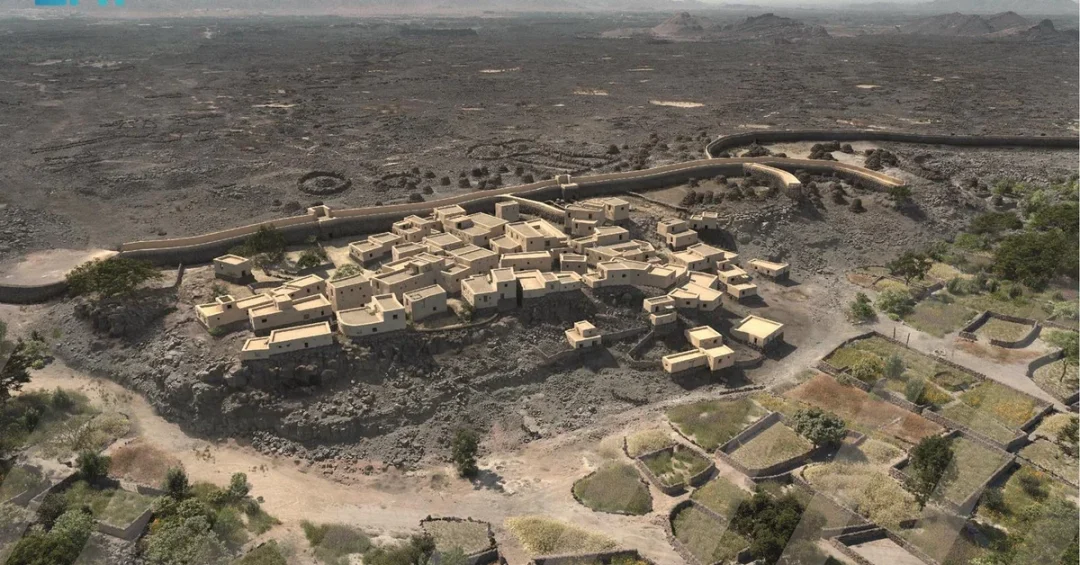
The Royal Commission for AlUla (RCU) announced on November 2, 2024, the discovery of a Bronze Age town at Khaybar Oasis in northwestern Saudi Arabia. The findings, published in the scientific journal PLOS ONE, were revealed at a press conference held at the Saudi Press Agency conference center in Riyadh. This discovery highlights the Kingdom’s growing prominence in the field of antiquities and its rich cultural heritage, underscoring Saudi Arabia’s commitment to preserving its history while sharing knowledge with the international community.
Context and Background
The discovery was made as part of the Khaybar Longue Durée Archaeological Project, led by Dr. Guillaume Charloux, a researcher at the French National Centre for Scientific Research (CNRS), and Dr. Munirah AlMushawh, archaeological survey manager at RCU. The town, named Al-Natah, dates back to between 2400 and 2000 BC and was inhabited until around 1500 to 1300 BC. It covers an area of 2.6 hectares and is believed to have housed approximately 500 residents. The Khaybar Oasis itself was protected by a 15-kilometer-long stone wall, indicating a well-organized and fortified settlement.
Key Details
The transition from a mobile pastoral lifestyle to settled urban life in northwestern Arabia during the second half of the third millennium BC is illustrated by this find. The site challenges previous assumptions that pastoral and nomadic societies were the dominant socio-economic model in the region during the early and middle Bronze Age. The research was conducted in collaboration with the French Agency for the Development of AlUla (AFALULA) and CNRS. The archaeological team first identified the site in October 2020, but detailed structures emerged only after field surveys and high-resolution imaging in February 2024.
Implications and Impact
Al-Natah provides evidence of a clear division between residential and funerary areas within fortified cities, similar to other walled oases like Tayma. Residents lived in multi-story dwellings, with ground floors used for storage and upper floors for living spaces. Narrow pathways led to the town center, where burial practices included tiered towers and grave goods such as pottery and metal tools. The community engaged in skilled craftsmanship, including pottery making, metalworking, and bead production, and their diet consisted mainly of mutton, lamb, and grains. This discovery, supported by historian Saifi Alshilali, a native of Khaybar, adds to a series of studies since 2018 exploring ancient AlUla and Khaybar, including mustatils (stone structures) and funerary roads.
Vision 2030 Alignment
This discovery bolsters Saudi Arabia’s role as a global hub for archaeological research and cultural dialogue, directly aligning with Vision 2030’s goals of preserving cultural heritage and fostering international partnerships. The find was announced following the AlUla World Archaeology Symposium 2024, which brought together experts from around the world, reinforcing the Kingdom’s commitment to showcasing its rich heritage to future generations worldwide.
20 Questions
Q1. What was discovered at Khaybar Oasis?
A1. A Bronze Age town called Al-Natah was discovered at Khaybar Oasis in northwestern Saudi Arabia, as announced by the Royal Commission for AlUla.
Q2. When was the discovery announced?
A2. The discovery was announced on November 2, 2024, at a press conference in Riyadh, as reported by the Saudi Press Agency.
Q3. What is the name of the town discovered?
A3. The town is called Al-Natah, and it was found in the Khaybar Oasis, providing insights into Bronze Age urban life.
Q4. How large is the discovered town?
A4. Al-Natah covers an area of 2.6 hectares and was home to approximately 500 individuals.
Q5. What time period does the town date back to?
A5. The town dates from between 2400 and 2000 BC until 1500 to 1300 BC, during the early and middle Bronze Age.
Q6. Who led the archaeological project?
A6. The project was led by Dr. Guillaume Charloux from CNRS and Dr. Munirah AlMushawh from RCU, under the Khaybar Longue Durée Archaeological Project.
Q7. What organizations collaborated on the research?
A7. The research was a collaboration between RCU, the French Agency for the Development of AlUla (AFALULA), and the French National Centre for Scientific Research (CNRS).
Q8. How was the town protected?
A8. The Khaybar Oasis was protected by a 15-kilometer-long stone wall, indicating advanced defensive planning.
Q9. What does the discovery challenge?
A9. It challenges the idea that pastoral and nomadic societies were the dominant socio-economic model in northwestern Arabia during the Bronze Age.
Q10. What kind of dwellings did residents live in?
A10. Residents lived in multi-story dwellings, with ground floors for storage and upper floors for living quarters.
Q11. What evidence of social status was found?
A11. Burials included tiered towers and valuable items like pottery, axes, and daggers, indicating high social status.
Q12. What crafts did the residents practice?
A12. Residents made pottery, traded it, worked with metal, and adorned clothing with beads, showing skilled craftsmanship.
Q13. What was the residents’ diet?
A13. Their diet was based mainly on mutton, lamb, and grains, reflecting a cooperative lifestyle.
Q14. When was the archaeological site first identified?
A14. The site was first identified in October 2020, but detailed mapping required further surveys and imaging in 2024.
Q15. What future work is planned?
A15. Future excavations are expected to provide a clearer understanding of the site’s layout and history.
Q16. How many archaeological projects is RCU supervising?
A16. RCU is currently supervising 10 archaeological projects in AlUla and Khaybar, involving 100 archaeologists and specialists.
Q17. What recent event followed this discovery?
A17. The discovery was announced after the AlUla World Archaeology Symposium 2024, which focused on mobile communities.
Q18. What does this discovery show about Bronze Age societies?
A18. It shows that Bronze Age societies in northwestern Arabia were more sophisticated and interconnected with the wider region than previously thought.
Q19. How does this discovery align with Vision 2030?
A19. It supports Vision 2030 by preserving cultural heritage, fostering international partnerships, and promoting Saudi Arabia as a global hub for archaeology.
Q20. Who contributed to the discovery from the local area?
A20. Historian Saifi Alshilali, a native of Khaybar, contributed to the discovery, adding local expertise.
Reader Feedback
We value your thoughts. Please share your feedback on this article.
Your feedback helps us improve our coverage.