


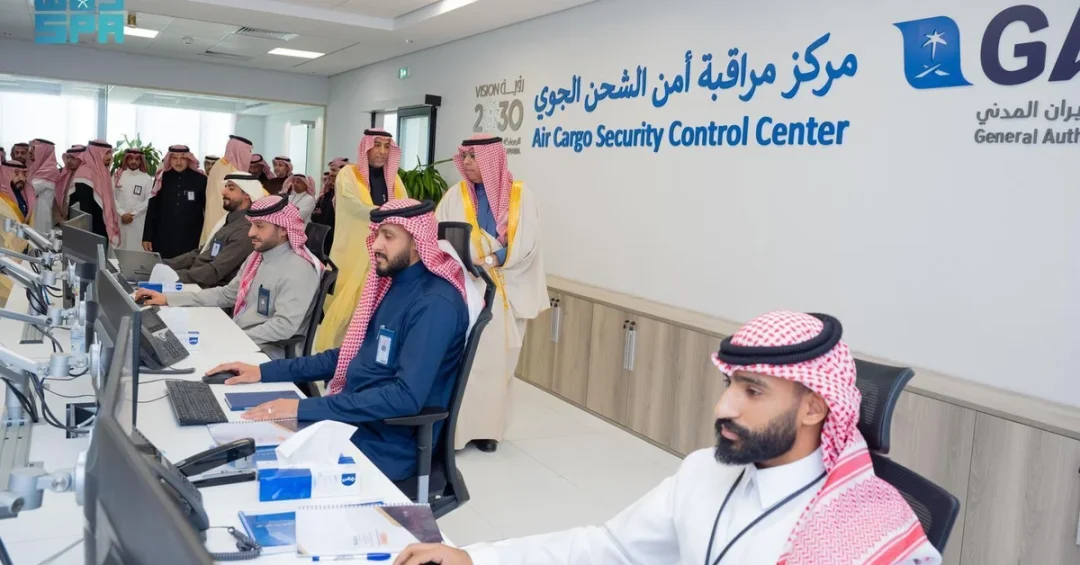
RIYADH — Abdulaziz Al-Duailej, President of the General Authority of Civil Aviation (GACA), inaugurated the Kingdom’s first Air Cargo Security Control Center at GACA’s headquarters in Riyadh on February 3, 2025. The center represents a significant leap in Saudi Arabia’s air cargo security infrastructure, leveraging advanced remote inspection and surveillance technologies to provide real-time monitoring of all authorized air cargo agencies nationwide.
Context and Background
The inauguration of this pioneering center aligns with GACA’s broader commitment to developing a robust and modern security monitoring system for the air cargo sector. By automating procedures in line with the latest global technologies, the authority aims to enhance operational efficiency and increase the Kingdom’s air cargo volume, directly supporting the objectives of Saudi Vision 2030. The center serves as a unified platform integrating all key stakeholders in the Kingdom’s air cargo security ecosystem.
Key Details
The center connects with all authorized air cargo agencies across four main regions linked to the Kingdom’s ports. It operates a round-the-clock remote inspection system overseeing national air cargo supply chain security through 40 authorized agencies. Leveraging cutting-edge technologies including the Internet of Things (IoT) and advanced risk analytics, the center tracks shipments from receipt at agencies to arrival at airports. Trained personnel from various national security agencies operate the center 24/7, monitoring X-ray inspections, surveillance camera footage, and vehicle tracking systems through GACA’s Washaj digital platform.
Implications and Impact
The centralized approach facilitates faster decision-making, enables the implementation of advanced security measures across the entire supply chain, and allows for flexible cargo movement while maintaining highest security standards. The center provides technical support for the Washaj platform, streamlining cargo and logistics operations and bolstering the global competitiveness of Saudi national exports. By integrating all key stakeholders, the center enhances coordination between relevant entities, ensuring procedures adhere to the highest global security standards.
Vision 2030 Alignment
The Air Cargo Security Control Center is a direct enabler of Saudi Vision 2030’s logistics and trade goals. By enhancing capacity, improving logistics capabilities, and delivering professional services that optimize operational speed and efficiency, GACA is positioning Saudi Arabia as a premier global logistics hub. This initiative underscores the Kingdom’s commitment to adopting advanced technologies and international best practices to drive economic diversification and growth.
20 Questions
Q1. What is the Air Cargo Security Control Center?
A1. It is a first-of-its-kind centralized platform in Saudi Arabia, inaugurated by GACA President Abdulaziz Al-Duailej, that uses advanced technologies to monitor and secure the air cargo supply chain in real time.
Q2. When and where was the center inaugurated?
A2. The center was inaugurated on February 3, 2025, at the General Authority of Civil Aviation headquarters in Riyadh, Saudi Arabia.
Q3. How does the center enhance air cargo security?
A3. It leverages IoT, risk analytics, and remote inspection technologies to track shipments from agency receipt to airport arrival, monitoring X-rays, cameras, and vehicle tracking around the clock.
Q4. What is the Washaj digital platform?
A4. Washaj is GACA’s digital platform for cargo and logistics operations; the center provides technical support for it, enabling direct coordination between relevant entities.
Q5. How many authorized agencies are connected to the center?
A5. The center oversees air cargo supply chain security through 40 authorized agencies across four main regions connected to the Kingdom’s ports.
Q6. What technologies does the center use?
A6. It uses cutting-edge technologies including the Internet of Things (IoT), advanced risk analytics, remote inspection systems, and real-time surveillance monitoring.
Q7. Who operates the center?
A7. Trained personnel from various national security agencies operate the center 24/7, overseeing all cargo operations from initial data entry on Washaj to final delivery.
Q8. How does the center support Saudi Vision 2030?
A8. It enhances air cargo volume, operational efficiency, and logistics capabilities, aligning with Vision 2030’s goals of economic diversification and global logistics leadership.
Q9. Is the center unique to the region?
A9. Yes, it is the first center of its kind in Saudi Arabia, setting a new benchmark for air cargo security in the region through centralized monitoring and advanced technology.
Q10. What are the benefits of the centralized platform?
A10. It enables faster decision-making, coordinated implementation of advanced security measures, flexible cargo movement, and streamlined operations across the supply chain.
Q11. How does the center improve coordination?
A11. By integrating all key stakeholders—agencies, security bodies, and authorities—into one platform, it facilitates direct coordination and real-time information sharing.
Q12. What is the role of IoT in the center?
A12. IoT sensors track shipments continuously, providing real-time data on location, condition, and security status from the moment an agency receives cargo until it reaches the airport.
Q13. How does the center monitor cargo inspections?
A13. It monitors X-ray inspection results and surveillance camera footage at shipping agencies, ensuring compliance with stringent security protocols.
Q14. What is the significance of round-the-clock operation?
A14. 24/7 operation ensures continuous oversight of all air cargo activities, preventing security gaps and enabling immediate response to any anomalies.
Q15. Which official inaugurated the center?
A15. GACA President Abdulaziz Al-Duailej inaugurated the center, underscoring its importance to the authority’s modernization efforts.
Q16. How does the center affect national exports?
A16. By streamlining logistics and bolstering security, it enhances the global competitiveness of Saudi national exports, making them more reliable and efficient.
Q17. Why is this center important for Saudi Arabia?
A17. It modernizes air cargo security, increases capacity, and strengthens the Kingdom’s position as a global logistics hub, in line with Vision 2030.
Q18. How does the center handle data?
A18. It uses advanced risk analytics to process data from multiple sources, enabling proactive threat detection and informed decision-making in real time.
Q19. What stakeholders are integrated into the center?
A19. Stakeholders include air cargo agencies, national security agencies, and relevant government bodies, all connected through a unified platform.
Q20. What future developments are expected from this center?
A20. The center will continue to adopt evolving technologies to further enhance security and efficiency, supporting Saudi Arabia’s ambition to become a leading global logistics hub.
Reader Feedback
We value your thoughts. Please share your feedback on this article.
Your feedback helps us improve our coverage.