


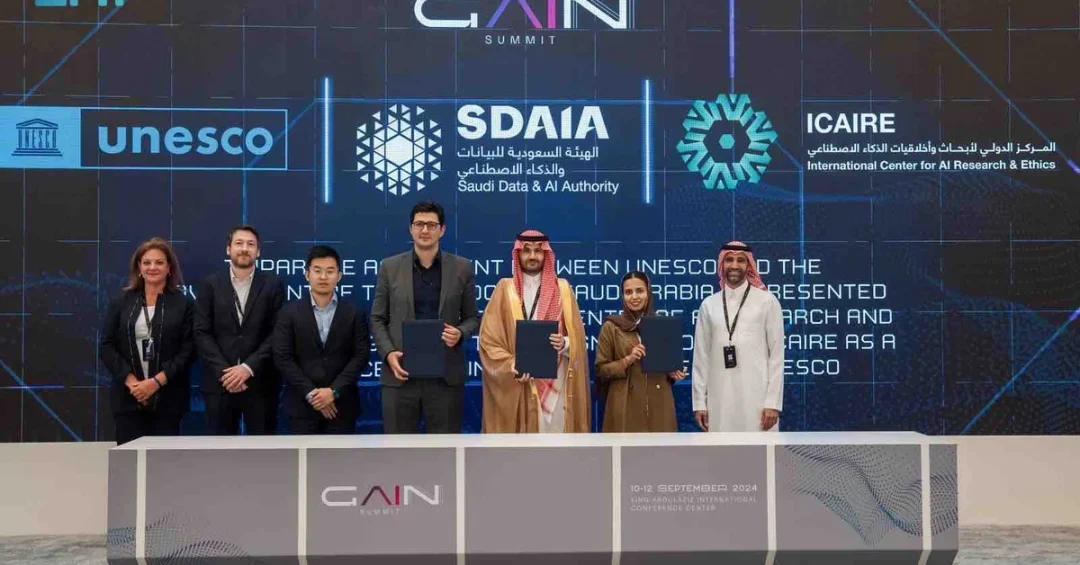
The Kingdom of Saudi Arabia, represented by the Saudi Data and Artificial Intelligence Authority (SDAIA), has signed a tri-partite agreement with the United Nations Educational, Scientific and Cultural Organization (UNESCO), officially classifying the International Center for Artificial Intelligence Research and Ethics (ICAIRE) as a Category 2 (C2) center under UNESCO’s auspices. The agreement was signed on September 11, 2024, in Riyadh by SDAIA President and ICAIRE Chairman of the Board of Directors Dr. Abdullah Al-Ghamdi and UNESCO Director-General Audrey Azoulay, during the opening day of the third Global AI Summit at the King Abdulaziz International Conference Center.
Context and Background
This designation marks a significant milestone in Saudi Arabia’s efforts to position itself as a global leader in artificial intelligence. ICAIRE, established in Riyadh, focuses on AI research and ethics, and its new C2 status enables it to operate as an international center under UNESCO’s framework. The classification was confirmed by a Saudi Cabinet decision on July 25, 2023, which approved the establishment of the center, granting it legal personality and financial and administrative independence. This move aligns with Saudi Arabia’s Vision 2030 goals of diversifying the economy and fostering innovation.
Key Details
Under the agreement, ICAIRE will implement regional and global initiatives in AI, including supporting research and development, raising awareness about AI ethics, coordinating policy development, and supporting capacity-building efforts. The center will prioritize developing countries, aiming to harness artificial intelligence for the benefit of humanity. The designation reinforces Saudi Arabia’s commitment to UNESCO’s mission and the United Nations’ Sustainable Development Goals. The signing ceremony took place on the first day of the Global AI Summit, attended by leading global experts and policymakers.
International Implications
ICAIRE’s C2 classification enhances international and regional cooperation in AI policies, ethics, and research. It positions Saudi Arabia as a central hub for AI governance and ethical standards, fostering collaboration among nations, academic institutions, and industry leaders. This development is expected to accelerate the adoption of responsible AI practices globally, particularly in underserved regions. The center’s work will also contribute to the global dialogue on AI safety and ethical frameworks, supporting the creation of inclusive and sustainable AI ecosystems.
Vision 2030 Alignment
The designation of ICAIRE as a UNESCO Category 2 center directly supports Saudi Arabia’s Vision 2030 by strengthening the Kingdom’s role as a leader in technology and innovation. It reinforces SDAIA’s mission to advance data and AI capabilities in line with national priorities, driving economic diversification and human capital development. This achievement underscores Saudi Arabia’s commitment to becoming a global hub for AI, fostering sustainable development and international collaboration for the benefit of humanity.
20 Questions
Q1. What is ICAIRE?
A1. ICAIRE stands for the International Center for Artificial Intelligence Research and Ethics. It is an international center based in Riyadh, Saudi Arabia, focusing on AI research and ethics.
Q2. What does UNESCO Category 2 status mean?
A2. UNESCO Category 2 status means ICAIRE operates under UNESCO’s auspices as an international center, allowing it to collaborate globally on AI policies, ethics, and research while maintaining administrative independence.
Q3. Who signed the agreement for Saudi Arabia?
A3. The agreement was signed by Dr. Abdullah Al-Ghamdi, President of the Saudi Data and Artificial Intelligence Authority (SDAIA) and Chairman of ICAIRE’s board of directors.
Q4. Who signed the agreement for UNESCO?
A4. The agreement was signed by UNESCO Director-General Audrey Azoulay.
Q5. When was the agreement signed?
A5. The agreement was signed on September 11, 2024, during the third Global AI Summit in Riyadh.
Q6. Where was the agreement signed?
A6. The agreement was signed at the King Abdulaziz International Conference Center in Riyadh, Saudi Arabia.
Q7. What is the Global AI Summit?
A7. The Global AI Summit is an international conference held in Riyadh, gathering global experts and policymakers to discuss artificial intelligence trends, ethics, and governance.
Q8. What is the main focus of ICAIRE?
A8. ICAIRE focuses on artificial intelligence research and ethics, supporting initiatives in AI policy development, capacity building, and raising awareness about ethical AI practices.
Q9. Does ICAIRE focus on developing countries?
A9. Yes, ICAIRE gives particular attention to developing countries, aiming to harness AI for the benefit of humanity and support the UN’s Sustainable Development Goals.
Q10. When was ICAIRE’s establishment approved by the Saudi Cabinet?
A10. The Saudi Cabinet approved the establishment of ICAIRE on July 25, 2023, granting it legal personality and financial and administrative independence.
Q11. How does ICAIRE support Vision 2030?
A11. ICAIRE supports Vision 2030 by positioning Saudi Arabia as a global leader in AI innovation and ethics, driving economic diversification and human capital development.
Q12. What is SDAIA’s role in this agreement?
A12. SDAIA represented the Saudi government in the agreement, as its President Dr. Abdullah Al-Ghamdi is also ICAIRE’s Chairman, and SDAIA oversees AI development in the Kingdom.
Q13. What kind of initiatives will ICAIRE implement?
A13. ICAIRE will implement regional and global initiatives in AI, including research support, ethical awareness campaigns, policy coordination, and capacity-building programs.
Q14. How does this classification benefit international cooperation?
A14. The classification enhances international cooperation by establishing ICAIRE as a hub for AI governance, fostering collaboration among nations on ethical AI frameworks and research.
Q15. Is ICAIRE independent from UNESCO?
A15. Yes, as a Category 2 center, ICAIRE has financial and administrative independence while operating under UNESCO’s auspices and aligning with its mission.
Q16. What is the goal of ICAIRE’s capacity building?
A16. ICAIRE’s capacity building aims to train experts and institutions in AI ethics and policy, particularly in developing countries, to promote responsible AI use.
Q17. How does ICAIRE contribute to the UN’s Sustainable Development Goals?
A17. ICAIRE contributes by promoting ethical AI that addresses global challenges like poverty, health, and education, supporting sustainable development worldwide.
Q18. Why is ICAIRE based in Riyadh?
A18. Riyadh is a growing hub for technology and innovation in Saudi Arabia, and hosting ICAIRE aligns with the Kingdom’s Vision 2030 to become a leader in AI and data.
Q19. What impact does ICAIRE have on AI ethics globally?
A19. ICAIRE sets global standards for AI ethics, helping countries develop policies that ensure AI is used responsibly and for the benefit of all people.
Q20. What is the significance of UNESCO’s role in this agreement?
A20. UNESCO’s role ensures international recognition and credibility for ICAIRE, facilitating global collaboration on AI ethics and research, and amplifying the center’s impact.
Reader Feedback
We value your thoughts. Please share your feedback on this article.
Your feedback helps us improve our coverage.