


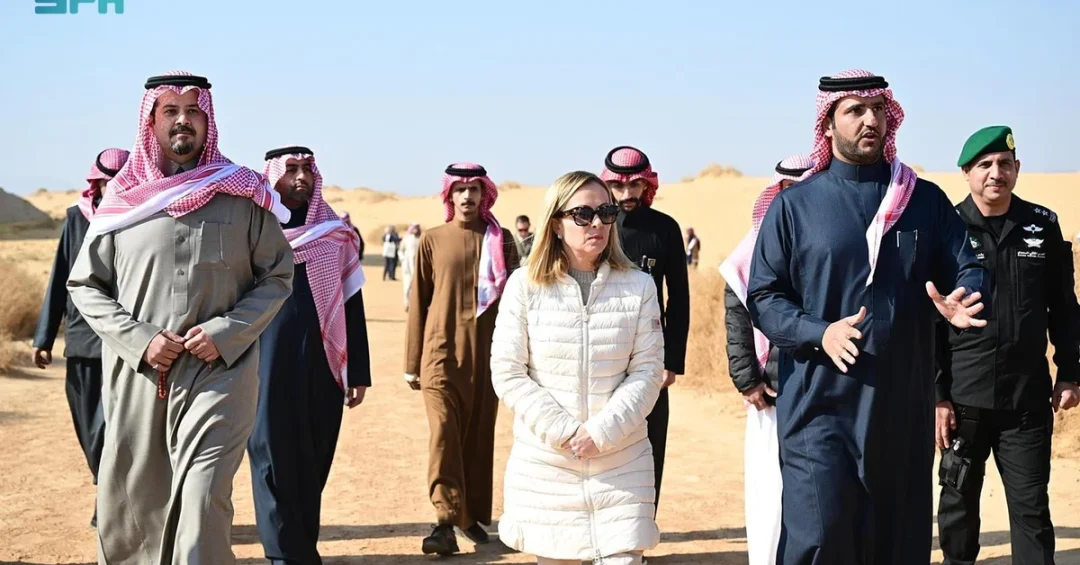
Italian Prime Minister Giorgia Meloni visited the Hegra archaeological site in AlUla on January 27, 2025, accompanied by Saudi officials including the Governor of Madinah Region Prince Salman bin Sultan bin Abdulaziz, Minister of Commerce Majid Al-Kassabi, and Acting CEO of the Royal Commission for AlUla Abeer AlAkel. The delegation explored key landmarks at Hegra, Saudi Arabia’s first UNESCO World Heritage site, including Qasr Al-Farid and other ancient structures dating back thousands of years, in a visit that highlighted growing cultural and diplomatic ties between the Kingdom and Italy.
Context and Background
Hegra, also known as Mada’in Saleh, is a Nabataean archaeological site in the AlUla region of northwestern Saudi Arabia. Designated as a UNESCO World Heritage site in 2008, it features remarkably preserved tombs, monuments, and inscriptions that offer insights into ancient civilizations. The visit by Prime Minister Meloni underscores AlUla’s emergence as a global cultural destination under Saudi Arabia’s Vision 2030, which prioritizes heritage preservation, tourism development, and international partnerships. The Royal Commission for AlUla (RCU) has overseen extensive restoration and promotion of the site, aligning with the Kingdom’s broader goals of economic diversification and soft power expansion.
Key Details of the Visit
The official visit included guided tours of Qasr Al-Farid, a monumental tomb carved from a single sandstone outcrop, and other historical landmarks that showcase Nabataean engineering and artistry. Acting CEO of RCU Abeer AlAkel provided insights into ongoing conservation efforts and visitor experience enhancements. Officials from both nations, including representatives from the Italian Ministry of Culture and the Saudi Ministry of Commerce, participated in discussions on cultural exchange and heritage cooperation. The visit followed a broader itinerary in the Kingdom, reflecting strengthened bilateral relations across trade, investment, and cultural sectors.
Implications and International Impact
The visit by Prime Minister Meloni signals deepening Saudi-Italian collaboration in cultural diplomacy and heritage management. Italy, with its own rich archaeological traditions, stands as a natural partner for Saudi Arabia’s ambitions to position AlUla as a world-class cultural hub. The high-level engagement also reinforces the Kingdom’s openness to global audiences and its commitment to showcasing its historical legacy. Such visits enhance Saudi Arabia’s international reputation as a destination for heritage tourism and cross-cultural dialogue, supporting the objectives of Vision 2030 to attract 150 million annual visits by 2030.
Vision 2030 Alignment
The AlUla development is a flagship project of Vision 2030, transforming the region into a center for culture, heritage, and sustainable tourism. The Royal Commission for AlUla, established in 2017, drives this transformation through partnerships with international institutions, including the renowned archaeological expertise of Italy. Prime Minister Meloni’s visit to Hegra exemplifies how Saudi Arabia is leveraging its historical treasures to foster global cultural exchange, drive economic diversification, and create new opportunities for international cooperation. This aligns with Vision 2030’s commitment to preserving the Kingdom’s heritage while promoting it to the world.
20 Questions
Q1. Who visited the Hegra archaeological site in AlUla?
A1. Italian Prime Minister Giorgia Meloni visited Hegra on January 27, 2025, accompanied by Saudi officials including the Governor of Madinah Region Prince Salman bin Sultan bin Abdulaziz and Minister of Commerce Majid Al-Kassabi.
Q2. Which Saudi officials accompanied Prime Minister Meloni during the visit?
A2. Accompanied by Prince Salman bin Sultan bin Abdulaziz, Governor of Madinah Region; Minister of Commerce Majid Al-Kassabi; Acting CEO of the Royal Commission for AlUla Abeer AlAkel; and other Saudi and Italian officials.
Q3. What is Hegra, and why is it significant?
A3. Hegra, also known as Mada’in Saleh, is Saudi Arabia’s first UNESCO World Heritage site, featuring Nabataean tombs and monuments dating back thousands of years, representing a significant archaeological legacy.
Q4. What specific landmarks were visited at Hegra?
A4. The delegation visited Qasr Al-Farid, a monumental tomb carved from a single sandstone outcrop, and other key archaeological and historical landmarks within the Hegra site.
Q5. When did Prime Minister Meloni’s visit take place?
A5. The visit occurred on January 27, 2025, according to the Saudi Press Agency (SPA), with the delegation exploring the site in the morning.
Q6. Which Saudi agency reported on the visit?
A6. The Saudi Press Agency (SPA) reported the visit, highlighting the participation of officials from both Saudi Arabia and Italy.
Q7. How does this visit relate to Saudi Arabia’s Vision 2030?
A7. The visit supports Vision 2030’s goals of developing AlUla as a global cultural destination, preserving heritage, and fostering international partnerships to boost tourism and economic diversification.
Q8. What is the role of the Royal Commission for AlUla in this visit?
A8. The Royal Commission for AlUla manages the development and conservation of the site, with Acting CEO Abeer AlAkel providing insights into ongoing heritage preservation efforts and visitor programs.
Q9. Why is Italy a notable partner for Saudi Arabia in cultural heritage?
A9. Italy, with its extensive experience in managing archaeological sites and cultural heritage, offers valuable expertise for Saudi Arabia’s efforts to preserve and promote AlUla’s historical landmarks.
Q10. What does Qasr Al-Farid represent in Nabataean history?
A10. Qasr Al-Farid is a large tomb carved from a single sandstone block, showcasing Nabataean architectural skills and serving as a symbol of the region’s ancient civilization.
Q11. How does AlUla’s development impact tourism in Saudi Arabia?
A11. AlUla’s development, including sites like Hegra, positions the region as a key tourism destination under Vision 2030, attracting international visitors and generating economic growth.
Q12. What international recognition does Hegra hold?
A12. Hegra was designated a UNESCO World Heritage site in 2008, recognizing its outstanding universal value and ancient Nabataean remains.
Q13. Did the visit include discussions on further cooperation?
A13. The visit featured discussions among officials on cultural exchange, heritage management, and cooperation, reflecting strengthened Saudi-Italian bilateral relations.
Q14. What is the broader significance of high-level visits to AlUla?
A14. High-level visits, such as Prime Minister Meloni’s, highlight Saudi Arabia’s openness to global audiences and its ambition to showcase historical sites as part of cultural diplomacy and international engagement.
Q15. How does the visit align with Saudi Arabia’s cultural diplomacy goals?
A15. The visit enhances Saudi Arabia’s cultural diplomacy by demonstrating its commitment to heritage preservation and fostering international partnerships, promoting mutual understanding and soft power.
Q16. What is the historical significance of the Nabataean civilization in AlUla?
A16. The Nabataeans, who inhabited the region over 2,000 years ago, built sophisticated tombs and water management systems, leaving a rich archaeological heritage in AlUla that attracts global interest.
Q17. Are there plans for further Saudi-Italian cultural projects?
A17. The visit facilitated discussions that may lead to future projects in cultural exchange, archaeological research, and tourism development, building on existing cooperation.
Q18. How does the Royal Commission for AlUla involve international experts?
A18. The RCU collaborates with international experts and institutions, including those from Italy, to conduct conservation, research, and development projects at Hegra and other AlUla sites.
Q19. What other recent developments have occurred at Hegra?
A19. Recent developments include enhanced visitor facilities, guided tours, and ongoing conservation work to preserve the site’s tombs and monuments while improving the tourist experience.
Q20. How does this visit benefit Italy-Saudi Arabia relations?
A20. The high-level visit strengthens bilateral relations by promoting cultural understanding, opening avenues for cooperation in heritage, tourism, and trade, benefiting both nations.
Reader Feedback
We value your thoughts. Please share your feedback on this article.
Your feedback helps us improve our coverage.