


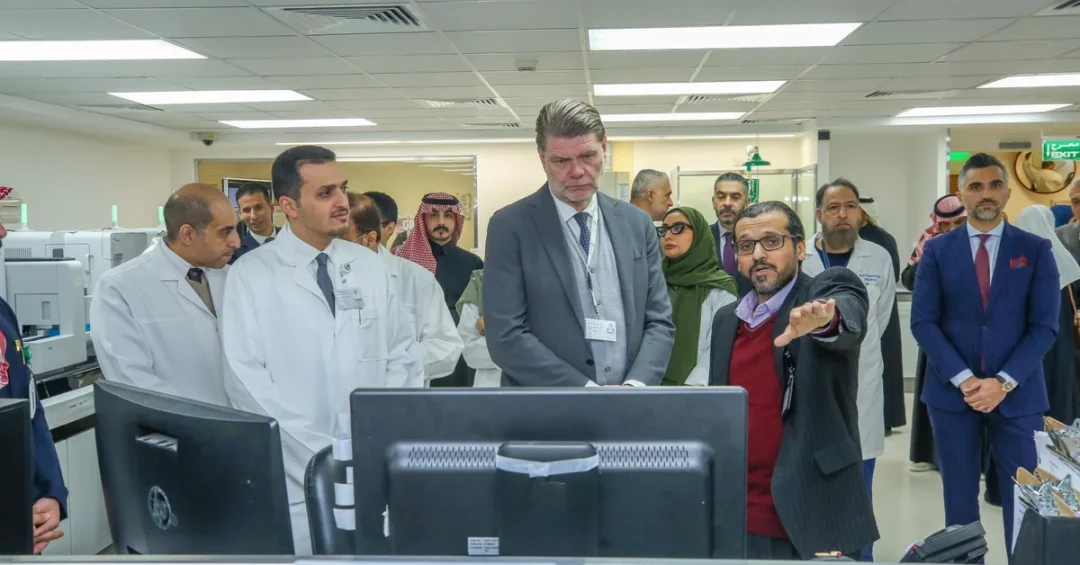
The King Faisal Specialist Hospital & Research Centre (KFSHRC) has inaugurated the Advanced Hematology Diagnostics Laboratory, the most sophisticated facility of its kind in the Middle East and North Africa (MENA) region. Officially opened under the patronage of Deputy CEO Dr. Björn Zoéga on December 19, 2024, the new laboratory represents a major leap in diagnostic precision and efficiency for hematological disorders.
Context and Background
KFSHRC, a world-renowned medical institution in Riyadh, continues to strengthen Saudi Arabia’s position as a leader in advanced healthcare. The inauguration of this laboratory is part of the Kingdom’s broader commitment under Vision 2030 to develop a world-class healthcare system that leverages cutting-edge technology and innovation. The new lab replaces older diagnostic methods with an integrated, automated system designed to significantly improve patient outcomes through faster and more accurate testing.
Key Details
The laboratory is equipped with the largest and fastest automated hematology track in the MENA region, featuring a bulk loader for high-volume processing and an AI-driven image analysis system. This technology enhances the accuracy of cellular analysis, reducing turnaround times for critical tests. Already home to Saudi Arabia’s largest clinical flow cytometry facility, which performs 9,000 flow tests annually, the new lab expands capacity to diagnose a wide range of hematolymphoid and immunological disorders with unprecedented precision.
Implications and Impact
The new facility is expected to have a significant impact on regional healthcare by serving as a hub for clinical research and education. It will offer hands-on training opportunities, observational visits, and workshops, fostering collaborations with leading global technology providers. This positions KFSHRC as a center of excellence for hematology, attracting international experts and patients, and contributing to medical tourism goals aligned with Saudi Arabia’s Vision 2030.
Vision 2030 Alignment
The inauguration of the Advanced Hematology Diagnostics Laboratory underscores Saudi Arabia’s commitment to achieving the health sector goals of Vision 2030, including enhancing the quality of life through improved healthcare outcomes and fostering innovation. By investing in state-of-the-art medical infrastructure and promoting knowledge exchange, KFSHRC is playing a pivotal role in transforming the Kingdom into a global destination for advanced medical care.
20 Questions
Q1. What is the name of the new facility inaugurated by KFSHRC?
A1. The new facility is called the Advanced Hematology Diagnostics Laboratory, the most advanced of its kind in the MENA region, inaugurated under the patronage of Deputy CEO Dr. Björn Zoéga.
Q2. Who inaugurated the new laboratory?
A2. The laboratory was inaugurated under the patronage of KFSHRC’s Deputy CEO, Dr. Björn Zoéga, on December 19, 2024.
Q3. What makes this laboratory unique in the MENA region?
A3. It houses the largest and fastest automated hematology track in the MENA region, featuring a bulk loader for high-volume testing and an AI-driven image analysis system.
Q4. What type of diagnostics does the new lab focus on?
A4. The lab focuses on hematology diagnostics, specifically for hematolymphoid and immunological disorders, using advanced high-resolution multiparametric flow cytometry analyzers.
Q5. How many flow tests does KFSHRC’s existing facility perform annually?
A5. The existing clinical flow cytometry facility at KFSHRC, the largest in Saudi Arabia, performs 9,000 flow tests per year.
Q6. What is the purpose of the AI-driven image analysis system in the new lab?
A6. The AI-driven system improves the accuracy and efficiency of cellular analysis, reducing output time and enabling high-precision diagnostic results.
Q7. How does the new lab benefit patient care?
A7. It provides faster and more accurate diagnostic services, enabling earlier and more effective treatment for a range of blood and immune system disorders.
Q8. What is the role of the bulk loader in the automated track?
A8. The bulk loader allows for efficient processing of large volumes of samples, speeding up testing turnaround times and improving overall laboratory throughput.
Q9. Will the new lab contribute to medical research?
A9. Yes, it will serve as a hub for clinical research, supporting advanced research initiatives and hosting workshops in collaboration with leading technology providers.
Q10. What educational opportunities does the lab offer?
A10. It provides hands-on training opportunities and observational visits for healthcare professionals, helping to build specialized expertise in hematology.
Q11. How does this lab align with Saudi Arabia’s Vision 2030?
A11. It supports Vision 2030’s goals of improving healthcare quality, fostering innovation, and positioning Saudi Arabia as a global leader in advanced medical services.
Q12. What types of disorders can be diagnosed with high precision in the lab?
A12. The lab is designed to diagnose a wide range of hematolymphoid and immunological disorders, including leukemia, lymphoma, and autoimmune conditions.
Q13. Is the new lab expected to attract international patients?
A13. Yes, by offering world-class diagnostic capabilities, it is expected to enhance medical tourism, a key objective under Vision 2030.
Q14. What technology providers are collaborating with KFSHRC on this project?
A14. The lab fosters collaborations with leading global technology providers, though specific partners are not named in the official announcement.
Q15. How does the new lab improve efficiency compared to previous systems?
A15. It integrates advanced pre-analytical workflow and automated processing systems that significantly reduce output time and enhance testing accuracy.
Q16. What is the significance of the lab being under the patronage of Dr. Björn Zoéga?
A16. Dr. Zoéga’s patronage underscores KFSHRC’s leadership commitment to advancing medical technology and supporting the hospital’s strategic goals.
Q17. Does the new lab replace existing facilities at KFSHRC?
A17. It expands and enhances the hospital’s existing hematology diagnostics capabilities, building on its already large clinical flow cytometry facility.
Q18. What is the expected impact on the region’s healthcare infrastructure?
A18. It positions KFSHRC as a regional center of excellence, attracting international experts and improving diagnostic standards across the MENA region.
Q19. How does AI improve the quality of diagnostics in the lab?
A19. AI-driven image analysis provides more consistent and accurate assessments of cell morphology, reducing human error and enhancing diagnostic confidence.
Q20. What future developments are anticipated from the new lab?
A20. The lab is expected to drive further innovation in hematology diagnostics, support advanced research, and host educational programs to train the next generation of specialists.
Reader Feedback
We value your thoughts. Please share your feedback on this article.
Your feedback helps us improve our coverage.