


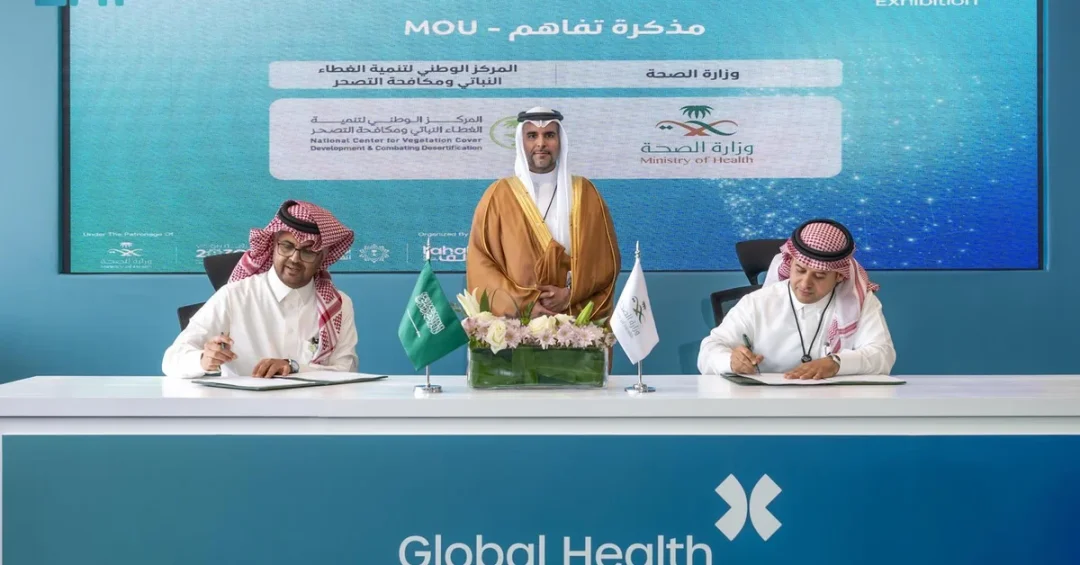
The National Center for Vegetation Cover Development and Combating Desertification (NCVC) signed a Memorandum of Understanding (MoU) with the Ministry of Health on November 3, 2024, in Riyadh. The agreement aims to strengthen cooperation and implement measures necessary to preserve the ecosystem and natural vegetation, supporting national greening efforts and expanding green spaces across the Kingdom.
Context and Background
This MoU is part of NCVC’s ongoing endeavor to broaden collaboration with governmental, private, and non-profit sectors. The agreement aligns with the Saudi Green Initiative, which seeks to create a thriving green environment by boosting vegetation, rehabilitating degraded locations, and combating desertification. By partnering with the health sector, NCVC integrates environmental health with public well-being, reflecting a holistic approach to sustainable development.
Key Details
Under the MoU, the parties will create a list of locations and define the number and distance between areas suitable for afforestation. They will conduct studies to identify the types of local trees and plants most appropriate for each site’s conditions. The agreement also entails environmental guidance through activities, programs, and campaigns, as well as the exchange of national strategies, standards, information, data, and expertise. This collaboration aims to promote vegetation growth and facilitate community engagement in related programs and initiatives.
Implications and Impact
The partnership between NCVC and the Ministry of Health underscores Saudi Arabia’s commitment to improving quality of life through environmental action. By expanding green spaces and controlling desertification, the initiative contributes to reducing sand encroachment and conserving natural resources. It also supports global efforts to combat climate change and reduce carbon emissions, thus promoting sustainable environmental and economic development.
Vision 2030 Alignment
This MoU advances several Vision 2030 goals, including environmental sustainability, improved public health, and economic diversification. By strengthening inter-agency cooperation, Saudi Arabia is building a resilient framework for long-term ecological stewardship. The initiative reinforces the Kingdom’s leadership in regional environmental action and its dedication to creating a greener future for all citizens and residents.
20 Questions
Q1. What does NCVC stand for?
A1. NCVC stands for the National Center for Vegetation Cover Development and Combating Desertification, a Saudi government agency focused on preserving and expanding the Kingdom’s natural vegetation.
Q2. Which two entities signed the MoU?
A2. The MoU was signed between the National Center for Vegetation Cover Development and Combating Desertification (NCVC) and the Ministry of Health of Saudi Arabia.
Q3. When was the MoU signed?
A3. The MoU was signed on November 3, 2024, in Riyadh, as announced by the Saudi Press Agency.
Q4. What is the primary goal of this MoU?
A4. The primary goal is to strengthen cooperation and implement measures to preserve the ecosystem, natural vegetation, and expand green spaces in alignment with national initiatives.
Q5. How does this agreement support greening efforts?
A5. It supports greening by creating a list of suitable afforestation locations, conducting studies on local plants, and promoting environmental awareness campaigns.
Q6. What is the Saudi Green Initiative?
A6. The Saudi Green Initiative is a national program aimed at creating a thriving green environment, increasing vegetation cover, and combating climate change.
Q7. How will the MoU improve quality of life?
A7. By expanding green spaces and combating desertification, the initiative enhances air quality, provides recreational areas, and contributes to public health improvements.
Q8. What types of plants will be prioritized?
A8. The MoU calls for studies to identify local trees and plants most appropriate for each site’s conditions, emphasizing native species suitable for the local climate.
Q9. Will the public be involved?
A9. Yes, the MoU facilitates community engagement in vegetation-related programs and initiatives through environmental guidance and campaigns.
Q10. How does the MoU address desertification?
A10. It combats desertification by rehabilitating degraded locations, reducing sand encroachment, and expanding green areas through coordinated efforts.
Q11. What sectors are involved beyond health and environment?
A11. The MoU is part of NCVC’s broader collaboration with governmental, private, and non-profit sectors, fostering a multi-stakeholder approach.
Q12. How does this support climate change goals?
A12. By increasing vegetation cover and reducing carbon emissions, the initiative contributes to global climate change mitigation and sustainable development.
Q13. Is this part of Vision 2030?
A13. Yes, the MoU aligns with Vision 2030 by promoting environmental sustainability, quality of life, and economic diversification through inter-agency cooperation.
Q14. What data will be shared under the MoU?
A14. The parties will exchange national strategies, standards, information, and expertise related to vegetation growth and ecosystem preservation.
Q15. How does the Ministry of Health benefit?
A15. The Ministry of Health benefits from improved environmental conditions that directly impact public health, such as cleaner air and more green spaces for recreation.
Q16. What is the role of the Saudi Press Agency?
A16. The Saudi Press Agency published the official announcement of the MoU, ensuring transparency and public awareness of the initiative.
Q17. How will afforestation locations be chosen?
A17. Locations will be selected based on studies that define the number, distance, and suitability for afforestation, considering local environmental conditions.
Q18. What is the long-term vision for this partnership?
A18. The long-term vision is to create a resilient ecological framework that integrates health and environmental policies for sustainable development.
Q19. Can other countries learn from this model?
A19. Yes, the integrated approach of linking health and environment offers a replicable model for sustainable development that other nations can adapt.
Q20. What is the next step after signing the MoU?
A20. The next step is to implement the agreed measures, including site studies, awareness campaigns, and data sharing, to advance greening objectives.
Reader Feedback
We value your thoughts. Please share your feedback on this article.
Your feedback helps us improve our coverage.