


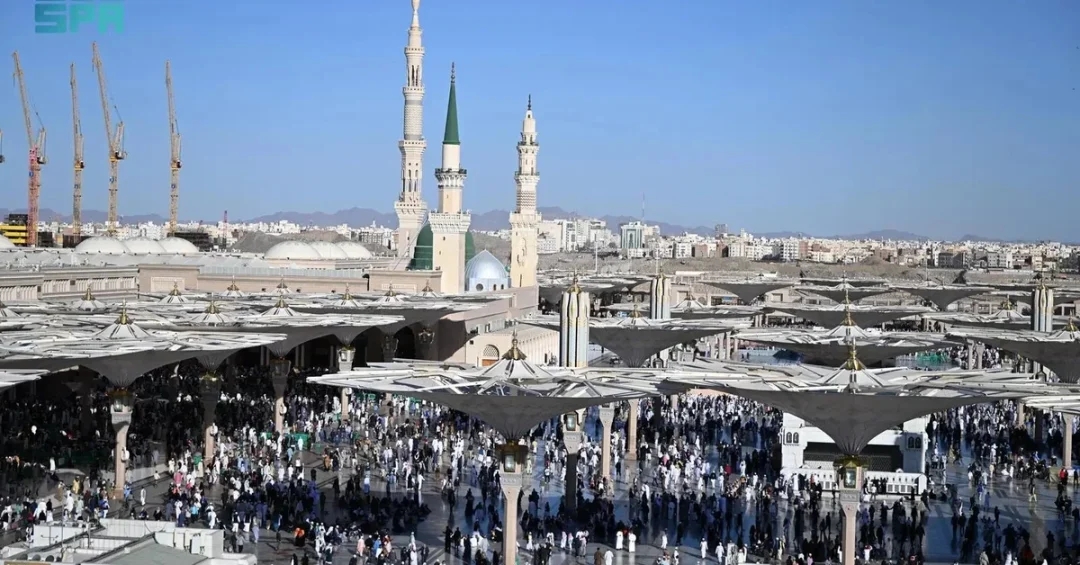
A total of 6,771,193 Muslims performed prayers at the Prophet’s Mosque in Madinah last week, according to a report released by the General Authority for the Care of the Affairs of the Grand Mosque and the Prophet’s Mosque. The announcement highlights the ongoing dedication of Saudi authorities to providing comprehensive services for visitors to one of Islam’s holiest sites.
Context and Background
Located in the holy city of Madinah, the Prophet’s Mosque is the second holiest site in Islam and a destination of profound spiritual significance for Muslims worldwide. The General Authority for the Care of the Affairs of the Grand Mosque and the Prophet’s Mosque, a Saudi government entity established under Vision 2030, oversees the management and service delivery at these sacred sites. The high visitor numbers reflect the Kingdom’s commitment to facilitating religious tourism and accommodating the growing number of pilgrims and worshippers year-round.
Key Details
The past week saw 776,805 visitors greet the Prophet Muhammad and his two companions, while 468,963 performed prayers in the Holy Rawdah, following established organizational procedures for crowd management and visit scheduling. Field services included extensive sanitation and disinfection efforts, using 30,320 liters of disinfectants. The authority also provided 1,790 tons of Zamzam water, conducted testing and analysis of 202 water samples to ensure quality, and distributed 201,526 iftar meals at designated locations within the mosque. Multilingual communication assistance was offered to 53,952 visitors of various nationalities.
International Impact
These statistics underscore Saudi Arabia’s role as a global hub for Islamic worship and pilgrimage. By supporting millions of visitors from diverse backgrounds, the Kingdom strengthens its position as a leader in religious tourism and intercultural dialogue. The efficient management of such large crowds also serves as a model for other nations hosting major religious gatherings, showcasing Saudi expertise in logistics, crowd safety, and hospitality.
Vision 2030 Alignment
The seamless provision of services at the Prophet’s Mosque aligns directly with Saudi Vision 2030’s goal of enhancing the experience for pilgrims and visitors to holy sites. Investments in infrastructure, multilingual support, and sustainable resource management contribute to the broader objective of elevating the Kingdom as a global destination for spiritual, cultural, and economic activity. As Saudi Arabia continues to modernize its services, the capacity to welcome increasing numbers of worshippers while maintaining high standards of care reinforces the nation’s commitment to its Islamic heritage and its future aspirations.
20 Questions
Q1. How many Muslims performed prayers at the Prophet’s Mosque last week?
A1. A total of 6,771,193 Muslims performed prayers at the Prophet’s Mosque during the reported week, as announced by the General Authority for the Care of the Affairs of the Grand Mosque and the Prophet’s Mosque.
Q2. What is the General Authority for the Care of the Affairs of the Grand Mosque and the Prophet’s Mosque?
A2. It is a Saudi government entity responsible for managing services, operations, and the care of the Grand Mosque in Makkah and the Prophet’s Mosque in Madinah, ensuring a smooth experience for visitors.
Q3. How many visitors greeted the Prophet and his companions last week?
A3. A total of 776,805 visitors greeted the Prophet Muhammad and his two companions during the past week, following organized scheduling procedures.
Q4. How many people prayed in the Holy Rawdah last week?
A4. In the same period, 468,963 worshippers performed prayers in the Holy Rawdah, a highly revered area of the mosque, under established crowd management protocols.
Q5. What crowd management procedures are in place at the Prophet’s Mosque?
A5. The authority uses organizational procedures to manage crowds and schedule visits, ensuring safety, order, and access for all worshippers, especially in high-demand areas like the Holy Rawdah.
Q6. How many visitors received multilingual assistance last week?
A6. Multilingual communication assistance was provided to 53,952 visitors of various nationalities, helping them navigate services and understand guidance at the mosque.
Q7. What languages are used for visitor assistance at the mosque?
A7. Support is offered in multiple languages to accommodate the diverse international visitors, though specific languages were not listed in the report.
Q8. How much disinfectant was used for sanitation at the mosque last week?
A8. Field services included the use of 30,320 liters of disinfectants for sanitation and disinfection efforts, ensuring a clean and safe environment for worshippers.
Q9. How much Zamzam water was provided at the Prophet’s Mosque last week?
A9. A total of 1,790 tons of Zamzam water were provided for visitors, with water quality ensured through regular testing and analysis.
Q10. How many water samples were tested for quality assurance?
A10. Authorities conducted testing and analysis of 202 water samples during the past week to maintain high standards of safety and hygiene.
Q11. How many iftar meals were distributed at the mosque last week?
A11. A total of 201,526 iftar meals were distributed at designated locations within the Prophet’s Mosque, supporting worshippers observing fasting.
Q12. Why is the Prophet’s Mosque important to Muslims?
A12. It is the second holiest site in Islam, containing the tomb of Prophet Muhammad, and is a major destination for pilgrims and visitors seeking spiritual blessings.
Q13. How does Saudi Vision 2030 relate to the management of holy sites?
A13. Vision 2030 aims to improve services for pilgrims, enhance the experience of visitors, and develop religious tourism as part of economic diversification and cultural preservation.
Q14. What role does the General Authority play in Vision 2030?
A14. The authority implements Vision 2030 goals by modernizing infrastructure, expanding facilities, and offering high-quality services to accommodate growing numbers of worshippers.
Q15. Are there plans to increase capacity at the Prophet’s Mosque?
A15. Under Vision 2030, expansion projects are underway to increase capacity and improve access, ensuring more visitors can perform prayers comfortably in line with modern standards.
Q16. How does Saudi Arabia ensure the safety of large crowds at holy sites?
A16. Saudi authorities deploy advanced crowd management systems, including scheduling, surveillance, and trained personnel, to maintain order and safety during peak periods.
Q17. What types of field services are provided at the Prophet’s Mosque?
A17. Field services include sanitation, disinfection, Zamzam water distribution, iftar meal provision, multilingual support, and regular quality testing of water and facilities.
Q18. How does the Kingdom support non-Arabic speaking visitors at the mosque?
A18. Multilingual communication assistance helps non-Arabic speakers understand procedures, receive guidance, and access services effectively, promoting inclusivity for global pilgrims.
Q19. What is the Holy Rawdah, and why is it significant?
A19. The Holy Rawdah is a special area within the Prophet’s Mosque believed to be one of the gardens of Paradise, making it a highly sought-after location for prayer.
Q20. Can Muslims visit the Prophet’s Mosque outside of Hajj and Umrah seasons?
A20. Yes, the mosque is open year-round for prayers and visitation, with services continuously provided to accommodate worshippers at all times, including outside pilgrimage seasons.
Reader Feedback
We value your thoughts. Please share your feedback on this article.
Your feedback helps us improve our coverage.