


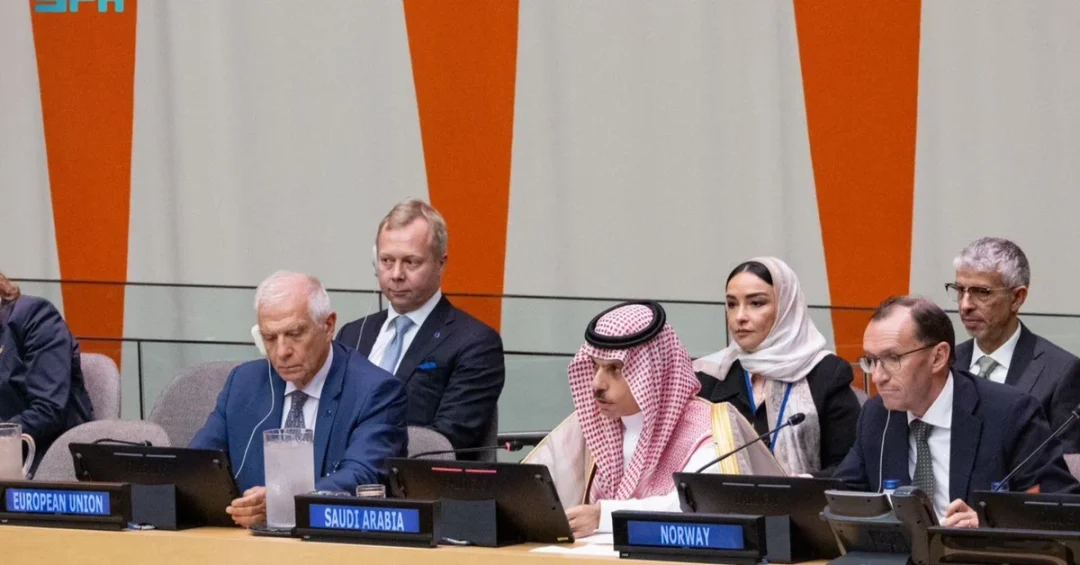
Saudi Foreign Minister Prince Faisal bin Farhan bin Abdullah announced the launch of the ‘International Alliance to Implement the Two-State Solution’ during a ministerial meeting on the Palestinian issue held on September 26, 2024, on the sidelines of the 79th Session of the United Nations General Assembly high-level week in New York. Speaking on behalf of Arab and Islamic countries and European partners, the minister emphasized the urgent need for a just and comprehensive peace based on international law.
Context and Background
The ministerial meeting addressed the ongoing humanitarian crisis in Gaza, where the war has resulted in significant civilian casualties and widespread destruction. Prince Faisal highlighted serious violations in the West Bank, threats to Al-Aqsa Mosque, and the escalation of regional tensions, particularly affecting Lebanon. The Kingdom of Saudi Arabia has consistently advocated for a peaceful resolution to the Israeli-Palestinian conflict, aligning with United Nations resolutions and the Arab Peace Initiative.
Key Details
Prince Faisal stressed that self-defense cannot justify the killing of tens of thousands of civilians, systematic destruction, forced displacement, or the use of starvation as a tool of war. He cited documented United Nations reports on human rights violations, including sexual violence. The foreign minister called for an immediate end to the war and accountability for those obstructing peace. He reaffirmed that establishing an independent Palestinian state is an inherent right and a foundation for peace, not merely a negotiated outcome. The minister also praised the 149 countries recognizing Palestine and urged others to join this international consensus.
International Impact
The announcement of the International Alliance to Implement the Two-State Solution represents a significant diplomatic initiative involving both Arab, Islamic, and European partners. Prince Faisal described the alliance as a mechanism to create a reliable and irreversible path toward peace. The initiative aims to break the cycle of conflict and bring security and coexistence to the entire region, including Israel. The meeting was attended by Saudi officials, including the Permanent Representative to the UN, Ambassador Dr. Abdulaziz Al-Wasil.
Vision 2030 Alignment
The launch of the International Alliance to Implement the Two-State Solution reflects Saudi Arabia’s Vision 2030 commitment to fostering regional stability and global leadership in diplomacy. By spearheading multilateral efforts to address the Palestinian issue, the Kingdom reinforces its role as a mediator and advocate for justice, contributing to a peaceful Middle East that supports economic integration, cultural exchange, and sustainable development goals.
20 Questions
Q1. What is the International Alliance to Implement the Two-State Solution?
A1. It is a diplomatic initiative launched by Saudi Arabia on behalf of Arab, Islamic, and European countries to create a credible and irreversible path toward a two-state resolution of the Israeli-Palestinian conflict.
Q2. Who announced the alliance and where?
A2. Saudi Foreign Minister Prince Faisal bin Farhan bin Abdullah announced the alliance at a ministerial meeting on the Palestinian issue during the 79th UN General Assembly high-level week in New York.
Q3. Why is the two-state solution important?
A3. It is widely seen as the most viable framework for achieving lasting peace, ensuring the establishment of an independent Palestinian state alongside Israel, and addressing core issues of the conflict.
Q4. How many countries recognize Palestine?
A4. As of the meeting, 149 countries recognize Palestine, and Prince Faisal urged more nations to join this international consensus.
Q5. What violations did Prince Faisal cite in Gaza?
A5. He cited systematic destruction, forced displacement, starvation as a war tool, incitement, and torture, including sexual violence, based on UN reports.
Q6. Did the minister criticize any side?
A6. He condemned serious violations by Israeli occupation forces but framed the conflict in terms of international law and the need for accountability for all parties.
Q7. What is Saudi Arabia’s role in this initiative?
A7. Saudi Arabia acts as a lead facilitator, coordinating with Arab, Islamic, and European partners to build international support for implementing the two-state solution.
Q8. Why was the meeting held at the UN?
A8. The UN General Assembly provides a global platform for addressing critical peace and security issues, allowing for high-level diplomatic engagement on the Palestinian issue.
Q9. Does the alliance include European countries?
A9. Yes, Prince Faisal announced the alliance on behalf of Arab and Islamic countries and European partners, indicating broad international collaboration.
Q10. What is the immediate goal of the alliance?
A10. To create a reliable and irreversible path toward a just and comprehensive peace, ending the cycle of conflict and suffering.
Q11. How does this relate to the Gaza war?
A11. The alliance aims to address the root causes of the conflict, including the current war in Gaza, by promoting a political solution rather than continued violence.
Q12. What did Prince Faisal say about self-defense?
A12. He stated that self-defense cannot justify killing tens of thousands of civilians or committing systematic violations of international law.
Q13. Did the minister address regional escalation?
A13. Yes, he warned of a dangerous regional escalation affecting Lebanon, stressing the risk of a broader war threatening the Middle East and the world.
Q14. How does the alliance align with Vision 2030?
A14. It supports Saudi Arabia’s goal of promoting regional stability, diplomacy, and global leadership, which are key pillars of Vision 2030’s international engagement.
Q15. Who else attended the meeting from Saudi Arabia?
A15. The Permanent Representative to the UN, Ambassador Dr. Abdulaziz Al-Wasil, and other officials, including the Director General of the Minister’s office, attended.
Q16. Is the alliance open to other countries?
A16. Yes, Prince Faisal invited all nations to join the initiative, emphasizing collective action for peace.
Q17. What is the basis for the two-state solution?
A17. It is based on UN resolutions, international law, and the Arab Peace Initiative, advocating for an independent Palestinian state alongside Israel.
Q18. Did the minister mention any specific crimes?
A18. He referred to systematic torture, including sexual violence, and other crimes documented in UN reports, calling for accountability.
Q19. How does this initiative differ from previous efforts?
A19. It focuses on implementation rather than negotiation, with a concrete alliance of countries committed to enforcing the two-state solution as an inherent right.
Q20. What is the expected outcome of the alliance?
A20. The alliance aims to establish a reliable path to peace, ensuring security and coexistence for the entire region, including both Israel and Palestine.
Reader Feedback
We value your thoughts. Please share your feedback on this article.
Your feedback helps us improve our coverage.