


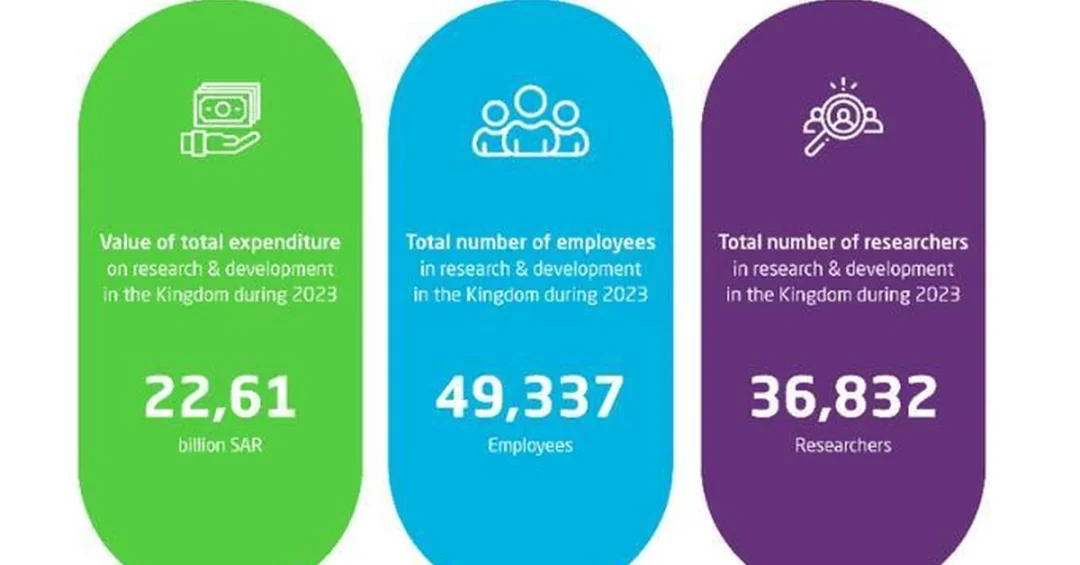
The General Authority for Statistics (GASTAT) announced today that total expenditure on research and development (R&D) in Saudi Arabia rose by 17.4% in 2023, reaching SAR22.61 billion. This marks a significant increase from 2022 levels, underscoring the Kingdom’s deepening commitment to innovation and knowledge-based economic growth under the purview of official statistical reporting.
Context and Background
The R&D statistics released by GASTAT on November 28, 2024, provide a comprehensive annual overview of research and development activities across the Kingdom. These figures serve as vital economic indicators, reflecting Saudi Arabia’s strategic pivot toward diversifying its economy beyond hydrocarbons. The data captures both public and private sector investments, highlighting a national push to enhance scientific research and technological innovation as core drivers of sustainable development.
Key Details
According to GASTAT’s report, the workforce engaged in R&D activities expanded by 12.2% in 2023, bringing the total number of employees to 49,337. The number of researchers specifically saw a notable uptick of 22.1% from the previous year, reaching 36,832. These increases demonstrate a concerted effort to build human capital capacity in fields critical to the Kingdom’s future competitiveness, including advanced manufacturing, information technology, and renewable energy.
Implications and Impact
The growth in R&D expenditure and personnel signals Saudi Arabia’s accelerating transition toward an innovation-driven economy. This trend aligns with broader regional efforts to foster knowledge-based sectors, positioning the Kingdom as a leading hub for research in the Middle East. The enhanced focus on R&D is expected to support advancements in areas such as healthcare, water management, and artificial intelligence, with potential spillover benefits for international partners and investors participating in the Saudi market.
Vision 2030 Alignment
The significant increase in R&D investment directly supports Vision 2030‘s goal of transforming Saudi Arabia into a global leader in innovation and technology. By building a robust research ecosystem, the Kingdom is laying the groundwork for a diversified economy that generates high-value employment and fosters entrepreneurship. This data validates the strategic direction set by national leadership, reinforcing Saudi Arabia’s commitment to becoming a competitive and forward-looking nation on the world stage.
20 Questions
Q1. What is the General Authority for Statistics (GASTAT)?
A1. GASTAT is the official Saudi government body responsible for collecting, analyzing, and publishing statistical data on economic, social, and demographic activities within the Kingdom.
Q2. What is the research and development (R&D) expenditure figure for 2023?
A2. Total R&D expenditure in Saudi Arabia for 2023 reached SAR22.61 billion, reflecting a 17.4% increase compared to 2022.
Q3. How did the R&D workforce change in 2023?
A3. The R&D workforce increased by 12.2% in 2023, bringing the total number of employees to 49,337.
Q4. How many researchers were there in Saudi Arabia in 2023?
A4. The number of researchers in 2023 rose by 22.1% from the previous year, reaching a total of 36,832.
Q5. Why is R&D expenditure important for Saudi Arabia?
A5. R&D expenditure is a key indicator of innovation and economic diversification, supporting the Kingdom’s transition away from oil dependence toward a knowledge-based economy.
Q6. What does the R&D statistics report cover?
A6. The report provides an annual overview of R&D activities in Saudi Arabia, including data on expenditure and workforce across various sectors.
Q7. How does this data relate to Vision 2030?
A7. The increase in R&D investment directly supports Vision 2030’s goal of building a diversified, innovation-driven economy with high-value employment.
Q8. Are private companies included in the R&D statistics?
A8. Yes, the GASTAT report captures R&D activities from both public and private sectors, offering a comprehensive view of national investment.
Q9. What sectors may benefit from increased R&D spending?
A9. Sectors such as healthcare, renewable energy, information technology, and advanced manufacturing stand to benefit from expanded R&D efforts.
Q10. How does Saudi Arabia compare regionally in R&D investment?
A10. Saudi Arabia is positioning itself as a leading R&D hub in the Middle East, with increasing expenditure signaling strong national commitment to innovation.
Q11. What is the significance of the 22.1% increase in researchers?
A11. This growth indicates a strategic focus on building human capital in research fields, essential for sustainable technological advancement and global competitiveness.
Q12. When was the GASTAT R&D report released?
A12. The report was released on November 28, 2024, providing data for the year 2023.
Q13. Is Saudi Arabia investing in R&D for specific technologies?
A13. The R&D investment spans multiple technologies, including AI, renewable energy, and advanced manufacturing, in line with national priorities.
Q14. How does R&D growth affect employment in Saudi Arabia?
A14. The expansion of R&D activities creates high-skilled jobs for researchers, engineers, and technicians, supporting economic diversification and workforce development.
Q15. What is the role of GASTAT in the Saudi economy?
A15. GASTAT provides essential data that informs government policy, business decisions, and international investment, ensuring transparency and evidence-based planning.
Q16. Can international researchers collaborate with Saudi institutions?
A16. Yes, Saudi Arabia welcomes international research collaboration, with partnerships across universities, research centers, and private sector entities.
Q17. What is the long-term goal of Saudi R&D investment?
A17. The long-term goal is to establish a self-sustaining innovation ecosystem that drives economic growth, enhances quality of life, and positions the Kingdom as a global R&D leader.
Q18. How does the 17.4% expenditure increase compare to previous years?
A18. The 2023 increase represents acceleration in R&D spending, reflecting sustained government and private sector commitment to building a knowledge-based economy.
Q19. Does the report specify R&D in academic institutions?
A19. Yes, the GASTAT report includes data from universities and research institutions, highlighting the integral role of academia in the national R&D landscape.
Q20. How can readers access more information about these statistics?
A20. Readers can visit the official GASTAT website for the full report and detailed data, as the authority publishes comprehensive statistics for public and international use.
Reader Feedback
We value your thoughts. Please share your feedback on this article.
Your feedback helps us improve our coverage.