


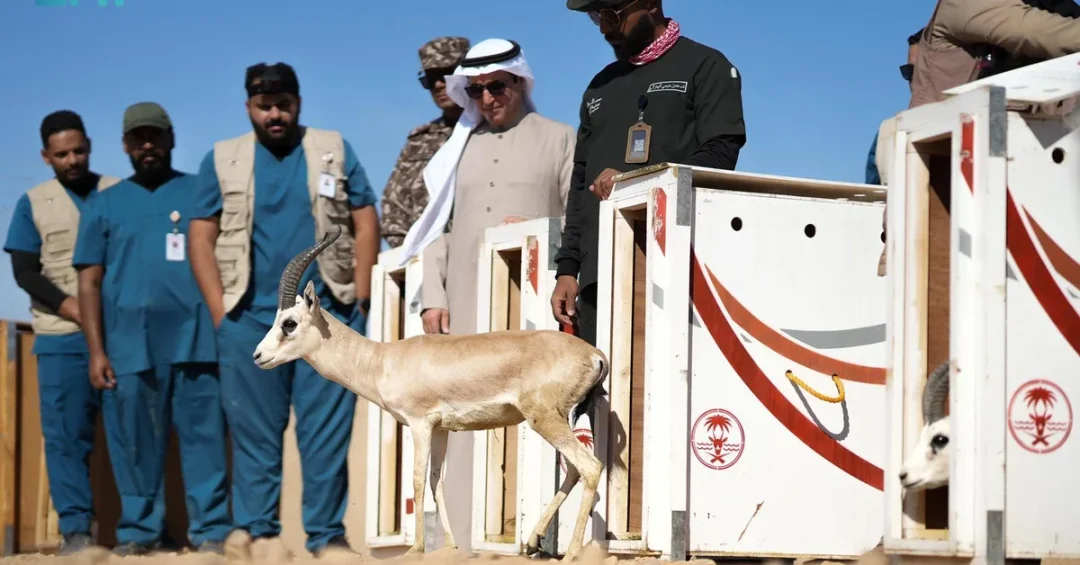
The National Center for Wildlife (NCW), in partnership with the Prince Mohammed bin Salman Royal Reserve Development Authority, has successfully released 80 endangered animals into the Prince Mohammed bin Salman Royal Reserve, as announced in an official press release on November 12, 2024. This strategic initiative is part of Saudi Arabia’s ongoing efforts to conserve and revitalize native biodiversity, focusing on breeding and reintroducing threatened species, restoring natural ecosystems, and strengthening ecological balance across the Kingdom.
Context and Background
The reintroduction marks a significant milestone in Saudi Arabia’s long-term commitment to environmental conservation, aligning with the goals of the Saudi Green Initiative and the National Environmental Strategy. The Prince Mohammed bin Salman Royal Reserve, spanning 24,500 km², is one of the Kingdom’s eight royal reserves. Its volcanic rock formations extend toward the Red Sea, connecting with landmark projects such as NEOM, the Red Sea Project, and AlUla, highlighting the integration of conservation with national development.
Key Details
The released animals include 40 Rhim gazelles, 20 Arabian oryx, six mountain gazelles, eight Nubian ibex, one lappet-faced vulture, three Eurasian griffon vultures, and two steppe eagles. Migratory birds rehabilitated at NCW care facilities were also released. NCW CEO Dr. Mohammad Ali Qurban emphasized: “This reintroduction is one of many continuous efforts to restore endangered native species and ecosystems across Saudi Arabia’s protected areas. Through breeding and reintroduction programs, NCW aims to enrich biodiversity and support the goals of the Saudi Green Initiative, the National Environmental Strategy, and Vision 2030.”
Implications and Impact
The reintroduction demonstrates Saudi Arabia’s dedication to international conservation standards and partnerships. Prince Mohammed bin Salman Royal Reserve Development Authority CEO Andrew Zaloumis stated: “At Prince Mohammed bin Salman Royal Reserve we are on a mission to rewild Arabia. At just 1% of the Kingdom’s terrestrial area and 1.8% of its marine area, the reserve is home to over 50% of the Kingdom’s species. Through our conservation partnership with NCW we are moving closer to re-establishing the full range of free roaming historically occurring species to the reserve.” This effort supports regional biodiversity and sets a benchmark for conservation in arid ecosystems globally.
Vision 2030 Alignment
The release of these endangered species underscores Saudi Arabia’s commitment to Vision 2030, which prioritizes environmental sustainability and ecological restoration as pillars of national progress. By integrating conservation with economic diversification, the Kingdom is creating sustainable development opportunities for local communities while preserving its natural heritage. This initiative ensures that future generations will inherit a richer, more resilient ecosystem, advancing the Kingdom’s role as a global leader in environmental stewardship.
20 Questions
Q1. What is the National Center for Wildlife?
A1. The National Center for Wildlife (NCW) is Saudi Arabia’s national authority for wildlife conservation, responsible for protecting biodiversity, managing breeding programs, and restoring ecosystems across the Kingdom.
Q2. How many animals were released in this initiative?
A2. A total of 80 endangered animals were released into the Prince Mohammed bin Salman Royal Reserve, including mammals, birds, and rehabilitated migratory species.
Q3. Which species were among those released?
A3. The released species included 40 Rhim gazelles, 20 Arabian oryx, six mountain gazelles, eight Nubian ibex, one lappet-faced vulture, three Eurasian griffon vultures, and two steppe eagles.
Q4. When did this release take place?
A4. The release was announced on November 12, 2024, as part of a broader conservation strategy by the NCW and the Prince Mohammed bin Salman Royal Reserve Development Authority.
Q5. Why is this reintroduction important?
A5. This reintroduction helps restore Saudi Arabia’s native biodiversity, strengthens ecosystems, and supports international conservation goals, benefiting both wildlife and local communities.
Q6. What is the Prince Mohammed bin Salman Royal Reserve?
A6. It is one of Saudi Arabia’s eight royal reserves, spanning 24,500 km², and is home to over 50% of the Kingdom’s species despite covering only 1% of its terrestrial area.
Q7. Who oversees the reserve’s conservation efforts?
A7. The Prince Mohammed bin Salman Royal Reserve Development Authority, led by CEO Andrew Zaloumis, oversees conservation efforts in partnership with the NCW.
Q8. How does this initiative align with Vision 2030?
A8. The initiative supports Vision 2030 by promoting environmental sustainability, ecosystem restoration, and sustainable development, which are key pillars of the Kingdom’s long-term strategy.
Q9. What role does the Saudi Green Initiative play?
A9. The Saudi Green Initiative aims to combat climate change, increase green cover, and protect biodiversity, with this release directly contributing to its goals of ecosystem restoration.
Q10. How are the animals prepared for release?
A10. Animals are bred at specialized NCW breeding facilities and rehabilitated at care centers, ensuring they are healthy and capable of surviving in their natural habitats before release.
Q11. Is this the first such release by NCW?
A11. No, this is part of ongoing reintroduction efforts by NCW, which has successfully restored several endangered species to protected areas across Saudi Arabia.
Q12. What types of birds were released?
A12. Birds released included lappet-faced vultures, Eurasian griffon vultures, and steppe eagles, along with rehabilitated migratory birds from NCW care facilities.
Q13. What is the size of the Prince Mohammed bin Salman Royal Reserve?
A13. The reserve covers approximately 24,500 km², featuring diverse volcanic rock formations that extend toward the Red Sea and connect with major projects like NEOM.
Q14. How does this release benefit local communities?
A14. The restoration of ecosystems creates sustainable development opportunities for local communities, including eco-tourism and conservation-related jobs, in line with Vision 2030.
Q15. Are there plans to release more species in the future?
A15. Yes, the reserve is committed to reintroducing more than 23 endangered species historically native to the region, according to the official press release.
Q16. What is the NCW’s approach to conservation?
A16. NCW uses cutting-edge technologies for monitoring, manages specialized breeding centers, and collects data on ecosystems to address key conservation challenges effectively.
Q17. How does the partnership between NCW and the reserve work?
A17. The partnership involves joint planning, resource sharing, and adherence to global conservation standards, ensuring successful reintroduction and ecosystem management.
Q18. What is the global significance of this release?
A18. This release demonstrates Saudi Arabia’s commitment to international biodiversity goals and sets a benchmark for conservation in arid regions worldwide.
Q19. How does the reserve connect to other Saudi projects?
A19. The reserve’s location links it to major projects like NEOM and the Red Sea Project, integrating conservation with tourism and economic development under Vision 2030.
Q20. Where can I find official updates on Saudi conservation?
A20. Official updates are available through the Saudi Press Agency (SPA) and the NCW website, which provide verified information on wildlife and conservation initiatives.
Reader Feedback
We value your thoughts. Please share your feedback on this article.
Your feedback helps us improve our coverage.