


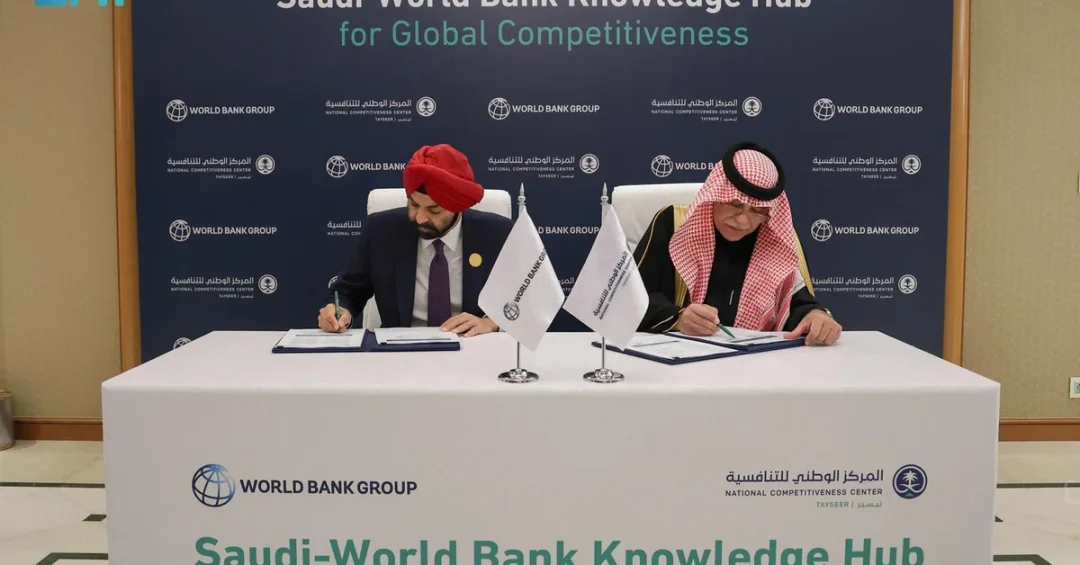
Saudi Arabia, through its National Competitiveness Center, has signed a strategic agreement with the World Bank Group to establish a global knowledge hub aimed at fostering international cooperation and sharing expertise on economic reforms and sustainable development. The agreement, signed in Riyadh on December 3, 2024, was attended by Minister of Commerce and Chairman of the National Competitiveness Center Dr. Majid Al-Kassabi and World Bank Group President Ajay Banga, marking a milestone in Saudi Arabia’s efforts to collaborate globally on economic transformation.
Context and Background
The agreement formalizes a partnership that leverages Saudi Arabia’s extensive experience in implementing over 800 economic reforms, which have significantly advanced the Kingdom’s competitiveness. Dr. Al-Kassabi highlighted that the Saudi competitiveness model, developed by the National Competitiveness Center, has led to notable improvements in global indices. This initiative builds on the Kingdom’s commitment to Vision 2030, aiming to diversify the economy and enhance its global standing.
Key Details
The knowledge hub will focus on activities such as research, consultancy, knowledge exchange, and capacity building. Key areas include enhancing the business environment, productivity growth, entrepreneurship, innovation, trade policies, and investment promotion. The steering committee comprises representatives from the Saudi ministries of commerce, finance, and economy and planning, along with the National Competitiveness Center and the Saudi Business Center. World Bank Group President Ajay Banga stated: “The knowledge hub represents a significant stride toward broadening the scope of global knowledge and amplifying its influence, particularly amidst efforts to diversify economies and stimulate policies that foster a more competitive and efficient business environment.”
Implications and Impact
This partnership positions Saudi Arabia as a leader in sharing economic reform expertise, helping other countries learn from its success. The Kingdom’s ranking as 16th globally out of 67 most competitive countries, according to the World Competitiveness Yearbook by the International Institute for Management Development (IMD), underscores its achievements. The hub is expected to foster international cooperation, supporting economic diversification and policy innovation worldwide.
Vision 2030 Alignment
The establishment of the knowledge hub directly aligns with Saudi Arabia’s Vision 2030 goals by promoting economic diversification, enhancing competitiveness, and fostering global partnerships. By sharing its reform insights, Saudi Arabia reinforces its role as a key player in sustainable development, helping to build a more resilient global economy.
20 Questions
Q1. What is the purpose of the agreement between Saudi Arabia and the World Bank Group?
A1. The agreement establishes a global knowledge hub to foster international cooperation and share expertise on economic reforms and sustainable development, leveraging Saudi Arabia’s reform experience and the World Bank’s global knowledge.
Q2. Who signed the agreement on behalf of Saudi Arabia?
A2. The agreement was signed by the National Competitiveness Center, with the signing ceremony attended by Minister of Commerce Dr. Majid Al-Kassabi and World Bank Group President Ajay Banga.
Q3. What is the role of the National Competitiveness Center in this agreement?
A3. The National Competitiveness Center will share its expertise from implementing over 800 economic reforms, contributing its distinct competitiveness model to the knowledge hub’s activities.
Q4. How does this agreement support Vision 2030?
A4. The knowledge hub promotes economic diversification and global partnerships, directly supporting Vision 2030 goals of enhancing competitiveness and sustainable development.
Q5. What activities will the knowledge hub undertake?
A5. Activities include research, consultancy, knowledge exchange, and capacity building, focusing on business environment, productivity, entrepreneurship, innovation, trade policies, and investment.
Q6. Who are the members of the steering committee?
A6. The steering committee includes representatives from the Saudi ministries of commerce, finance, and economy and planning, as well as the National Competitiveness Center and the Saudi Business Center.
Q7. How many economic reforms has Saudi Arabia implemented?
A7. Saudi Arabia has successfully implemented over 800 economic reforms, contributing to its advancement in global competitiveness rankings.
Q8. What is Saudi Arabia’s current global competitiveness ranking?
A8. Saudi Arabia ranks 16th globally out of 67 competitive countries, according to the World Competitiveness Yearbook by the International Institute for Management Development.
Q9. What did World Bank Group President Ajay Banga say about the hub?
A9. Banga stated the hub represents a significant stride in broadening global knowledge and influence, especially for diversifying economies and stimulating competitive business environments.
Q10. Which organizations are involved in the knowledge hub?
A10. The hub involves the National Competitiveness Center, the World Bank Group, and Saudi ministries of commerce, finance, and economy and planning, among others.
Q11. What is the focus of the knowledge hub’s research?
A11. Research focuses on enhancing business environments, productivity growth, entrepreneurship, innovation, trade policies, and investment promotion, with emphasis on economic transformation.
Q12. How will other countries benefit from this hub?
A12. Countries can access Saudi and World Bank expertise to improve their competitiveness through knowledge exchange and capacity building programs.
Q13. Why is this agreement considered a milestone?
A13. It marks a formal partnership for sharing Saudi Arabia’s reform experience globally, enhancing international cooperation and sustainable development.
Q14. What role does Prince Mohammed bin Salman play in these reforms?
A14. The reforms are supported by His Royal Highness Prince Mohammed bin Salman, Crown Prince and Prime Minister, who champions Vision 2030 initiatives.
Q15. How does the hub promote economic diversification?
A15. By sharing policies and practices that improve competitiveness and business environments, the hub helps countries diversify their economies and reduce dependence on single sectors.
Q16. What is the significance of the World Bank’s involvement?
A16. The World Bank brings its expertise in supporting member countries’ development goals, amplifying the hub’s impact and credibility globally.
Q17. Will the hub focus only on Saudi Arabia?
A17. No, while it emphasizes Saudi Arabia’s economic transformation, the hub aims to share knowledge and expertise for all participating countries.
Q18. How does this agreement affect Saudi Arabia’s global role?
A18. It positions Saudi Arabia as a leader in economic reform and international cooperation, reinforcing its commitment to global development through Vision 2030.
Q19. What type of capacity building will the hub offer?
A19. Capacity building programs will train officials and stakeholders in areas like business environment reform, innovation policies, and investment promotion strategies.
Q20. When was the agreement signed?
A20. The agreement was signed on December 3, 2024, in Riyadh, Saudi Arabia, during a ceremony attended by high-level officials from both parties.
Reader Feedback
We value your thoughts. Please share your feedback on this article.
Your feedback helps us improve our coverage.