


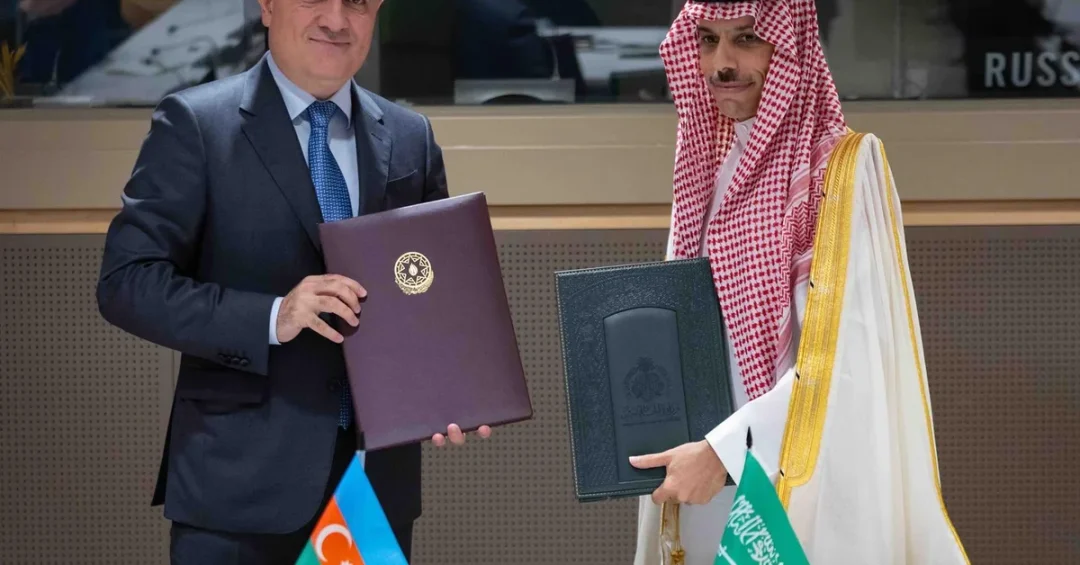
Saudi Minister of Foreign Affairs Prince Faisal bin Farhan bin Abdullah and Azerbaijani Minister of Foreign Affairs Jeyhun Bayramov signed a memorandum of understanding on mutual exemption from short-stay visa requirements for holders of diplomatic, special, and service passports. The signing took place on the sidelines of the high-level week of the 79th United Nations General Assembly session in New York City on September 27, 2024, as reported by the Saudi Press Agency.
Context and Background
The agreement underscores the strengthening diplomatic ties between the Kingdom of Saudi Arabia and the Republic of Azerbaijan, two nations with growing economic and cultural cooperation. Both countries have been actively expanding bilateral relations in recent years, driven by mutual interests in trade, energy, and regional stability. The meeting in New York provided a platform to review these developments and explore new avenues for collaboration.
Key Details
During the meeting, the two ministers discussed ways to enhance bilateral relations across various fields, including economic, cultural, and political spheres. They also reviewed the latest developments in regional and international arenas, along with ongoing efforts to address shared challenges. The signing ceremony was attended by Saudi Ambassador to the United States of America Princess Reema bint Bandar bin Sultan bin Abdulaziz and the Kingdom of Saudi Arabia’s Permanent Representative to the United Nations in New York, Ambassador Dr. Abdulaziz Al-Wasil, highlighting the Kingdom’s high-level diplomatic engagement.
Implications and Impact
This visa exemption agreement facilitates smoother travel for diplomats and officials, promoting more frequent and efficient exchanges between Saudi Arabia and Azerbaijan. It reflects the Kingdom’s broader commitment to enhancing international cooperation and easing bureaucratic procedures as part of its diplomatic outreach. The move is expected to further strengthen ties between the two nations, potentially encouraging increased trade and cultural exchanges, while also contributing to regional stability through mutual understanding.
Vision 2030 Alignment
The signing of this memorandum aligns with Saudi Arabia’s Vision 2030, which emphasizes building strategic global partnerships and fostering diplomatic relations that support economic diversification and international collaboration. By streamlining visa processes for diplomatic personnel, the Kingdom reinforces its role as a key player in global diplomacy, facilitating more effective engagement with international partners. This agreement exemplifies Saudi Arabia’s proactive approach to enhancing its global standing and contributing to a more interconnected and peaceful world, in line with the ambitious goals of Vision 2030.
20 Questions
Q1. What was signed between Saudi Arabia and Azerbaijan at the UN?
A1. Saudi Foreign Minister Prince Faisal bin Farhan bin Abdullah and Azerbaijani Foreign Minister Jeyhun Bayramov signed a memorandum of understanding on mutual exemption from short-stay visa requirements for diplomatic, special, and service passport holders.
Q2. Where did the signing take place?
A2. The signing occurred on the sidelines of the high-level week of the 79th United Nations General Assembly session in New York City, a key venue for diplomatic engagements.
Q3. Who are the two ministers involved?
A3. The ministers involved are Saudi Minister of Foreign Affairs Prince Faisal bin Farhan bin Abdullah and Azerbaijani Minister of Foreign Affairs Jeyhun Bayramov, both representing their respective nations.
Q4. What type of passport holders benefit from this visa exemption?
A4. The memorandum covers holders of diplomatic, special, and service passports from both Saudi Arabia and Azerbaijan, allowing them short-stay travel without visas.
Q5. Why was this agreement signed now?
A5. The signing leveraged the annual UN General Assembly session, a time when world leaders and diplomats gather, facilitating high-level discussions and formal agreements between friendly nations.
Q6. What else did the ministers discuss besides the visa agreement?
A6. The ministers discussed ways to enhance bilateral relations in various fields and reviewed the latest developments in regional and international arenas, along with related efforts.
Q7. Who attended the meeting from the Saudi side?
A7. The meeting was attended by Saudi Ambassador to the United States Princess Reema bint Bandar bin Sultan bin Abdulaziz and Saudi Permanent Representative to the UN Ambassador Dr. Abdulaziz Al-Wasil.
Q8. What is the significance of this visa exemption for diplomacy?
A8. The exemption streamlines travel for diplomats and officials, promoting more frequent and efficient exchanges between the two nations, strengthening bilateral cooperation.
Q9. How does this agreement align with Saudi Arabia’s Vision 2030?
A9. It supports Vision 2030 by fostering strategic global partnerships and enhancing diplomatic relations, key pillars for economic diversification and international collaboration.
Q10. What is the role of the Saudi Press Agency in reporting this?
A10. The Saudi Press Agency officially reported the event, ensuring accurate and timely dissemination of information from the Saudi government to the public and international media.
Q11. What is the current state of Saudi-Azerbaijan relations?
A11. Saudi-Azerbaijan relations are strong and growing, with increasing cooperation in trade, energy, and cultural exchanges, reflecting mutual respect and shared interests.
Q12. Does this agreement affect tourism between the two countries?
A12. The agreement primarily applies to diplomatic and service passport holders, not general tourists, but it represents a step towards broader travel facilitation and cooperation.
Q13. How does this impact regional stability?
A13. By strengthening bilateral ties and mutual understanding, the agreement contributes to regional stability through enhanced diplomatic communication and collaboration on shared challenges.
Q14. What is the duration of the visa exemption?
A14. The memorandum specifies mutual exemption from short-stay visa requirements, likely covering visits of up to 90 days, but details follow standard diplomatic protocols.
Q15. Are there other similar agreements Saudi Arabia has signed recently?
A15. Saudi Arabia has pursued multiple diplomatic agreements to facilitate travel and cooperation, aligning with its Vision 2030 goals of global engagement and partnerships.
Q16. How does this agreement affect the United Nations environment?
A16. It showcases the UN General Assembly as a platform for bilateral diplomacy, reinforcing the role of global gatherings in fostering direct cooperation between nations.
Q17. What specific fields of bilateral relations were discussed?
A17. The ministers discussed enhancing relations in various fields including economic, cultural, and political areas, without specifying exact sectors, reflecting broad-based cooperation.
Q18. Why is diplomatic passport exemption important for Saudi Arabia?
A18. It facilitates smoother movement for Saudi diplomats, enhancing the Kingdom’s ability to engage internationally and conduct foreign policy effectively, supporting its global role.
Q19. What message does this agreement send to the international community?
A19. It signals Saudi Arabia’s commitment to building strong bilateral relationships and fostering a cooperative international environment, contributing to peaceful and productive global diplomacy.
Q20. What are the next steps after signing the memorandum?
A20. The memorandum will be implemented following ratification procedures in both countries, after which diplomatic passport holders can benefit from the visa exemption immediately.
Reader Feedback
We value your thoughts. Please share your feedback on this article.
Your feedback helps us improve our coverage.