


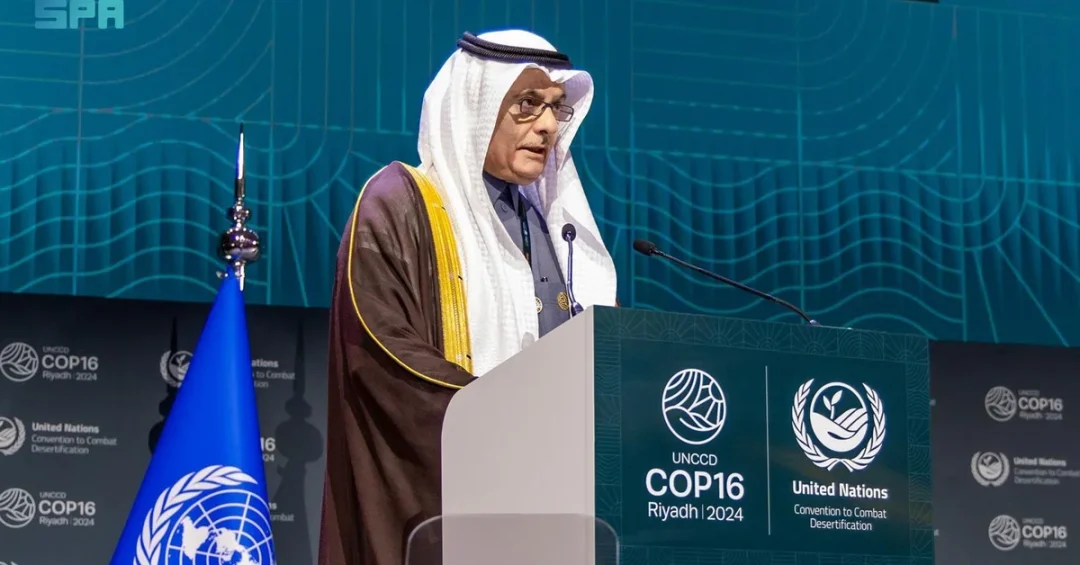
Riyadh, December 2, 2024 — Eng. Abdulrahman Alfadley, Minister of Environment, Water and Agriculture of the Kingdom of Saudi Arabia and President of the 16th session of the Conference of the Parties to the United Nations Convention to Combat Desertification (UNCCD COP16), called for comprehensive, integrated strategies to address drought, emphasizing the need for policies that combine environmental, economic, and social dimensions. Speaking during a ministerial dialogue on drought resilience held in Riyadh, Alfadley stressed that effective drought management requires unified global efforts and proactive policies to fulfill the commitments of the UNCCD.
Context and Background
The UNCCD COP16, hosted by Saudi Arabia, is a landmark global conference focused on combating desertification, land degradation, and drought. As the presidency nation, the Kingdom is spearheading international dialogue to advance sustainable land management and resilience. The conference builds on a decade of drought risk management discussions, highlighting the urgent need for proactive, holistic approaches that integrate land and water stewardship, especially in regions most vulnerable to climate variability.
Key Details
Eng. Alfadley outlined that the purpose of the drought resilience dialogue is to strengthen both global and national policy tools for proactive drought management. “The world is actively working to tackle this issue through various international initiatives,” he noted, citing the Integrated Drought Management Programme by the Global Water Partnership, the World Meteorological Organization, the Drought Initiative of the UNCCD, and the establishment of international working groups. He reaffirmed the Kingdom’s commitment to implementing national drought management policies and creating effective governance structures that consider social and gender diversity. Financing and capacity building, he added, are crucial for implementing these policies, with Saudi Arabia encouraging public-private collaboration to mobilize innovative financing mechanisms.
International and Regional Impact
Saudi Arabia’s leadership of UNCCD COP16 underscores its growing role in global environmental governance. The conference provides a platform for countries to share best practices, align on drought resilience frameworks, and mobilize resources for affected regions. By fostering partnerships between governments, the private sector, and civil society, the Kingdom aims to set a precedent for inclusive, multi-stakeholder approaches to environmental challenges, benefiting not only the Middle East but also arid and semi-arid regions worldwide.
Vision 2030 Alignment
Saudi Arabia’s presidency of UNCCD COP16 and its advocacy for holistic drought strategies align with Vision 2030’s environmental sustainability goals, including land restoration, water conservation, and green initiatives. The Kingdom continues to demonstrate its commitment to global cooperation and proactive climate action, positioning itself as a leader in the fight against desertification and drought, while driving sustainable development and economic diversification for future generations.
20 Questions
Q1. Who called for holistic strategies to combat drought at UNCCD COP16?
A1. Eng. Abdulrahman Alfadley, Minister of Environment, Water and Agriculture of Saudi Arabia and President of UNCCD COP16, made the call during a ministerial dialogue in Riyadh.
Q2. What is the full name of the conference?
A2. It is the 16th session of the Conference of the Parties to the United Nations Convention to Combat Desertification (UNCCD COP16).
Q3. What does the holistic approach to drought include?
A3. The approach integrates environmental, economic, and social policies, combining land and water management for sustainable outcomes.
Q4. Why is proactive drought management important?
A4. Proactive management helps mitigate drought impacts on ecosystems, economies, and societies, reducing vulnerability and building resilience.
Q5. Which international initiative supports drought management?
A5. The Integrated Drought Management Programme by the Global Water Partnership and the World Meteorological Organization is one key initiative.
Q6. What is the UNCCD Drought Initiative?
A6. It is an international program under the UNCCD that aims to support countries in developing national drought management policies and building resilience.
Q7. How does Saudi Arabia plan to implement national drought policies?
A7. The Kingdom is creating effective governance structures that support drought policies, considering social and gender diversity.
Q8. What role does financing play in drought management?
A8. Financing and capacity building are crucial for implementing policies and developing national and regional resilience plans.
Q9. How does the private sector contribute to UNCCD COP16?
A9. Saudi Arabia encourages public-private sector collaboration to mobilize innovative financing and involve private entities as key players.
Q10. What is the timeframe for UNCCD COP16?
A10. The conference began in December 2024, hosted in Riyadh, building on a decade of drought risk discussions.
Q11. Which other international groups focus on drought?
A11. International working groups focused on drought, under the UNCCD and other bodies, also contribute to global efforts.
Q12. What is the goal of the COP16 presidency?
A12. The presidency aims to strengthen policy tools and unify global efforts for proactive drought management.
Q13. How does drought impact societies?
A13. Drought affects food security, water availability, livelihoods, and can exacerbate social inequalities, necessitating integrated responses.
Q14. What is the significance of Saudi Arabia hosting COP16?
A14. It highlights the Kingdom’s leadership in environmental governance and commitment to Vision 2030 sustainability goals.
Q15. What did the Drought Resilience Conference outcomes emphasize?
A15. The outcomes highlighted the importance of proactive policies and a holistic approach combining land and water management.
Q16. Are there gender considerations in drought policies?
A16. Yes, Eng. Alfadley noted that governance structures should consider social and gender diversity for inclusive resilience.
Q17. How does UNCCD COP16 support global cooperation?
A17. It provides a platform for countries, private sector, and civil society to share practices, align frameworks, and mobilize resources.
Q18. What is the role of civil society in COP16?
A18. Civil society is actively involved as a key player, contributing to inclusive dialogue and implementation of drought resilience strategies.
Q19. How does drought management relate to Vision 2030?
A19. It supports environmental sustainability, land restoration, and water conservation goals, aligning with the Kingdom’s long-term development plans.
Q20. What is the expected impact of COP16 outcomes?
A20. The outcomes aim to strengthen global and national drought resilience, ensuring sustainable management of land and water resources for future generations.
Reader Feedback
We value your thoughts. Please share your feedback on this article.
Your feedback helps us improve our coverage.