


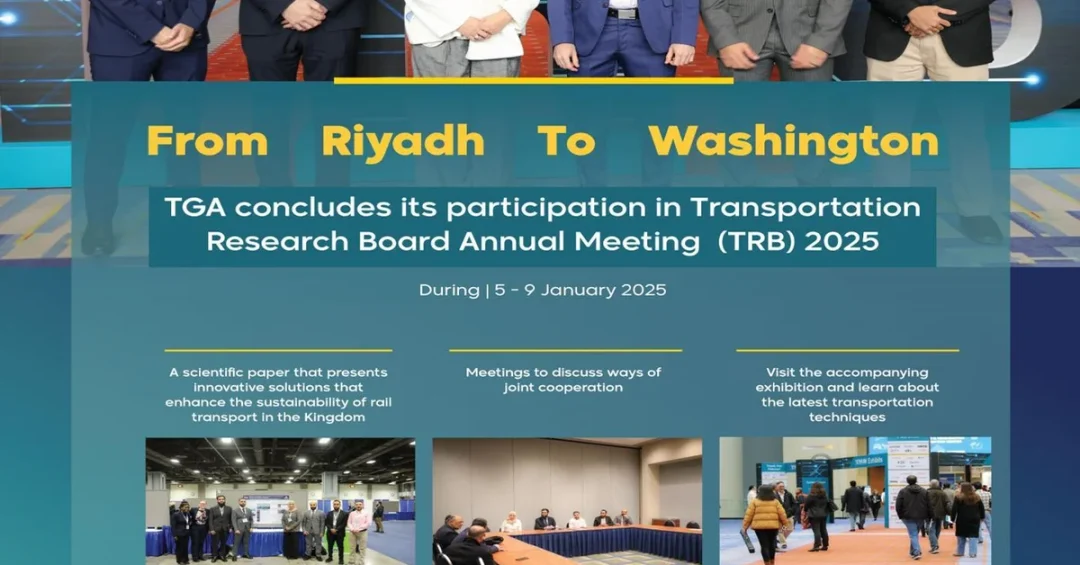
The Transport General Authority (TGA) of Saudi Arabia concluded its active participation in the 104th annual meeting of the Transportation Research Board (TRB), held in Washington, D.C., from January 5-9, 2025. The TGA delegation, led by Deputy of Transport Enablement Dr. Omaimah Bamasag, engaged with global experts and shared Saudi expertise in rail transport development, reinforcing the Kingdom’s commitment to international scientific collaboration in transportation.
Context and Background
The TRB annual meeting is the world’s largest gathering of transportation researchers, policymakers, and industry leaders. Saudi Arabia’s consistent participation underscores the Kingdom’s dedication to adopting global best practices in transport innovation. This year’s event focused on sustainable mobility, infrastructure resilience, and the integration of advanced technologies—areas directly aligned with Saudi Arabia’s National Transport and Logistics Strategy (NTLS) which aims to position the Kingdom as a global logistics hub by 2030.
Key Details
The TGA presented a scientific paper titled “Applying the Financial and Economic Evaluation Model of Railways between the Kingdom’s Cities.” The paper introduced a flexible model designed to assess the technical and economic feasibility of future railway projects across Saudi Arabia. It provided innovative solutions to support sustainable development plans and stimulated discussions with international researchers and experts on rail network expansion and financing mechanisms.
On the sidelines of the meeting, Dr. Bamasag held bilateral talks with specialized transportation authorities and companies. These meetings aimed to exchange technical expertise and explore collaborative opportunities, particularly in modern transport systems. The consultations focused on leveraging international experiences to enhance Saudi Arabia’s rail and logistics infrastructure, which is vital for the economic diversification goals of Vision 2030.
Implications and Impact
Saudi Arabia’s active participation in the TRB meeting reinforces the Kingdom’s role as a key contributor to global transportation knowledge. By sharing its evaluation model and engaging with global peers, the TGA facilitates knowledge transfer that can accelerate the implementation of strategic rail projects, such as the Saudi Landbridge and other intercity connections. This collaboration also enhances the Kingdom’s attractiveness for international investment in transport infrastructure, supporting its ambition to become a leading logistics hub connecting three continents.
Vision 2030 Alignment
The TGA’s engagement at the TRB meeting directly supports the Vision 2030 objective of building a world-class transportation network. By integrating international research and fostering partnerships, Saudi Arabia is accelerating the development of sustainable, efficient, and integrated transport systems. This participation aligns with the broader goal of the National Transport and Logistics Strategy: to raise the sector’s contribution to the non-oil GDP, improve the quality of life for citizens and residents, and cement the Kingdom’s position as a pivotal global logistics center.
20 Questions
Q1. What event did the Saudi Transport General Authority (TGA) participate in?
A1. The TGA participated in the 104th annual meeting of the Transportation Research Board, held at the Walter Washington Conference Center in Washington, D.C., from January 5-9, 2025.
Q2. Who led the Saudi delegation at the TRB meeting?
A2. The delegation was led by Dr. Omaimah Bamasag, who serves as the Deputy of Transport Enablement at the Transport General Authority.
Q3. What was the theme of the TGA’s scientific paper?
A3. The paper was titled “Applying the Financial and Economic Evaluation Model of Railways between the Kingdom’s Cities,” focusing on assessing the feasibility of future railway projects.
Q4. What purpose did the evaluation model serve?
A4. The model was developed to evaluate the technical and economic feasibility of proposed railway transport projects, supporting efficient investment decisions.
Q5. What were the objectives of the TGA’s bilateral meetings in Washington?
A5. The meetings aimed to exchange technical expertise and explore collaboration with international transportation companies, particularly in modern transport technologies.
Q6. How does the TGA’s participation support Saudi Vision 2030?
A6. It aligns with Vision 2030 by promoting sustainable transport strategies, infrastructure development, and economic diversification through enhanced logistics connectivity.
Q7. What is the Transportation Research Board?
A7. The TRB is a division of the U.S. National Academies of Sciences, Engineering, and Medicine, dedicated to advancing transportation research and innovation globally.
Q8. How does Saudi Arabia benefit from international research collaboration?
A8. Collaboration allows Saudi experts to access global best practices, innovative technologies, and financing models, accelerating the modernization of domestic transport infrastructure.
Q9. What is the National Transport and Logistics Strategy?
A9. It is a Saudi initiative under Vision 2030 aimed at transforming the Kingdom into a global logistics hub by enhancing connectivity, efficiency, and sustainability.
Q10. Why was the TGA’s paper on railway evaluation significant?
A10. It introduced a flexible tool that helps planners and investors assess the viability of intercity rail projects, potentially reducing costs and construction timelines.
Q11. What transport sectors does the TGA regulate?
A11. The TGA oversees all aspects of land transport, including heavy trucks, buses, taxis, railways, and logistics services, ensuring safety and efficiency.
Q12. What international organizations did the TGA hold meetings with?
A12. The delegation met with specialized transport authorities and companies from various countries to share knowledge and explore partnerships.
Q13. How does the TGA’s participation enhance Saudi Arabia’s global image?
A13. It showcases the Kingdom’s proactive role in transportation research, highlighting its openness to international cooperation and advanced planning.
Q14. What type of infrastructure projects are prioritized in Saudi rail development?
A14. Priority projects include the Saudi Landbridge railway, Haramain High-Speed Rail, and regional intercity lines that connect major economic hubs.
Q15. Could the evaluation model be applied to other countries?
A15. Yes, the model is flexible and can be adapted by international researchers and planners for similar feasibility studies in other contexts.
Q16. What is the role of Dr. Omaimah Bamasag in the TGA?
A16. As Deputy of Transport Enablement, Dr. Bamasag leads initiatives that facilitate the development and implementation of modern transport systems.
Q17. How does the TGA ensure its research stays relevant?
A17. By participating in global forums like TRB, the TGA stays updated on emerging trends and integrates international findings into its planning.
Q18. What impact does rail development have on Saudi cities?
A18. Improved rail networks reduce travel time, lower carbon emissions, and boost economic activity by connecting cities and industrial zones.
Q19. Is the TGA involved in any other international transport conferences?
A19. Yes, the TGA regularly engages with global bodies such as the International Union of Railways and World Logistics Forum.
Q20. What future steps are expected after this TRB meeting?
A20. The TGA is expected to implement lessons learned, forge new partnerships, and advance pilot projects aligned with the national transport strategy.
Reader Feedback
We value your thoughts. Please share your feedback on this article.
Your feedback helps us improve our coverage.