


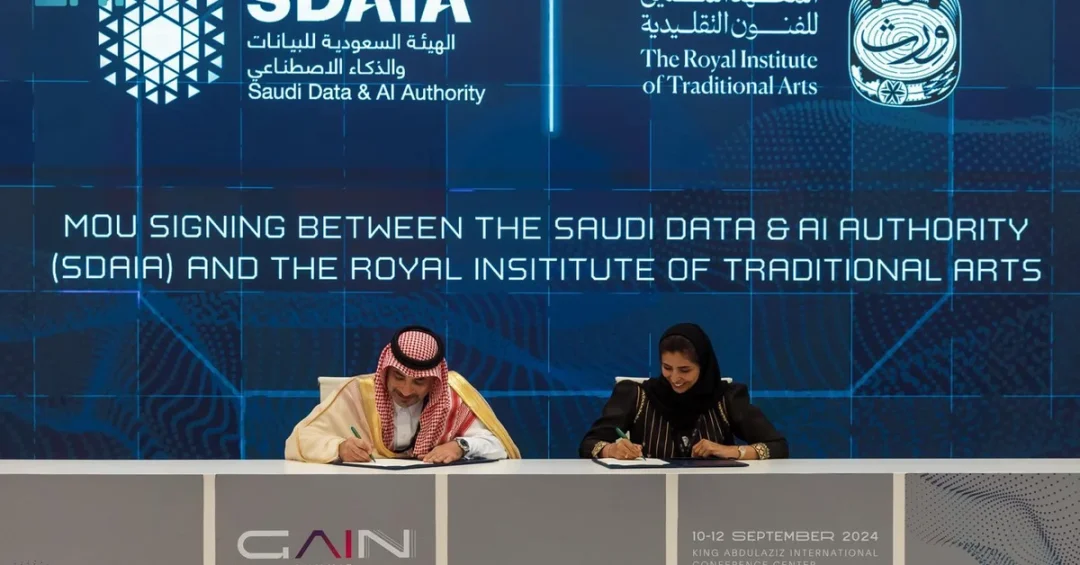
The Saudi Data and Artificial Intelligence Authority (SDAIA) and the Royal Institute of Traditional Arts (WRTH) signed a memorandum of understanding (MoU) on September 12, 2024, in Riyadh, to activate joint projects that preserve local identity and enhance cultural creativity through technology. The agreement was co-signed by Deputy Director of the National Information Center at SDAIA Dr. Mishary Ibrahim Al-Mishary and CEO of WRTH Dr. Susan bint Mohammed Al-Yahya on the sidelines of the Global AI Summit (GAIN Summit), underscoring the Kingdom’s commitment to integrating modern innovation with cultural heritage.
Context and Background
The MoU marks a strategic collaboration between two key Saudi institutions: SDAIA, the national authority overseeing data and artificial intelligence development aligned with Vision 2030, and WRTH, an institute dedicated to preserving and promoting traditional Saudi arts. Signed during the GAIN Summit—a premier global event for AI dialogue hosted in Riyadh—the partnership reflects Saudi Arabia’s dual focus on technological leadership and cultural preservation. The agreement builds on ongoing efforts to position the Kingdom as a hub for innovation while safeguarding its rich historical legacy for future generations.
Key Details
Under the MoU, SDAIA and WRTH will collaborate on multiple fronts, including training and developing nationally qualified professionals in data and AI fields. The partnership also focuses on leveraging technology for knowledge and research projects related to traditional arts, aiming to preserve and archive artistic practices. A core objective is to protect the Kingdom’s cultural legacy by making historical and cultural artifacts more accessible to present and future audiences through digital tools and AI-driven solutions. The agreement was announced via the official Saudi Press Agency (SPA), highlighting its significance to national priorities.
Implications and Impact
This collaboration has broad implications for Saudi Arabia’s cultural and technological sectors. By integrating AI into heritage preservation, the Kingdom sets a regional precedent for using advanced analytics and data management to safeguard intangible cultural assets. Internationally, the MoU positions Saudi Arabia as a leader in applying technology to cultural sustainability, potentially inspiring similar initiatives across the Gulf and beyond. For local communities, the partnership promises enhanced educational opportunities in traditional arts and digital skills, aligning with Vision 2030’s goals of economic diversification and human capital development.
Vision 2030 Alignment
The SDAIA-WRTH MoU directly supports Saudi Arabia’s Vision 2030 by bridging the gap between technological progress and cultural identity. As the Kingdom accelerates its digital transformation, initiatives like this ensure that modernization does not come at the expense of heritage. By preserving traditional arts for future generations and fostering a skilled workforce in AI, this agreement contributes to a vibrant society and a thriving economy, cementing Saudi Arabia’s role as a global model for balancing innovation with cultural authenticity under the leadership of the Custodian of the Two Holy Mosques.
20 Questions
Q1. What is the purpose of the MoU between SDAIA and WRTH?
A1. The MoU aims to establish strategic cooperation to activate joint projects and initiatives that preserve local identity and increase opportunities for cultural creativity in traditional arts through technology.
Q2. When and where was the MoU signed?
A2. The MoU was signed on September 12, 2024, in Riyadh, on the sidelines of the Global AI Summit (GAIN Summit), a key event for international AI dialogue.
Q3. Who signed the MoU for SDAIA?
A3. The MoU was co-signed by Deputy Director of the National Information Center at SDAIA, Dr. Mishary Ibrahim Al-Mishary, representing the authority.
Q4. Who signed the MoU for WRTH?
A4. The MoU was co-signed by CEO of the Royal Institute of Traditional Arts (WRTH), Dr. Susan bint Mohammed Al-Yahya, representing the institute.
Q5. What is SDAIA?
A5. The Saudi Data and Artificial Intelligence Authority (SDAIA) is the national body overseeing data and AI development in Saudi Arabia, driving innovation aligned with Vision 2030.
Q6. What is WRTH?
A6. The Royal Institute of Traditional Arts (WRTH) is a Saudi institution dedicated to preserving, promoting, and teaching traditional arts to protect the Kingdom’s cultural heritage.
Q7. How does the MoU support traditional arts?
A7. The MoU leverages technology for knowledge and research projects related to traditional arts, including training professionals and archiving artistic practices for future generations.
Q8. What role does AI play in this partnership?
A8. AI is used to enhance the preservation and accessibility of traditional arts, applying data-driven tools to archive cultural artifacts and support research initiatives.
Q9. Will the MoU involve training programs?
A9. Yes, the agreement includes training and developing nationally qualified professionals in data and artificial intelligence to empower the traditional arts sector.
Q10. How does this MoU preserve Saudi cultural legacy?
A10. The MoU focuses on preserving and archiving traditional artistic practices, making historical and cultural artifacts more accessible to present and future generations through digital means.
Q11. What is the significance of the GAIN Summit for this MoU?
A11. The GAIN Summit, a global AI event in Riyadh, provided a strategic platform for announcing the MoU, highlighting Saudi leadership in technology and culture.
Q12. How does the MoU align with Vision 2030?
A12. The partnership supports Vision 2030 by integrating technological innovation with cultural preservation, contributing to a vibrant society, economic diversification, and human capital development.
Q13. What are the international implications of this agreement?
A13. The MoU positions Saudi Arabia as a leader in using AI for cultural sustainability, setting a regional precedent that could inspire similar initiatives in other countries.
Q14. Will the MoU help make Saudi culture more accessible globally?
A14. Yes, by using AI and digital tools to archive and present traditional arts, the MoU enables global audiences to access Saudi cultural artifacts and heritage.
Q15. What type of artifacts will be preserved under this MoU?
A15. The MoU aims to preserve traditional artistic practices and historical artifacts, including intangible cultural assets like crafts and visual arts, for future generations.
Q16. How does this fit into Saudi Arabia’s digital transformation?
A16. The MoU integrates AI into cultural sectors, advancing Saudi Arabia’s broader digital transformation goals under Vision 2030 to modernize while preserving heritage.
Q17. Was the MoU announced through official channels?
A17. Yes, the MoU was announced by the Saudi Press Agency (SPA), the Kingdom’s official news source, ensuring transparency and reliability of the information.
Q18. What benefits does this MoU offer to Saudi professionals?
A18. Saudi professionals gain training opportunities in data and AI, enhancing their skills and enabling them to contribute to both technological and cultural fields.
Q19. How does this partnership protect local identity?
A19. By preserving traditional arts through technology, the MoU safeguards Saudi Arabia’s cultural identity, ensuring that modernization does not erode heritage.
Q20. What is the long-term goal of this SDAIA-WRTH collaboration?
A20. The long-term goal is to create a sustainable model for using AI to preserve cultural heritage, supporting Vision 2030’s ambition for a prosperous and culturally rich Saudi society.
Reader Feedback
We value your thoughts. Please share your feedback on this article.
Your feedback helps us improve our coverage.